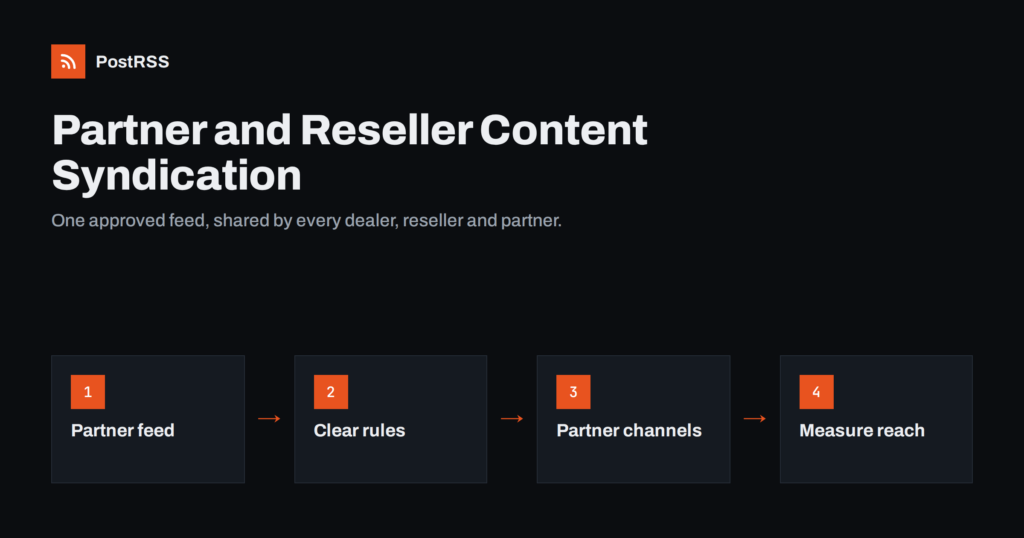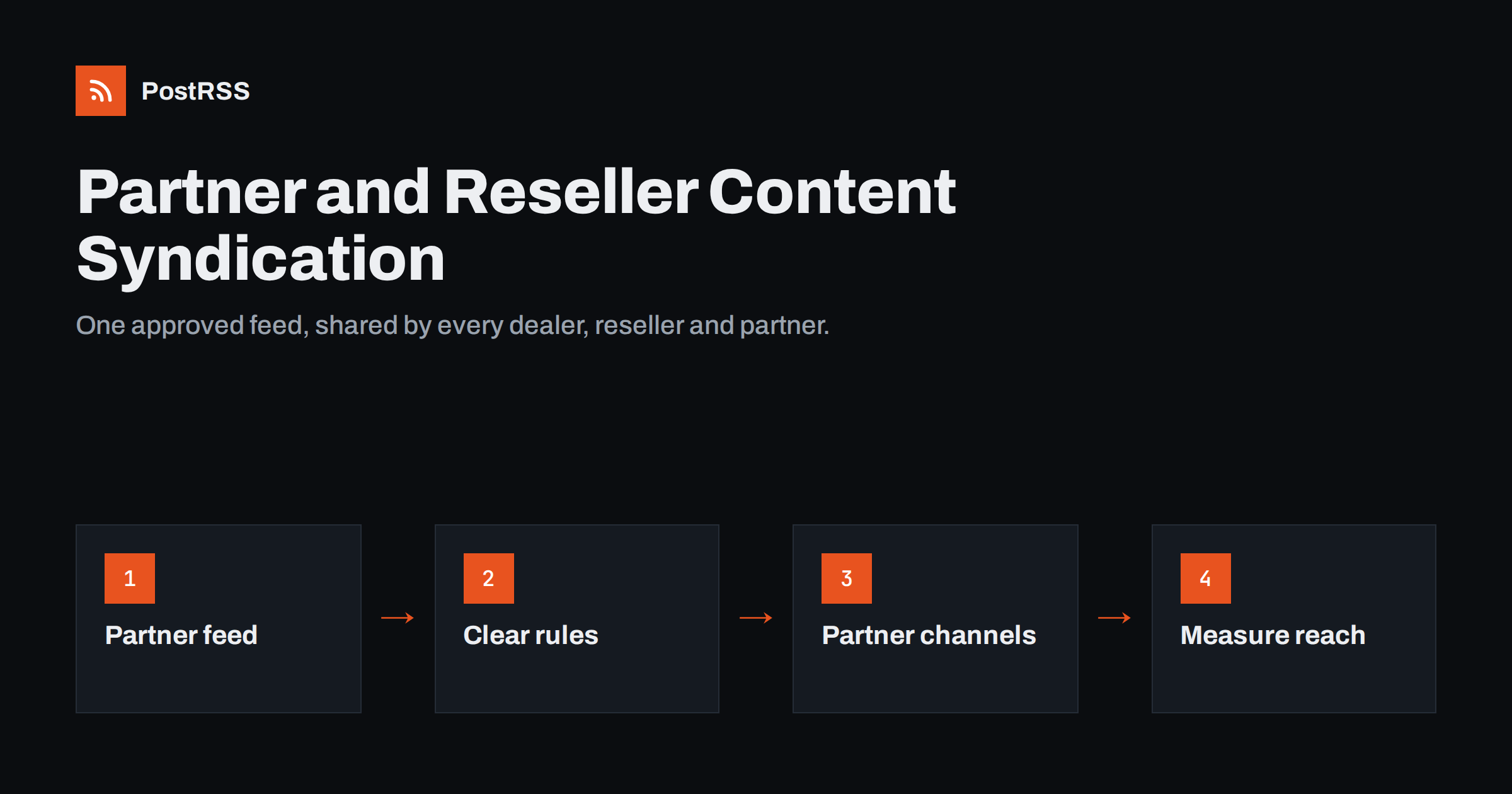
Short answer: A brand with dealers, resellers, franchisees, distributors or partner agencies can publish a dedicated RSS feed of approved content, such as product news, guides and campaign posts, and invite partners to use it. Each partner connects the feed to their own social channels with an auto-posting tool, or displays it on their website, so brand content reaches every partner’s local audience without emails full of attachments. The keys to success are a separate, curated partner feed, clear usage rules, links that credit the original source and UTM tags that show which partners bring results.
Many brands sell through other businesses. A manufacturer works with hundreds of dealers, a software company with resellers and implementation partners, a franchise system with independent owners, a publisher with regional partners. Each of those businesses has its own website and social channels, and their customers trust them locally.
The brand usually wants partners to share its news: new products, seasonal campaigns, helpful guides and announcements. The traditional approach is a partner portal or newsletter with ready-made posts that partners are asked to copy. In practice, few partners do it consistently. They are busy running their own businesses, the material arrives in the wrong format or at the wrong time, and copying posts into several apps is tedious. The result is uneven: a handful of enthusiastic partners share everything, most share nothing.
There is also a consistency problem. When partners copy posts by hand, they often shorten or rewrite them, pick different images or post weeks after a campaign has ended. The brand loses control over how its products are presented, and customers see outdated or inconsistent messages depending on which partner they follow.
RSS syndication changes the default. Instead of asking partners to copy content, the brand offers a feed they can connect once. After that, new approved content flows to each partner’s channels automatically, and partners only need to act if they want to adjust or add something.
The setup has two sides. On the brand side:
On the partner side:
The brand does not need access to any partner account, and partners do not need access to the brand’s systems. The feed is the only connection between them, which keeps the arrangement simple and secure. If a partnership ends, the partner simply removes the feed, and nothing on the brand side has to change.
Partners can also display the feed on their own websites, for example as a “Latest news from the brand” box, using a feed widget or their CMS’s built-in feed tools.
A partner feed is not the same as the brand’s main blog feed. Partners share content with their own customers, under their own name, so the feed should contain only material that makes sense in that context:
Write these posts with the partner’s customer in mind. Avoid phrases like “our dealers” or “visit your nearest reseller”, which read oddly when the post appears on a dealer’s own page. Neutral wording such as “ask your local specialist” or simply describing the product works for every partner.
Keep out anything that could embarrass partners or conflict with their business: investor news, internal announcements, direct-sales promotions that bypass partners, recruitment posts for the brand and competitive comparisons that partners might not want to repeat. A curated feed of fewer, better posts is far more likely to stay connected than a firehose of everything the brand publishes.
Syndication works best when everyone knows the rules. Write a short usage policy and share it with the feed URL. It should cover:
Keep the policy short and in plain language. A one-page document that partners can read in two minutes is far more likely to be followed than a long legal agreement. If your partner contracts already cover marketing materials, refer to them rather than repeating everything.
For most partner setups, sharing titles, short descriptions and links back to the brand site avoids nearly all copyright and SEO questions. The social post points to the original, and the brand site keeps the full content. Our article on auto-posting and copyright explains the general principles, and duplicate content and canonical tags covers the SEO side of full republishing.
A single partner feed often serves partners in different countries, languages and market segments. One feed for all can quickly become irrelevant for many of them. Better options include:
Multi-location businesses face a similar challenge with their own branches. The approaches in automating local social media for multi-location businesses and franchises apply to partner networks too.
Brands usually want to know whether syndication works and which partners drive results. Because the links in the feed point to the brand site, measurement is straightforward:
utm_source=partner-name dan utm_medium=social. Many auto-posting tools can add custom parameters to every link automatically.Remember that measurement is about improving the feed, not ranking partners publicly. If certain types of posts consistently bring more visits through partner channels, publish more of them. If some posts are rarely clicked anywhere, they probably do not belong in the partner feed.
For a detailed method, see tracking the ROI of RSS automation with UTM parameters.
A feed that no one connects has no value. Make adoption easy:
It helps to name one person at the brand as the contact for the partner feed. Partners then know whom to ask when a post looks wrong, a link breaks or they want a particular topic covered, and the brand gets a steady stream of feedback about what partners actually find useful.
Partners should also know that they stay in control. They can pause the feed, add their own posts and choose which channels receive brand content. Syndication is an offer that makes their life easier, not an obligation.
PostRSS lets anyone post an RSS or Atom feed to the networks they connect, so it suits both sides of partner syndication. A brand can publish a partner feed, and each partner can connect it to their own Facebook Page, LinkedIn page, X, Telegram and many other channels in their own PostRSS account. Partners choose message formats, posting windows on paid plans, keyword filters and UTM parameters for every link. Agencies managing several partners can connect one feed to many targets. Plans and limits are on the pricing page.
Partners are often a brand’s most trusted voice in local markets, but they rarely have time to copy brand content by hand. A curated partner RSS feed, clear usage rules and a simple setup guide let partners share approved content automatically on their own channels. Keep the feed relevant and reliable, link back to the original, measure results with UTM tags, and syndication becomes a steady, low-effort extension of your marketing.
It means providing approved content that partners, such as dealers, resellers or franchisees, can publish on their own channels. With RSS, partners connect a feed once and new content is shared automatically. The brand keeps the original on its own site.
For most setups, titles, short descriptions and links back to the brand site are best. They avoid duplicate content and copyright questions. If full republishing is allowed, use canonical links or clear attribution.
Offer a curated partner feed rather than the main blog feed, and consider separate feeds by language, region or segment. Partners can also apply keyword filters in their auto-posting tools.
Ask partners to add UTM parameters such as their partner name to links, or provide partner-specific feed URLs. Then compare sessions and conversions by partner in your analytics.
No. Any tool that reads RSS feeds can be used, including auto-posting services and website feed widgets. A short setup guide helps partners choose and configure one.
What changed in the networks, what broke, and how to fix it before it costs you reach.
 English
 Lietuviškai
 Deutsch
 Français
 Русский
 Español
 Polski
 Italiano
 Українська
 Čeština
 Português
 日本語
日本語 Latviešu valoda
 Eesti
Eesti Magyar
 Bahasa Indonesia
 Türkçe
 हिन्दी
 Ελληνικά
 العربية
 ไทย
ไทย Tiếng Việt
 Română
 Bahasa Melayu
 বাংলা
বাংলা