RSS to 26 social networks: Facebook, Instagram, X, LinkedIn, Telegram and more Blog Affiliation Contacts
Translation agencies and language service providers sell trust and precision – two qualities that are hard to demonstrate through a social media presence that goes quiet for months between posts. Like many project-based professional services firms, LSPs tend to have exactly the people who could write compelling content (project managers who just delivered a complex multilingual localization project, linguists with deep subject-matter expertise) fully occupied with billable client work instead. RSS auto-posting gives these firms a way to turn their own website updates – case studies, certifications, industry commentary – into automatic, consistent social distribution.
Most B2B service firms sell one core capability with variations. Translation agencies and LSPs often sell dozens of language pairs across multiple specialized verticals – legal, medical, patent, financial, marketing localization, and certified document translation for immigration purposes – each with its own buyer, its own credibility signals, and often its own dedicated page on the company website. That breadth makes consistent content production genuinely harder than for a firm with a single, focused service line, and it’s exactly the kind of scattered, high-volume content that benefits most from automatic distribution rather than manual, one-by-one social posting.
| Content type | Audience it reaches |
|---|---|
| Case studies and localization project write-ups | Corporate buyers evaluating vendors for upcoming multilingual projects |
| New language pair or service page launches | Prospects searching for a specific niche capability (e.g., “certified Ukrainian medical translation”) |
| ISO certifications and quality accreditations | Procurement teams at larger enterprises with formal vendor requirements |
| Industry commentary (machine translation, post-editing, AI localization trends) | Peers, competitors, and clients evaluating the firm’s technical sophistication |
| Linguist and team spotlights | Builds trust in the human expertise behind the service, especially for specialized fields |
| Community-facing certified translation services (immigration, legal documents) | Individual consumers and local community members, not just corporate clients |
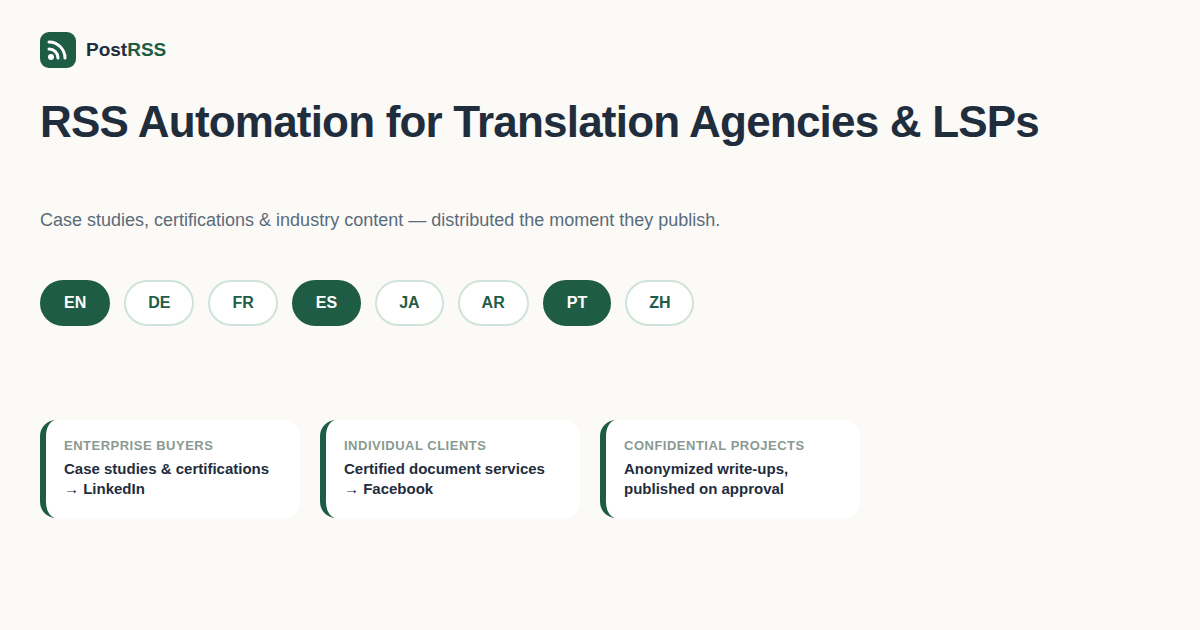
LSPs typically serve two very different audiences at once, and the channels that reach each one look different:
Trying to serve both audiences from a single undifferentiated feed usually dilutes both – a certified-translation consumer post and a machine-translation-post-editing technical article read very differently, and each performs better in front of the audience it was actually written for.
Much of an LSP’s most impressive work is covered by client NDAs – a major software company’s localization project or a pharmaceutical firm’s regulatory translation work often can’t be named publicly, even in a general case study. This isn’t a reason to avoid the content entirely; it’s a reason to build anonymized case studies (“a Fortune 500 medical device manufacturer,” “a leading European fintech”) into the standard project close-out process, so there’s always something publishable without waiting on case-by-case client sign-off. Once that anonymized write-up is published to the site, the same RSS automation handling everything else picks it up automatically.
| Étape | Who does it |
|---|---|
| Project manager drafts an anonymized case study as part of project close-out | Project management team |
| Marketing reviews for confidentiality and writes a social-ready excerpt | Marketing or business development |
| Case study is published to the website | Marketing or content manager |
| Post automatically distributes to LinkedIn (and Facebook, if consumer-relevant) | Automated via RSS |
Enterprise translation contracts often go through months-long procurement processes involving legal, IT security review, and multiple stakeholder sign-offs. A sales team working one of these cycles benefits directly from a steadily updated, multilingual-capable content presence, since prospects and their internal champions frequently revisit a vendor’s website and LinkedIn page multiple times before a final decision. A consistent stream of automated case studies and certifications gives a sales rep fresh, relevant material to reference in follow-up conversations without needing to ask marketing to produce something new for every individual deal, which matters a great deal when a single enterprise contract can take six to twelve months from first contact to signature.
Enterprise buyers evaluating translation vendors for a large project routinely check a shortlisted firm’s LinkedIn presence as an informal due-diligence step, the same way they’d check client references. A firm that posts three substantive case studies a year, automatically and consistently, projects more active credibility than one that posts fifteen items in one enthusiastic week and then goes quiet for the rest of the year. RSS automation is well suited to this because it removes the temptation to batch-post everything at once – each piece of content goes out the moment it’s genuinely ready, spaced naturally by the pace of real project work.
The rise of neural machine translation and AI-assisted post-editing has shifted what clients actually want reassurance about. Five years ago, a translation agency’s marketing focused mostly on accuracy and turnaround time; today, buyers increasingly want to understand where a firm stands on machine translation versus human translation, how post-editing workflows maintain quality, and what safeguards exist around client data when AI tools are involved. Publishing genuine, specific commentary on these questions – not vague reassurances, but real detail about a firm’s actual workflow – has become one of the highest-value content categories an LSP can produce, precisely because so many competitors avoid the topic or address it only superficially. This kind of thought leadership ages well and is exactly the type of content worth feeding through automated distribution the moment it’s published, since its relevance doesn’t depend on being tied to a specific client project.
There’s a credibility angle specific to this industry that most other B2B service firms don’t face: a translation agency’s own website is often the first place a prospective client evaluates whether the firm can walk the walk. A firm that only ever publishes in English, while selling multilingual services, sends a subtly undermining signal. Where a firm does maintain content in multiple languages, routing each language version’s own feed to the audience actually likely to engage with it – rather than posting every language variant to the same general account – keeps the content relevant to whoever sees it, instead of showing, say, a German-language case study to a primarily English-speaking LinkedIn following with no context.
Legal, medical, and patent translation each carry higher stakes than general business translation, and buyers in these verticals scrutinize a vendor’s credibility more closely before engaging. For these specific service lines, the content that moves the needle tends to be narrow and specific rather than broad: a write-up of how a firm handles medical device labeling translation for FDA submissions reads as far more credible to a pharmaceutical client than a general “we translate medical documents” service page ever could. Because this kind of specialized content is inherently produced less frequently than general marketing copy, automating its distribution matters even more – a single well-written technical piece deserves the full reach an automated LinkedIn post can give it, rather than being one more item in a marketing team’s ever-growing backlog of things to post manually “when there’s time.”
Not necessarily each pair individually, but grouping by major service vertical (legal, medical, certified personal documents) usually produces more useful, higher-performing content than a page-by-page approach covering every possible language combination.
Build an anonymized version into your standard project close-out process – describing the client type and industry without naming them – so there’s always publishable content available without waiting on per-project legal approval.
Yes, if your firm genuinely serves both audiences. A single feed mixing enterprise localization case studies with personal certified-document services usually underperforms compared to two more targeted streams routed to the channels each audience actually uses.
Most modern CMS platforms generate an RSS feed automatically, or can add one through a plugin or minor configuration change; the underlying automation works the same regardless of which platform publishes the feed.
Include it in the published case study itself – crediting the linguist or subject-matter expert by name (with their permission) adds credibility and often leads to that individual resharing the post from their own network, extending reach beyond the company page alone.
Indirectly – a steady stream of genuine case studies and industry commentary published on your own site improves search visibility on its own, and the social distribution that follows from RSS automation adds a secondary traffic and backlink-attraction channel on top of that base SEO value.
This varies by firm size, but even a modest cadence of one to two substantive pieces per month, distributed automatically and consistently, outperforms an inconsistent stream of infrequent manual posts in terms of the ongoing credibility signal it sends to prospective clients.
It’s worth distinguishing between an individual freelance translator and a multi-linguist agency here, since the right approach differs. A solo freelancer’s personal brand often benefits more from direct, personal engagement on LinkedIn than from automation – clients hiring an individual translator are often evaluating the person, not a company process. An agency with a roster of linguists and a steady stream of project work is the better fit for RSS-driven automation, since the content volume and cadence quickly outpaces what any one person can realistically post manually while also managing client projects. Firms that grow from a solo practice into a small agency often keep posting the old, manual way out of habit long after their content volume has grown past the point where that approach makes sense.
Overall, treating content distribution as an automated byproduct of normal project delivery, rather than a separate task competing for the same team’s limited hours, is what makes the difference between a stale-looking vendor and one that reads as consistently active. Translation agencies and language service providers have genuinely compelling content to share – specialized expertise, certifications, and real project outcomes across dozens of language pairs and verticals – but it rarely gets shared consistently because the people who could write about it are billing hours to clients instead. Connecting case study and news pages to LinkedIn and, where relevant, Facebook through RSS automation turns publication into the only manual step in the process, letting a firm’s real work speak for itself on a schedule that matches when projects actually finish, not when someone remembers to log in and post.
What changed in the networks, what broke, and how to fix it before it costs you reach.
 English
 Lietuviškai
 Deutsch
 Français
 Русский
 Español
 Polski
 Italiano
 Українська
 Čeština
 Português
 日本語
日本語 Latviešu valoda
 Eesti
Eesti Magyar
 Bahasa Indonesia
 Türkçe
 हिन्दी
 Ελληνικά
 العربية
 ไทย
ไทย Tiếng Việt
 Română
 Bahasa Melayu
 বাংলা
বাংলা