RSS 66 sotsiaalvõrgustikku: Facebook, Instagram, X, LinkedIn, Telegram ja teised Blogi Partnerprogramm Kontaktid
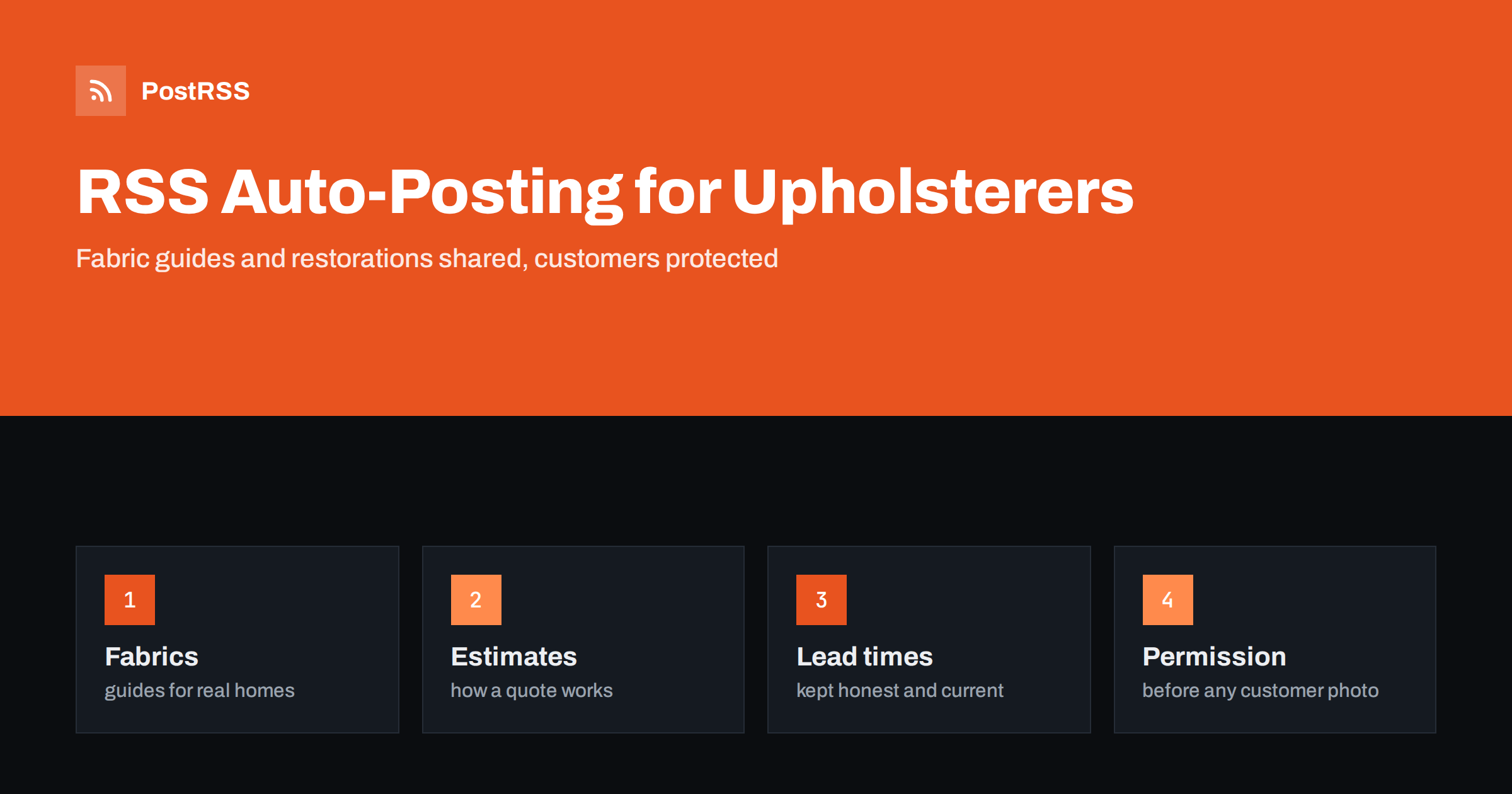
Short answer: RSS auto-posting lets upholstery workshops share fabric guides, restoration stories, care tips, how-an-estimate-works pages, lead time notices and workshop news on social media automatically. Publish each item as a page on your workshop website, let an auto-poster read the feed, and every new page appears on your Facebook Page, Pinterest boards, LinkedIn page and other networks with its link and image. Owners of tired sofas, dining chairs and heirlooms learn what is possible and how to ask for an estimate, while customer names, addresses and unapproved photographs of their furniture stay out of every automated post.
A well-made chair or sofa can outlive three sets of cushions, and many people would rather renew a piece they love than replace it with something cheaper that will not last. Reupholstery is a craft, and most customers know little about it. They wonder whether their old frame is worth the cost, what fabric will survive children and pets, how long the work takes and how a workshop prices it. They search at home, often with a photograph on their phone, and they compare a few workshops by how clearly each one explains the work. An upholsterer has all the answers, and most of them can be written once as a page and used for years. The craft is also visual, which suits social media: a before and after picture tells the story in a second. A feed turns each new page into a post as soon as it is published. This guide explains what to publish, how to connect it and where to be careful, because the furniture belongs to your customers and some safety rules apply.
The advice fits many kinds of businesses that cover, repair and restore seating and soft furnishings:
Each has a list of services, a queue of jobs and customers who need clear information before they bring a piece in. The workshop website is the natural source for every other channel.
Most of the useful content can be turned into a short page:
Each page appears on your website, where a person who searches for an upholsterer can find it. The feed then announces it automatically, and a short post about a new guide reaches the people who follow your workshop.
Most workshops already use a system that creates feeds:
/feed/ and one for every category, such as /category/fabric-guides/feed/. If you are unsure of the address, see how to find your WordPress feed link.Use categories to separate audiences: services, fabric guides, care tips, restoration stories, commercial and news. Each category has its own feed, and each feed can go where it works best: restoration stories and fabric guides to Pinterest and Facebook, commercial news to LinkedIn, lead time notices to a local channel. Routing by category is explained in category filtering for auto-posting.
| Content | Automate? | Notes |
|---|---|---|
| Service pages and process guides | Yes | Plain words, clear next step |
| Fabric and care guides | Yes | Practical, one topic per page |
| Lead time and availability notices | Yes | Keep them current |
| Job openings and apprenticeships | Yes | Duties and how to apply |
| Pictures of customer furniture | Only with permission | Written consent for each picture |
| Customer names, addresses and prices | No | Handle by phone or message |
A simple rule: if it helps many people understand upholstery, automate it. If it concerns one customer, one piece or one quote, it needs a person and a private channel.
A before and after picture is the strongest content an upholsterer has. It is also a picture of a stranger’s possession, sometimes taken in their home. Ask for written permission before you publish any picture of customer furniture, say where it will appear and respect a refusal without argument. Do not show the customer’s room, family photographs, house numbers or documents in the background, and do not name the customer or the street. Many workshops photograph pieces on a neutral background in the workshop, which solves most problems. Describe the work and the materials in the caption, such as the type of fabric and the repairs to the frame, not the price. If a piece has a story, such as a chair handed down in a family, ask the owner to approve the text as well as the image. A workshop that handles pictures carefully is trusted with more heirlooms.
Rules about the flammability of upholstered furniture, labels, filling materials and the use of fire-retardant treatments differ between countries, and they are strict in some. Do not state that a piece complies with a standard unless your workshop has verified it for that specific item and place of use. Do not claim that a fabric is fireproof, stain-proof or allergy-free as a fact unless the supplier has documented it, and then present the claim as the supplier’s. For commercial jobs in hotels, restaurants and public buildings, explain that requirements depend on the building and the local authority, and link to the official guidance instead of summarising it. If you work on vehicles and boats, the same caution applies to seating that is part of a safety system. A modest and accurate page protects both the workshop and the customer.
The most common reason that people hesitate to contact a workshop is that they cannot tell what a job will cost or how it works. A page that explains the process removes that fear without publishing a price list that goes out of date. Describe what to photograph: the front, the back, the legs, the underside, a close view of any damage and a label if there is one. Explain which measurements help. List what affects the cost in general terms: the size of the piece, the condition of the frame, the amount of fabric, patterned fabrics that need matching and the time needed for details such as buttons, piping and pleats. Say how long a quote is valid and how the workshop handles deposits and collection. These pages stay useful for years, so share them again from time to time with a fresh introduction instead of writing new content every week.
Good workshops are often busy, and a queue of several weeks is normal. A page that states the current lead time, updated when it changes, saves enquiries from people who need a piece back in a fortnight and tells patient customers that the workshop is in demand. Publish a short notice when you open the diary for a new season, or when a gap appears. Avoid urgent language and discount pressure, because the craft sells on quality, not on speed. If you close for a holiday, say so in a page and share it once. When you update a page rather than publish a new one, remember that the feed announces a change only when the item date changes, so decide on a rule and follow it.
Most workshops do best with Pinterest and a Facebook Page, plus the website and a phone number that is answered. Two active channels beat five forgotten ones.
/feed/, and check that it lists recent pages with their images.PostRSS has been automating RSS posting since 2014. It checks your website feeds as often as every minute and publishes each new page, with its real image and link, to the channels you connect, from Pinterest boards and Facebook Pages to LinkedIn, Bluesky, Mastodon, Telegram and many more among its 66 supported networks. You can choose how each post is built, filter items by keywords, add UTM parameters and post only within chosen hours or at exact times in your time zone. See the PostRSS features page for everything it does and the pricing page for plan limits. More ideas for craft businesses are under the Local Business tag.
An upholstery workshop sells skill, patience and the chance to keep something you love. RSS auto-posting shares every service page, fabric guide, care tip, restoration story, lead time notice and job opening automatically, as soon as it is published on your website. Write each page for an owner who has never reupholstered a chair, ask for written permission before you show anyone’s furniture, keep names, addresses and prices out of automated posts, present safety claims as the supplier’s and let your upholsterers spend their time with needle and tacks and not at the keyboard.
Yes. If your workshop has a website with a guides or news section, its RSS feed can be connected to an auto-poster that shares each new page on Pinterest, Facebook, LinkedIn and other channels. Customer details must stay out of automated posts.
Service explanations, estimate guides, fabric and care guides, restoration stories with permission, lead time notices and job openings. Keep names, addresses and prices out of posts.
Only with written permission from the owner, and without anything in the picture that reveals the home or the family. Photographing pieces in the workshop on a neutral background avoids most problems.
Only when the supplier documents the claim, and then present it as the supplier’s statement. Rules about furniture safety differ between countries, so link to official guidance.
Yes. PostRSS reads any valid RSS or Atom address that is reachable without a login. Paste the address, connect your channels and new pages are shared as soon as they appear.
What changed in the networks, what broke, and how to fix it before it costs you reach.
Loonud Internet Solutions, PostRSS-i taga olev meeskond. Iga toode säästab aega omal moel.
 English
 Lietuviškai
 Deutsch
 Français
 Русский
 Español
 Polski
 Italiano
 Українська
 Čeština
 Português
 日本語
 Latviešu valoda
 Eesti
 Magyar
 Bahasa Indonesia
 Türkçe
 हिन्दी
 Ελληνικά
 العربية
 ไทย
 Tiếng Việt
 Română
 Bahasa Melayu
 বাংলা