Every small business owner runs the same mental math at some point: is it actually worth paying for RSS auto-posting, or is manually sharing new content to social media a job you can just do yourself in a few minutes a day? The honest answer depends on how many platforms you post to, how consistently you actually manage to post manually over months rather than days, and what your time is worth doing something else. This guide breaks the comparison down concretely, with real numbers you can plug your own situation into, instead of a generic “automation saves time” pitch.
To compare fairly, it helps to list out everything manual posting actually requires, because most time estimates undercount it by only thinking about the “click share” step:
For a business posting to four platforms, three to five minutes per platform is a realistic per-item estimate once you include caption-writing and image selection — call it fifteen to twenty minutes per piece of content across a full multi-platform spread. For a business publishing content two or three times a week, that’s roughly thirty to sixty minutes a week of pure posting time, before accounting for the mental overhead of remembering to do it at all.
| Factor | Manual Posting | RSS Auto-Posting |
|---|---|---|
| Setup time | None | 10–30 minutes one-time, per platform connected |
| Ongoing time per item | ~15–20 minutes across platforms | Near zero once configured |
| Consistency over months | Tends to degrade during busy periods | Unaffected by how busy you are |
| Caption personalization | Fully custom per platform | Templated, though customizable per feed |
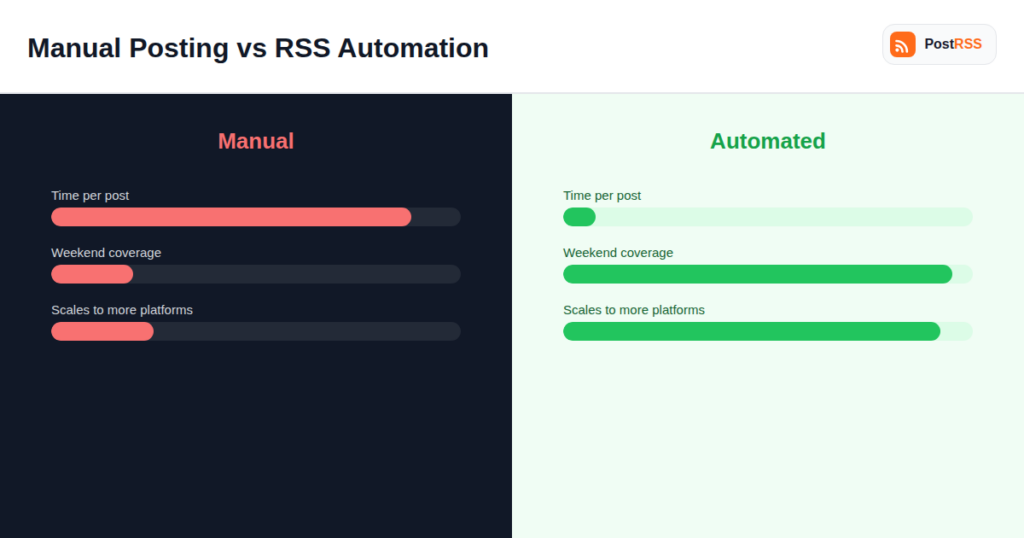
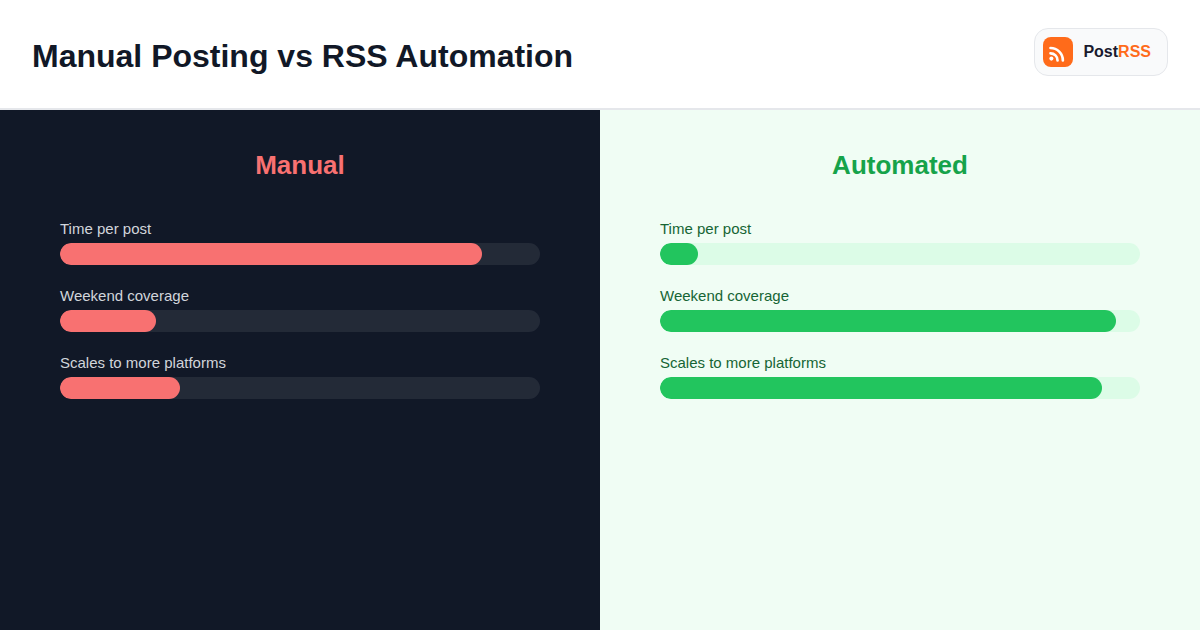
| Weekend / after-hours coverage | Usually skipped | Posts on schedule regardless of who’s working |
| Scaling to more platforms | Linear time cost per platform added | Near-zero added time per platform |
| Risk of forgetting to post | Real and common | Eliminated for anything in the feed |
| Cost | Your time only | Small monthly subscription |
The time-per-post estimate above actually understates the real cost of manual posting, because the biggest cost isn’t the minutes spent — it’s the posts that never happen at all. Manual workflows are vulnerable to exactly the situations that matter most for a growing business: a busy launch week, a sick day, a vacation, a staffing change. Content marketing’s value compounds from consistency over months, and a process that reliably breaks down during your busiest or most understaffed weeks is quietly working against you at the worst possible times.
This is different from most other “should I automate this” business decisions, where the manual version is simply slower but equally reliable. Manual social posting tends to be reliable when things are calm and unreliable exactly when a business is growing or under pressure — which is backwards from when consistent visibility matters most.
To be fair to the manual side of the comparison, RSS auto-posting isn’t a complete substitute for hands-on social media management, and treating it as one leads to disappointing results. It doesn’t replace:
The realistic framing isn’t “automation versus manual work” as a binary choice — it’s using automation to guarantee the baseline distribution work always happens, freeing up the time you’d have spent on repetitive cross-posting for the engagement and strategy work that actually needs a human.
Publishing once or twice a week to two or three platforms, a solo operator might spend twenty to thirty minutes weekly on manual posting — not a huge amount, but it’s also the twenty to thirty minutes most likely to get skipped entirely during a busy client week. For a single person, the case for automation is less about raw hours saved and more about not losing distribution exactly when you’re too busy with client work to think about social media at all.
A business publishing new products, blog posts, or updates several times a week across four or five platforms is looking at an hour or more of manual posting time weekly, plus the compounding risk that a busy season (which is often exactly when a business most needs visibility) is when manual posting is most likely to lapse. Here, the time saved becomes concrete enough to compare directly against the subscription cost of an automation tool.
Once you’re managing distribution for multiple clients or multiple business locations, manual posting time scales linearly with each additional account — doubling your clients roughly doubles your manual posting workload. Automation’s per-platform cost, by contrast, stays close to flat, which is why RSS-based distribution becomes close to essential rather than optional once you’re managing content for more than a handful of accounts at once.
Numbers make this easier to reason about than general statements. Take a small business posting new content three times a week to four platforms: Facebook, X, LinkedIn, and Pinterest. At roughly four minutes per platform per item for writing a caption and confirming the image, that’s about sixteen minutes per piece of content, or roughly forty-eight minutes a week across three posts — call it just over three hours a month of pure posting time, before factoring in the mental overhead of remembering to do it and the realistic rate at which busy weeks cause posts to get skipped entirely.
If that task falls to an employee whose fully-loaded hourly cost is, say, $25–$40, three hours a month works out to roughly $75–$120 in labor cost — before counting the opportunity cost of what else that employee could have been doing, and before counting the posts that simply never happened because a week got busy. Compare that to a monthly automation subscription, and for most businesses posting at this frequency or higher, the math tips toward automation well before you even factor in the consistency benefit, which is arguably the larger value driver of the two.
The comparison shifts even further in automation’s favor as platform count grows, because the two approaches scale completely differently. Manual posting time scales roughly linearly — each additional platform adds another few minutes per post, forever, with no ceiling. Automation setup time is front-loaded and mostly one-time: connecting a fifth or sixth platform to an already-configured RSS feed typically takes a few minutes once, rather than adding recurring per-post work. A business that starts with two platforms and grows to six over a year sees its manual posting time roughly triple, while its automated posting time barely changes at all. This asymmetry is a big part of why automation tends to become more valuable, not less, as a business’s social media footprint grows.
A few objections come up repeatedly when businesses weigh this decision, and they’re worth addressing directly rather than glossing over:
Automation isn’t the right call for everyone. If you post rarely — a handful of times a month — the setup time for automation may not pay for itself quickly. If every single post benefits from heavy, platform-specific customization (a launch campaign with unique creative for every channel, for example), manual control may matter more than time savings. And if your content strategy leans heavily on curating and commenting on other people’s content rather than distributing your own, RSS-based automation — which is built around your own feed — isn’t really the right tool for that job in the first place.
It depends heavily on posting frequency and platform count, but a business posting three times a week across four platforms is typically looking at four to six hours of manual posting time saved per month, once you include the time spent remembering to post and writing platform-specific captions.
Not inherently. Platforms don’t penalize a post for being automated via an official API — what actually affects performance is caption quality, timing, and image relevance, all of which a well-configured automation tool can match reasonably closely to manual posting.
Yes, and most businesses do exactly this — using automation for routine content distribution and posting manually for time-sensitive announcements, promotions, or anything that needs a fully custom caption.
Possibly, but the time savings are smaller in absolute terms. The bigger benefit at low posting frequency is usually consistency — making sure that one weekly post actually goes out every week, including during vacations and busy periods, rather than raw minutes saved.
Manual posting has no direct monetary cost, only time — so the comparison really comes down to what an hour of your own time (or an employee’s time) is worth against a modest monthly subscription fee, multiplied by however many hours automation actually saves you.
No. Most RSS auto-posting tools, including PostRSS, let you filter by category, exclude certain feed items, and customize caption templates, so you retain meaningful control over what goes out and how it’s worded without doing it by hand every time.
A simple test: multiply your typical weekly manual posting time by your own hourly rate (or an employee’s), then compare that monthly figure against the subscription cost. Once you’re posting to three or more platforms multiple times a week, most businesses cross that threshold quickly.
Often yes, though the reasoning shifts. Larger teams usually keep automation for baseline, routine distribution (every blog post, every product update) while reserving manual, hand-crafted posts for campaigns, announcements, and platform-native formats. The goal isn’t replacing the team — it’s freeing their time from repetitive cross-posting so it goes toward the work that actually needs human judgment.
Manual posting isn’t inherently worse than automation — it’s simply harder to sustain consistently, and consistency is usually the whole point of a content distribution strategy in the first place. The real cost-benefit question isn’t “how many minutes does automation save,” it’s “how much of my current manual posting actually survives my busiest, most distracted weeks.” For most small businesses posting regularly across more than a couple of platforms, that question answers itself.
What changed in the networks, what broke, and how to fix it before it costs you reach.