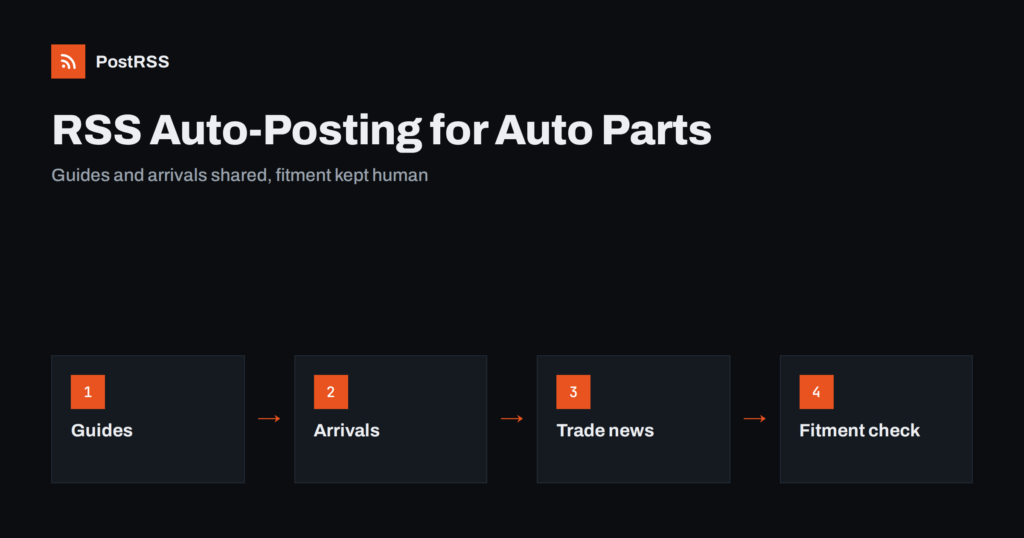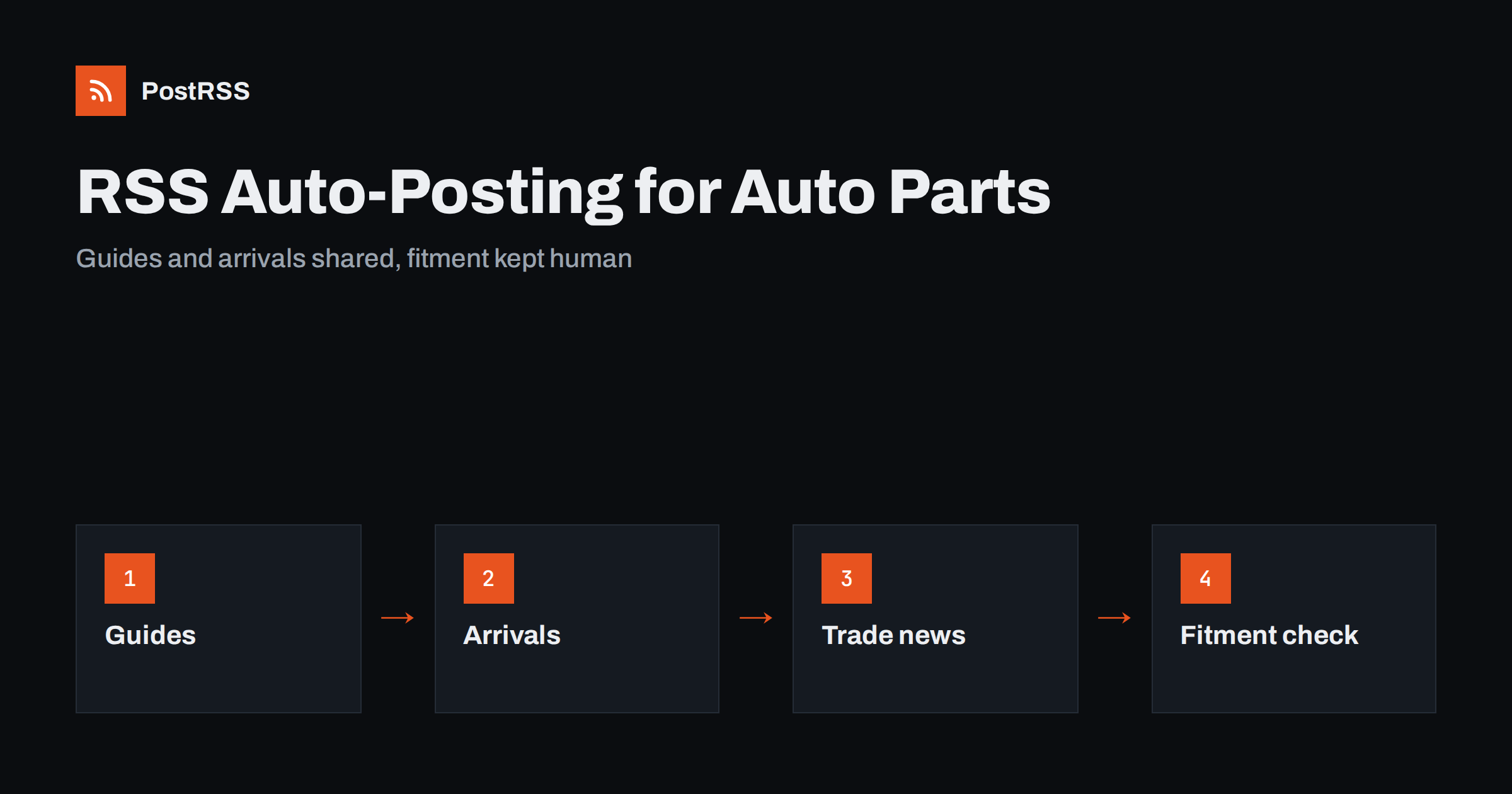
Short answer: RSS auto-posting lets auto parts stores and salvage yards share new arrivals, vehicles being dismantled, seasonal checklists, workshop tips, trade counter news and opening hours on social media automatically. Publish each item as a page on your website, let an auto-poster read the RSS feed, and every new page appears on your Facebook Page, Telegram channel and other networks with its link and image. Customers and garages see what is new without anyone retyping it, while fitment answers, prices, stock counts and safety advice stay with people who can check the part.
An auto parts business is built on precision. A brake pad that is almost right is wrong, and a part that fits one model year may not fit the next. Customers phone, message and walk in with a part number, a photograph or only a story about a noise, and the counter team has to find the right answer quickly. At the same time the stock changes every hour: a vehicle arrives at the yard, a pallet is delivered, an item sells. The team cannot post about every change, and it should not try. What it can do is publish a small number of useful pages each week, and let an auto-poster share them. This guide explains what to publish, how to connect your website to an auto-poster and what must stay out of automation.
The advice fits many kinds of parts business:
Each has a changing stock, a set of opening hours and a website where news can be listed. That page becomes the source for every other channel.
Most of what a parts business knows can be turned into a short page:
Each page is written once and appears on your website, where someone who searches for a part or a shop nearby can find it. The feed then announces it automatically.
Many businesses already use a system that creates feeds:
/feed/ and one for every category, such as /category/tips/feed/. If you are unsure of the address, see how to find your WordPress feed link.Use categories to separate audiences: tips, arrivals, trade news, projects and jobs. Each category has its own feed, and each feed can go to the channel where it works best; tips and projects to the Facebook Page, trade news to LinkedIn, arrivals to a channel for regular buyers. Routing by category is explained in category filtering for auto-posting.
| Content | Automate? | Notes |
|---|---|---|
| Seasonal checklists and guides | Yes | Written by someone who knows the parts |
| Arrivals at the yard | Yes | Vehicle and kind of parts, no prices or stock counts |
| Opening hours and holiday changes | Yes | Dates written out, one permanent hours page |
| Fitment and compatibility answers | No | Check the part number and the vehicle details |
| Prices, stock counts and reservations | No | Change too fast and need confirmation |
| Safety-critical advice | Not alone | Brakes, steering and airbags need a qualified person |
A simple rule: if it is general information that helps many people and sits on a finished page of your website, automate it. If it concerns one vehicle, one part or one price, it needs a human channel.
The most expensive mistake in this trade is the wrong part: a customer drives home, finds that it does not fit and returns it, and nobody is happy. Never promise in a post that a part fits a particular vehicle unless your system has checked the exact model, year, engine and options. General pages should explain how customers can identify what they need, for example by looking at the part number, reading the vehicle registration document or sending the vehicle identification number to the counter. Then ask them to confirm with a person before they buy. A short, reviewed page about how to check compatibility is more valuable than a list of products that will be wrong next week.
Brakes, steering, suspension, tires and airbags are safety-critical, and mistakes can hurt people. A post should never give detailed repair instructions for such parts, and it should say that work on them belongs to a qualified mechanic. Used parts need honest descriptions: say that they are used, describe their condition accurately, and explain the warranty and return rules on one permanent page. Some parts, such as batteries, fluids and certain components, also have rules for handling and disposal. Publish a short page about what your yard accepts and how it is processed. Rules for the sale of used parts and for environmental handling differ from place to place, so follow your local regulations. These points are general guidance, not legal advice.
Garages are the steady customers of many parts businesses, and they value reliability more than clever marketing. Give them a page with the facts they need: the trade counter hours, the delivery rounds, how to open an account and who to call for each brand or department. Share changes through the feed, such as holiday hours or a new delivery slot, and send urgent changes by phone or message as well, because a busy workshop does not read social media during the day. A LinkedIn post about a new service for garages can reach workshop owners and fleet managers who do not follow your shop elsewhere.
A parts post lives or dies by a clear photograph. Use your own pictures of the vehicle or part, taken in even light against a plain background, with the part number visible where it is useful. Show several angles for used parts, including any wear or damage, because honest pictures reduce returns. For arrivals at a yard, a photograph of the dismantled vehicle is enough, as long as the registration plate and any personal details are hidden. A feed can carry the picture as the featured image of the page, and the auto-poster will use it as the preview image. See how to control which image gets auto-posted to choose the right one.
Many parts customers are not garages but enthusiasts who care deeply about one make or one era. They follow forums, clubs and social groups, and they notice when a shop knows its subject. Pages about a restoration, a rare part that has arrived or a club evening at the counter build a reputation that no discount can buy. Ask customers for permission before you show their vehicle, and credit the club or the builder by name when they agree. Invite club newsletters to link to your pages, and link back to theirs, so that the feed becomes part of a community and not just an advertisement.
Most parts businesses do best with a Facebook Page and a simple email list that uses the same pages. Two active channels beat five forgotten ones.
/feed/, and check that it lists recent items.PostRSS has been automating RSS posting since 2014. It checks your website feeds as often as every minute and publishes each new page, with its real image and link, to the channels you connect, from Facebook Pages and Telegram to LinkedIn, Bluesky, Mastodon and many more among its 66 supported networks. You can choose how each post is built, filter items by keywords, add UTM parameters and post only within chosen hours or at exact times in your time zone. See the PostRSS features page for everything it does and the pricing page for plan limits. More ideas for local businesses are under the Automotive Marketing tag.
An auto parts business depends on accuracy and trust. RSS auto-posting shares each new guide, arrival and trade notice automatically on your Facebook Page and other channels. Give every page a real photograph and the facts people need, keep one permanent page for hours, returns and warranty, leave fitment, prices and safety advice to people who can check the part, and let your counter team spend its time on the customers who are standing there with a part number in their hand.
Yes. If your website has a blog or news section, its RSS feed can be connected to an auto-poster that shares each new page on your Facebook Page and other channels. Fitment, prices and stock should stay with staff.
Vehicles that have arrived for dismantling, the kinds of parts that will be available, opening hours and how to ask. Keep prices, stock counts and registration plates out of public posts.
Only if your system has checked the exact model, year and options. It is safer to explain how to identify the right part and ask customers to confirm with the counter.
General maintenance guides are fine. For safety-critical parts such as brakes and steering, say that the work belongs to a qualified mechanic.
Yes. PostRSS reads any valid RSS or Atom address that is reachable without a login. Paste the address, connect your channels and new pages are shared as soon as they appear.
What changed in the networks, what broke, and how to fix it before it costs you reach.
Creadas por Internet Solutions, el equipo detrás de PostRSS. Cada una te ahorra tiempo a su manera.
 English
 Lietuviškai
 Deutsch
 Français
 Русский
 Español
 Polski
 Italiano
 Українська
 Čeština
 Português
 日本語
 Latviešu valoda
 Eesti
 Magyar
 Bahasa Indonesia
 Türkçe
 हिन्दी
 Ελληνικά
 العربية
 ไทย
 Tiếng Việt
 Română
 Bahasa Melayu
 বাংলা