PostRSS and Ayrshare both turn new content into automatic social media posts, and both can be triggered by an RSS feed. That surface-level similarity is where the resemblance ends. One is a purpose-built, no-code tool for site owners who want their own blog or feed posted automatically. The other is a developer-first API platform built for engineers and agencies embedding social publishing into their own products, with RSS auto-posting included as one feature among many rather than the core product. Picking the wrong one means either paying for a lot of infrastructure you’ll never touch, or hitting a wall the moment you need something an RSS-only tool can’t do.
Ayrshare is a REST API for posting, scheduling, and moderating content across social platforms, with official SDKs for Node.js, Python, PHP, and other languages, plus low-code connectors for tools like Make, Bubble, Airtable, and Retool. Its dashboard exists and is usable directly by a non-developer, but the product itself is architected API-first: pricing tiers, documentation, and feature depth are all built around the assumption that a developer is integrating Ayrshare into a larger application — a SaaS platform, a content management tool, or an agency’s internal system — rather than a single site owner automating their own blog.
Buried inside that broader platform is a genuinely useful no-code feature: an “Automated RSS Feeds” tab in the dashboard where you paste a feed URL and Ayrshare checks it on a schedule (roughly every 10 minutes) and auto-publishes new items, no code required. It’s a real, working feature — not vaporware — but it’s a secondary capability layered onto a platform whose core identity is the API underneath it.
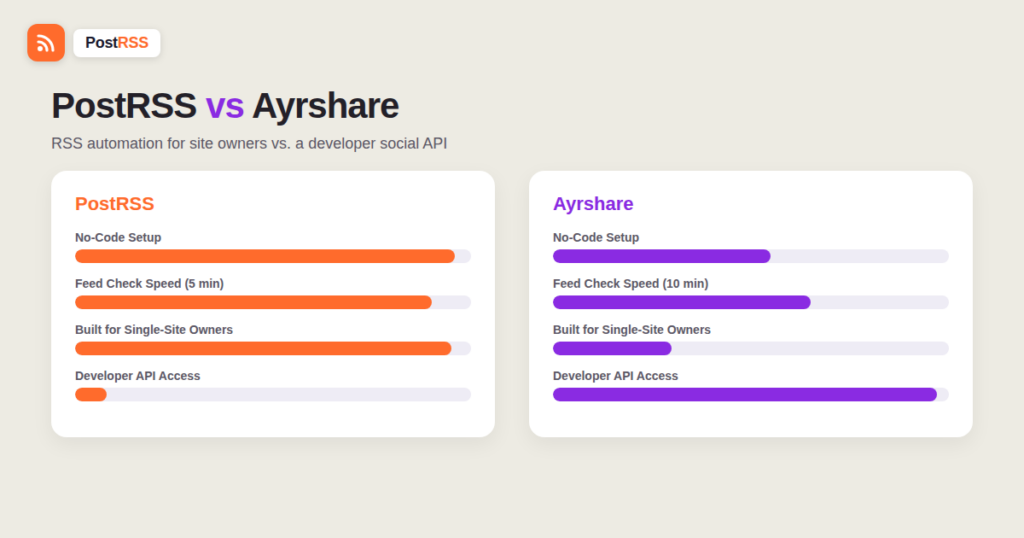
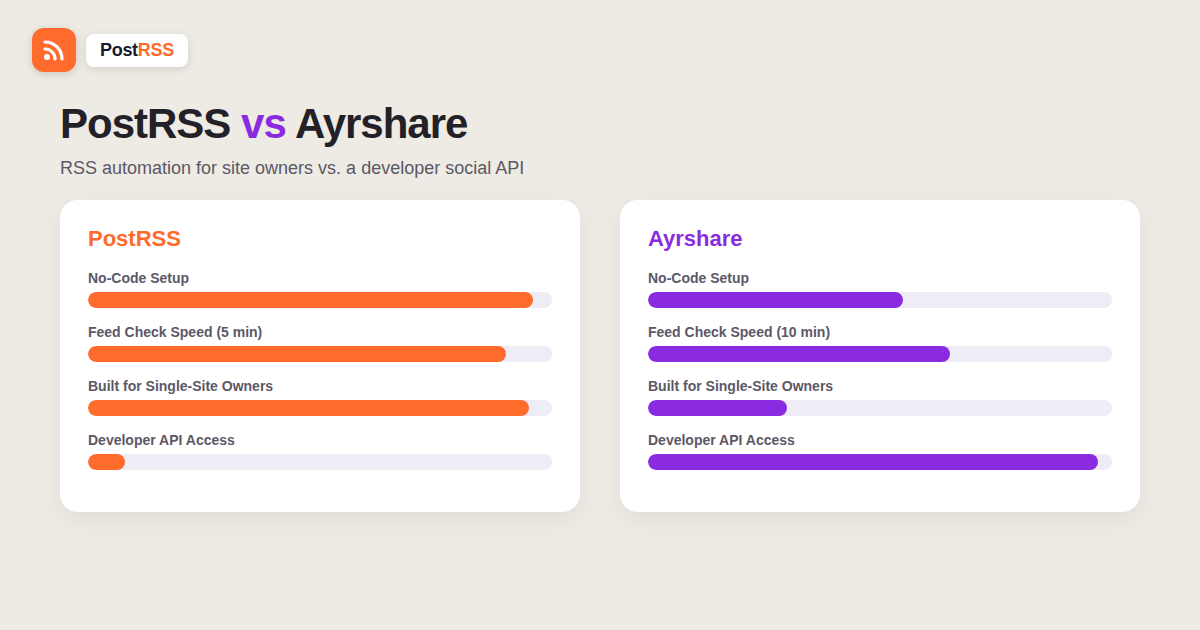
PostRSS is built around exactly one job: watch an RSS or Atom feed and turn each new item into a post on your connected social accounts, on a schedule as tight as every five minutes on standard plans. There’s no API you need to touch, no SDK to install, and no dashboard built for developers first and everyone else second — connecting a feed and authorizing accounts is the entire setup process, typically finished in a few minutes.
This is the part worth checking carefully in any comparison, since both products’ supported platforms are specific and worth getting right rather than assuming “more or less everything.” PostRSS’s current platform lineup is Facebook, X, LinkedIn, Pinterest, and VKontakte, with X and LinkedIn support starting at the Ultimate plan tier rather than every tier. Ayrshare’s dedicated RSS auto-posting feature, specifically, currently covers Facebook, Instagram, LinkedIn, Pinterest, Telegram, Bluesky, Threads, and Snapchat — but does not include X (dropped from RSS auto-posting as of a March 2026 API credential change), and does not support Reddit, TikTok, YouTube, or Google Business Profile through the RSS feature specifically, since those destinations need extra manual input (a media file, a subreddit choice) that a pure feed item can’t supply automatically.
| Platform (via RSS auto-posting) | PostRSS | Ayrshare’s RSS feature |
|---|---|---|
| Yes, all plans | Yes | |
| X (Twitter) | Yes, Ultimate plan and up | No (removed March 2026) |
| Yes, Ultimate plan and up | Yes | |
| Yes, Professional plan and up | Yes | |
| No | Yes | |
| Telegram, Bluesky, Threads, Snapchat | No | Yes |
| VKontakte | Yes, Professional plan and up | No |
| Reddit, TikTok, YouTube, Google Business Profile | No | No (not via the RSS feature specifically) |
The practical read: if X or VKontakte matters to your distribution strategy, Ayrshare’s RSS feature can’t help — it doesn’t cover either. If Instagram, Threads, Bluesky, or Telegram matter instead, PostRSS’s current lineup doesn’t reach them, and Ayrshare’s does. Neither product is simply “bigger” than the other; they cover genuinely different, only partly overlapping platform sets.
It’s tempting to count checkmarks and declare a winner, but that misreads what the table is actually showing. Ayrshare’s broader raw platform count exists because its full API — not its RSS feature specifically — reaches many more networks than either product covers through RSS alone; a developer willing to write integration code against Ayrshare’s API can reach TikTok, YouTube, Reddit, and Google Business Profile too, just not through the no-code RSS tab. PostRSS’s five platforms are the entire product, full stop, with no deeper API tier hiding additional reach behind a coding requirement. So the honest comparison isn’t “5 platforms vs. 8 platforms” — it’s “5 platforms with zero coding, ever” vs. “8 platforms with zero coding today, and dozens more if you’re willing to write code later.”
PostRSS’s pricing is structured around platform access and posting volume per tier, starting at a free plan and scaling up through paid tiers as more platforms and higher task volume unlock. Ayrshare prices around the number of connected social “profiles” rather than a simple platform-access ladder, with tiers that scale well past what a single site typically needs — Launch, Business, and Enterprise tiers are explicitly sized for managing many accounts or many client profiles at once, and published rates (worth confirming directly at ayrshare.com/pricing, since SaaS pricing changes) sit noticeably higher than a comparable single-site PostRSS plan. Ayrshare’s free option is a time-limited trial rather than a permanent free tier, unlike PostRSS’s ongoing free plan for light usage.
How quickly a new item turns into a live post depends on how often each tool actually polls your feed. PostRSS checks as often as every five minutes on standard plans, which matters most for time-sensitive content — breaking news, event announcements, or anything where showing up an hour late meaningfully hurts engagement. Ayrshare’s RSS feature checks roughly every ten minutes. For most blogs publishing a handful of posts a week, the difference between five and ten minutes is invisible to your audience. For a news site or anyone posting several times a day where being first matters, the tighter polling interval adds up over a month of publishing.
Because Ayrshare is built as a full API platform rather than a single-purpose auto-poster, it exposes endpoints well beyond publishing: post-performance analytics pulled directly from each platform’s own API, comment retrieval and moderation, and the ability to build custom reporting dashboards on top of that data for clients. None of that is relevant if all you want is your feed posted automatically, but it’s the reason Ayrshare’s pricing and positioning look the way they do — you’re paying for a toolkit, and RSS auto-posting is a small, if genuinely functional, corner of it. PostRSS deliberately doesn’t try to compete on that surface area; its own analytics story is limited to what you’d naturally get from the destination platforms themselves (Facebook Page Insights, X analytics, and so on) rather than a unified reporting layer, since building and maintaining that isn’t the product’s focus.
If you start on PostRSS and eventually need to embed social publishing into your own product for clients or end users, that’s a genuine outgrow-it scenario — no amount of configuration turns a no-code auto-poster into a developer API, and migrating to Ayrshare (or building directly against individual platform APIs) becomes the right next step. The reverse migration is more common in practice: teams that signed up for Ayrshare expecting a simple auto-poster, only to realize they’re paying developer-platform pricing for a single blog’s worth of Facebook and LinkedIn posts, often move to a purpose-built tool like PostRSS once they confirm their platform list doesn’t actually require Ayrshare’s broader API surface.
Despite the platform-coverage gaps above, Ayrshare is the right tool in a specific, common scenario: you’re building your own application — a content platform, a client-facing dashboard, an internal agency tool — and you need social publishing as a feature inside it, controlled entirely through code, with analytics and comment-moderation endpoints available beyond just posting. That’s a fundamentally different job than “auto-post my blog,” and it’s one PostRSS isn’t built to do at all, since PostRSS doesn’t expose a public API for embedding into someone else’s product. It’s the same reasoning covered across other tool-by-tool comparisons on this site: the right pick usually comes down to whether you’re automating your own content or building a platform for other people to automate theirs.
If the actual goal is “new content on my site should automatically become a post on Facebook, X, LinkedIn, Pinterest, or VK, without me writing code, managing API keys, or paying for a platform’s worth of unused developer tooling,” PostRSS is the more direct, faster, and typically cheaper answer. It’s built for exactly that use case and nothing else, which is precisely why it doesn’t carry the setup overhead or profile-based pricing structure that makes sense for a developer platform.
No — the RSS auto-posting tab in Ayrshare’s dashboard is no-code, the same as connecting a feed in PostRSS. The coding requirement applies to Ayrshare’s broader API surface, not to this one feature.
No, as of a March 2026 API credential change, X was removed from Ayrshare’s RSS auto-posting feature specifically, even though X posting may still be available through Ayrshare’s full API for developers building custom integrations.
No, PostRSS’s current supported platforms are Facebook, X, LinkedIn, Pinterest, and VKontakte — Instagram, Threads, Bluesky, and Telegram aren’t part of its current lineup.
Generally no — Ayrshare’s pricing is built around connected-profile counts and tiers sized for agencies and SaaS platforms, which tends to cost more than a single-site PostRSS plan covering the same basic “auto-post my feed” job.
Ayrshare is architected for that specifically, with multi-profile account structures and an API for building custom client-facing tooling; PostRSS is built around a single site’s own feed and accounts rather than a multi-tenant agency structure.
Yes, for the RSS auto-posting feature and general dashboard posting specifically — but you’ll be paying for a platform whose deeper capabilities (and pricing) assume you eventually will.
PostRSS does, starting at its Professional plan; Ayrshare’s platform list doesn’t include VKontakte at all, on the RSS feature or its broader API.
PostRSS checks as often as every five minutes on standard plans; Ayrshare’s RSS feature checks roughly every ten minutes — a gap that matters most for time-sensitive, frequently-published content.
No, PostRSS is a dashboard-only, no-code product by design; a team that outgrows that and needs to embed social publishing into its own application would need a developer-first platform like Ayrshare instead.
Ayrshare and PostRSS solve overlapping but distinct problems. Ayrshare is a developer platform with a genuinely useful no-code RSS feature bolted on, best suited to agencies and teams building social publishing into their own product. PostRSS is a purpose-built RSS-to-social tool with no API required and no developer overhead, best suited to a site owner who wants Facebook, X, LinkedIn, Pinterest, or VKontakte updated automatically without writing a line of code. Check both platform lists against your actual target networks before choosing — the right answer depends more on which specific platforms you need than on which tool sounds more full-featured on paper. If your list is Facebook, X, LinkedIn, Pinterest, or VK and you’d rather not manage an API, PostRSS gets you there directly.