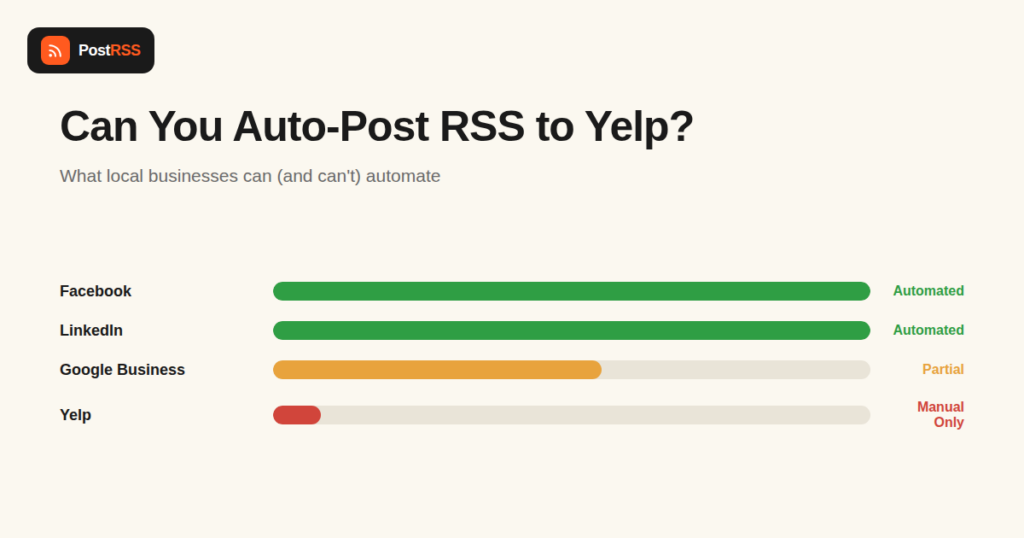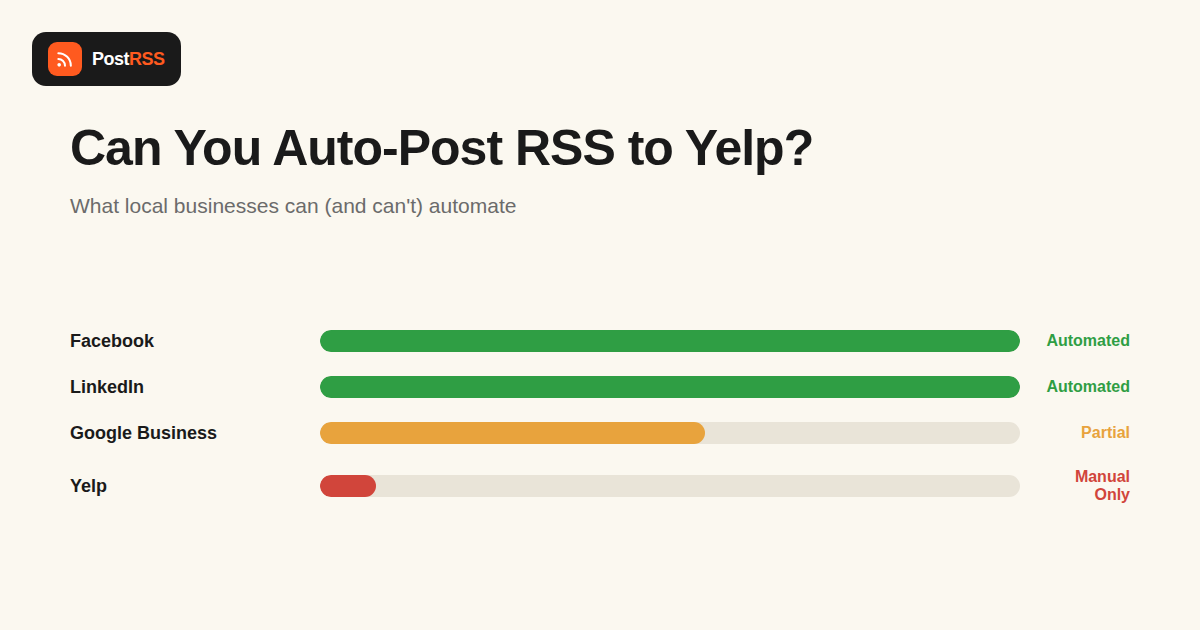
If you run a local business and you’ve gotten used to your blog posts, menu updates, or new listings flowing automatically into Facebook, Instagram, and Google Business Profile, it’s a reasonable question: why not Yelp too? The short answer is no — Yelp does not offer a public API that lets a third-party tool watch your RSS feed and automatically publish updates, offers, or posts to your Yelp business page. It’s a fair question to ask, since Yelp is such a heavily used decision-making tool for local, in-person purchases, and it would genuinely save time if it worked the same way the social side of your marketing already does. This guide explains exactly why, what Yelp’s API is actually built for, and what a realistic content routine for Yelp looks like alongside the channels that do support real automation, so you can stop looking for an integration that isn’t coming and put that time into the parts of your Yelp presence that genuinely need it.
Yelp does publish a developer API, called the Fusion API, but it’s built for a completely different purpose than posting content. Fusion is a read-focused API designed for looking up business listings, pulling ratings and review counts, and searching businesses by location and category — the kind of thing a restaurant-finder app or a review-aggregation widget would use. It is not designed to let an outside application create posts, upload photos, publish offers, or push any kind of content onto a business’s Yelp page on that business’s behalf.
This is a deliberate design choice, not a gap Yelp forgot to fill. Yelp’s business content — reviews most of all, but also photos, business updates, and offers — carries real weight in local purchase decisions, and the platform has strong incentives to keep that content looking authentic and manually curated rather than opening the door to bulk automated posting.
Yelp’s terms of service are explicit about prohibiting automated content submission, and this extends well beyond reviews. The platform has spent years building systems specifically to detect and filter content that looks automated, incentivized, or bulk-generated, because that kind of content is exactly what undermines the trust Yelp is selling to its users in the first place. A business posting update after update through a script would be operating directly against that enforcement effort, which creates real risk of the listing being flagged or restricted, not just a failed API call.
| Yelp Feature | Who Can Do It | Can It Be Automated via RSS? |
|---|---|---|
| Respond to reviews | Verified business owner, manually | No |
| Post a Business Update | Verified business owner, via Yelp for Business dashboard | No public API for this |
| Create a Yelp Deal or Offer | Verified business owner, manually configured | No |
| Upload photos to your listing | Business owner or customers | No — manual upload only |
| Update business hours or basic info | Business owner, via dashboard | Manual only, no third-party automation |
| Pull public listing data for your own use | Any developer | Yes, via the read-only Fusion API |
Since Yelp doesn’t fit into an automated posting stack, the practical move is the same one that applies to any platform without a publishing API: separate what can run on autopilot from what genuinely needs a human hand on it.
It’s worth being precise here, because the two platforms often get lumped together as “local listings” with the same rules. Google Business Profile has its own API that, under the right permissions, does support more structured programmatic management of certain listing fields for verified business accounts — though posting through it still generally requires going through Google’s own tooling or approved partners rather than an open self-serve connection for arbitrary RSS content. Yelp’s position is more restrictive across the board: there is no equivalent posting API tier at all, for anyone, regardless of business size or verification status. If you were assuming “well, it works for Google, so it probably works for Yelp too,” that assumption doesn’t hold.
Because so many local businesses want this exact capability, you will occasionally come across tools or agencies claiming they can “auto-post to Yelp.” Approach these claims skeptically. In practice, this usually means one of a few things: the tool is actually just reminding a human to log in and post manually (which isn’t automation at all), it’s using browser automation to simulate a real user clicking through Yelp’s dashboard (which violates Yelp’s terms and risks the account), or it’s conflating Yelp with a different platform in its marketing. None of these are the same as a legitimate, sanctioned API-based integration, and the ones that rely on simulating a logged-in user carry genuine account-suspension risk for a listing that matters to your business.
It’s worth separating Yelp’s content restrictions from its operational integrations, because the two get confused often. Yelp does maintain partner-level integrations for things like Yelp Waitlist, Yelp Reservations, and point-of-sale syncing, which let restaurant and service businesses connect their booking or table-management systems to Yelp so availability shows up accurately. Those integrations move structured operational data — table availability, reservation slots, wait times — not editorial content like posts, offers, or photos. A restaurant’s POS system telling Yelp “we have a table free at 7pm” is a completely different category of integration from a blog’s RSS feed trying to publish a new post as a Yelp Business Update. Confusing the two is a common reason people assume Yelp posting automation should be possible when it structurally isn’t.
Since Yelp content has to be manual, it’s worth being deliberate about what you actually post there rather than trying to mirror your entire content calendar. A few things tend to matter more on Yelp specifically than on social platforms:
Yelp isn’t unusual among review and directory platforms in restricting automated posting — it’s actually the norm. TripAdvisor, Angi, and most industry-specific directory sites take a similarly cautious stance on third-party content automation, for the same underlying reason: the value of a review or directory platform depends entirely on users trusting that what they’re seeing reflects genuine activity rather than scripted output. Social networks, by contrast, were built from the start around third-party developer ecosystems and public posting APIs, because their business model depends on maximizing the volume and variety of content flowing through them. That structural difference is why RSS automation naturally covers Facebook, X, LinkedIn, and Pinterest well, and consistently hits a wall with review-and-directory platforms like Yelp.
Yes, the Fusion API, but it’s read-only and built for querying business and review data, not for creating or publishing content to a listing.
No. Deals and offers are configured manually through the Yelp for Business dashboard, and there is no public API endpoint for creating them programmatically.
It’s a real risk. Yelp’s terms prohibit automated content submission, and behavior that looks like scripted or bot-driven activity is exactly what its enforcement systems are built to catch.
Yes — agencies commonly manage Yelp listings by logging into the dashboard on your behalf with proper account access, which is manual work done by a person, not an automated integration.
Yes. Facebook, X, LinkedIn, and Pinterest all offer developer APIs that support third-party posting with proper authorization, which is what makes RSS-based auto-posting to those platforms possible in the first place. Yelp simply never built that publishing capability for outside developers.
For most local, in-person businesses, yes — Yelp remains a significant discovery channel for near-term purchase decisions, even if maintaining it takes a manual weekly habit instead of a live feed integration.
If Yelp ever opens a publishing API to third parties, automation would become possible, but that would require a policy change on Yelp’s side — there’s no workaround available under its current API and terms of service.
Yes, that’s actually one of the more common legitimate uses of the read-only Fusion API — pulling your current rating and review count to display as a trust badge on your own site, which is the opposite direction from posting content into Yelp.
A weekly check for new reviews and a monthly refresh of photos or offers is a reasonable baseline for most small businesses — frequent enough to stay current without turning it into a daily task that competes with channels where automation can genuinely carry the load.
Yelp isn’t a platform you can add to an RSS auto-posting stack, and that’s true by design rather than by oversight — its Fusion API is read-only, and its terms of service specifically prohibit automated content submission. The realistic approach for a local business is to let automation carry the channels built for it, like Facebook, X, and LinkedIn, while treating Yelp as a deliberate, manual, low-frequency task focused on the few things — photos, review responses, and accurate hours — that actually move the needle there.