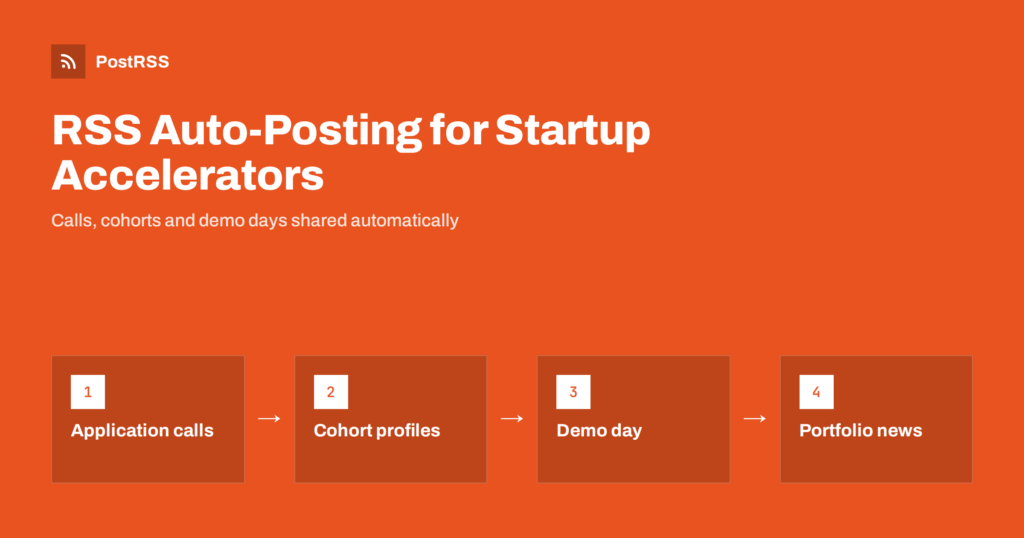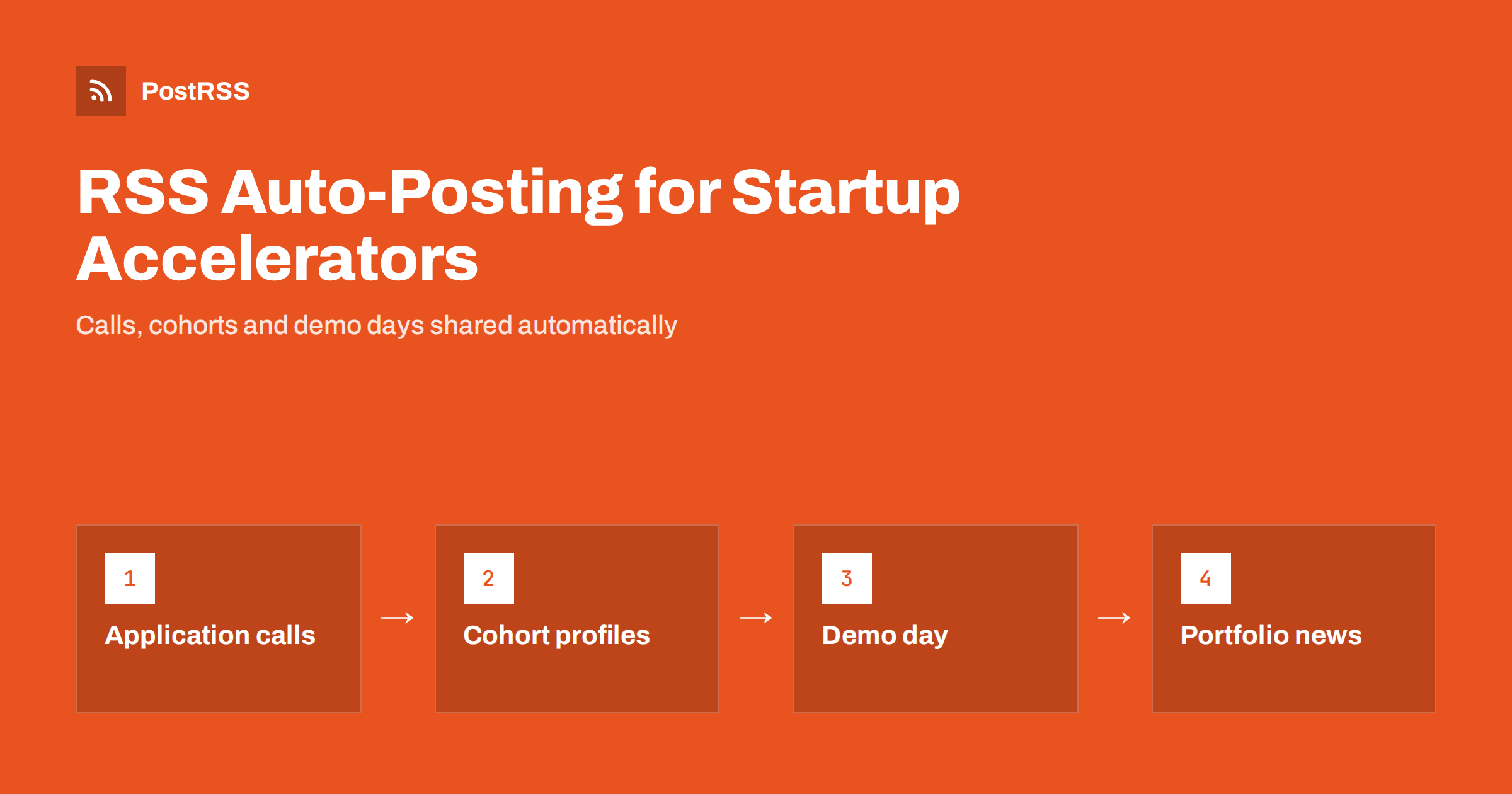
Short answer: RSS auto-posting lets startup accelerators, incubators and venture studios share every application call, cohort announcement, demo day, event and portfolio success automatically. Publish the item once on the programme website, and an auto-poster reads its RSS feed and posts it to LinkedIn, X, Bluesky, a Facebook Page, Telegram, Discord and other channels with its image and link. The programme team keeps a steady public presence through busy cohort weeks, and founders, mentors and investors see the news where they already spend time.
Accelerators depend on visibility in three directions at once. They need a constant flow of strong applicants, they need mentors, partners and investors to stay engaged, and they need to show that their startups succeed. Most programmes run with a lean team that is busy with workshops, office hours, investor introductions and demo day preparation. Social media updates are often posted in bursts when someone has time, then go quiet for weeks during the most intensive part of a cohort. This guide shows how to build a reliable publishing system around the programme website, which feeds to create, how to share portfolio news responsibly and how to plan the accelerator calendar.
An accelerator produces a lot of content that already lives, or should live, on its website:
Each of these has a different audience, but all of them benefit from appearing on social channels promptly and consistently. Automation means the website becomes the single place where the team publishes, and the channels follow on their own.
Most programme websites use WordPress, Webflow, Ghost or a similar system, and these publish RSS feeds automatically. WordPress has a main feed at /feed/ and one per category, such as /category/cohorts/feed/. Webflow can generate a feed for each collection, and Ghost publishes one at /rss/ with feeds per tag. Before connecting anything, open the feed and check that recent items appear first with clear titles and summaries; the structure is defined in the RSS 2.0 specification.
Organise content in categories that match your audiences:
Each category then has its own feed, and each feed can go to the channels where its audience is. Category filtering is explained in how to filter your RSS feed by category before auto-posting.
Application season is when an accelerator most needs reach. Publish each call as its own page with the essentials in the title and first lines: who can apply, the stage and sector focus, the programme dates, the deadline and whether the programme takes equity or charges fees. The applications feed shares it to LinkedIn, X, Bluesky and your community channels the moment it goes live.
A single announcement is not enough. Founders are busy, and many apply in the last days. Plan a sequence of items in the same category:
Each one is a new page, so the feed treats it as a new post. When the call closes, update the page so older posts no longer suggest it is open.
Announcing a new cohort is one of the most shared moments in the programme. Rather than one long list, publish a cohort overview page and a short profile page for each startup: what the company does, who the founders are, the problem it solves and a link to its website. Schedule the profiles over the first weeks of the programme, one or two per day, so every startup gets its own post and its own moment of attention. Founders reshare their profile, which brings the accelerator new followers.
Use a consistent image style for profiles, for example the team photo on a branded background, and set it as the featured image so the same picture appears on every network. If networks show the wrong picture, see why auto-posted links show the wrong image.
Portfolio success is the strongest proof that a programme works. Many portfolio companies have their own blog or newsroom with an RSS feed, and it is tempting to connect all of them to the accelerator’s accounts. That usually produces too much noise: product updates, minor feature releases and hiring posts that mean little to your followers. Better approaches are:
Brand safety matters too: anything a third-party feed publishes will appear under your name. The checks worth doing are described in brand safety for auto-posted content.
Start with LinkedIn and one community channel, and add others when you can also answer comments and messages.
Demo day is the culmination of a cohort and needs a short campaign of its own. Publish a save-the-date page, then the investor registration page, then pages for the running order and the livestream link, each as a separate item. After the event, publish a recap with photos and a list of the startups that pitched. Investors who could not attend often read recaps, and each startup gains another link to share.
Regular ecosystem events, such as founder breakfasts, office hours, workshops and hackathons, work the same way. Publish each event page with the date, place and time zone in the first lines, and let the events feed share it a week ahead. Posting windows keep routine announcements to working hours of your main audience, while time-critical items like the livestream link are published without limits. Event promotion is covered in more detail in how event organisers automate announcement distribution with RSS.
Guides on fundraising, legal set-up, pricing, hiring and go-to-market attract founders long before they apply, and they position the programme as a useful partner. Ask mentors and alumni to write short practical articles, publish one regularly and let the resources feed share each one. Public sources such as the U.S. Small Business Administration business guide can support basic planning topics, while your own content should focus on the experience your programme has. Track which channels bring readers and applicants with UTM parameters, as explained in tracking RSS automation with UTM parameters.
Many accelerators run a jobs board for their portfolio, because hiring is one of the biggest challenges for young startups. If each role is published as a page in a jobs category, its feed can go to LinkedIn and community channels automatically. Set a maximum number of posts per update so a large batch of roles added on one day does not flood the main account, or send jobs to a dedicated channel. Job feed tactics are explained in how recruiting agencies automate job posting distribution.
PostRSS has been automating RSS posting since 2014. It checks your programme’s feeds on the schedule you set, as often as every minute on Enterprise plans, and publishes each new call, cohort profile, event or portfolio milestone, with its image and link, to the channels you connect, from LinkedIn pages and profiles, X and Bluesky to Facebook Pages, Telegram, Discord, Slack via webhook and team chats, among its 66 supported networks. You can choose the post format, filter items by keywords, set the maximum number of posts per update, add UTM parameters, post only within chosen hours or at exact times in your time zone, and connect the same feed to several accounts with their own settings. See the PostRSS features page for everything it does and the pricing page for plan limits. More B2B guides are collected under the B2B Marketing tag.
Startup accelerators and incubators publish a steady stream of news that founders, mentors and investors want: calls, cohorts, demo days, resources and portfolio wins. RSS auto-posting shares each item from the programme website to LinkedIn, X, Bluesky and community channels automatically, so the programme stays visible even in the busiest weeks. Plan application sequences, schedule startup profiles, curate portfolio news and keep the team’s time for founders.
Yes. Application calls, cohort profiles, events, resources and portfolio news published on the programme website can be shared automatically from its RSS feeds to LinkedIn, X, Bluesky, Facebook, Telegram, Discord and other channels.
Only with care. Unfiltered startup feeds produce a lot of routine posts. It is usually better to publish curated portfolio highlights on your own website, or to use keyword filters on a dedicated portfolio channel, after agreeing with founders.
Publish the call as its own page, then add separate items for information sessions, alumni stories and reminders two weeks and a few days before the deadline. Each new page becomes a new post on every connected channel.
LinkedIn usually matters most, because founders, partners, mentors and investors use it professionally. X and Bluesky reach technology founders and investors, and a Discord or Telegram channel serves the alumni and applicant community.
Yes. Publish save-the-date, registration, running order, livestream and recap pages as separate items, and the events feed shares each one. Time-critical items such as the livestream link can be published without posting windows.
What changed in the networks, what broke, and how to fix it before it costs you reach.
Entwickelt von Internet Solutions, dem Team hinter PostRSS. Jedes Produkt spart Ihnen auf seine Weise Zeit.
 English
 Lietuviškai
 Deutsch
 Français
 Русский
 Español
 Polski
 Italiano
 Українська
 Čeština
 Português
 日本語
日本語 Latviešu valoda
 Eesti
Eesti Magyar
 Bahasa Indonesia
 Türkçe
 हिन्दी
 Ελληνικά
 العربية
 ไทย
ไทย Tiếng Việt
 Română
 Bahasa Melayu
 বাংলা
বাংলা