Updated: August 24, 2026
By 2026, AI writing tools have become a normal part of how many businesses produce blog posts, product updates, and announcements — the same content that RSS automation then distributes automatically to social media the moment it's published. That combination raises a question worth answering deliberately rather than by accident: if AI wrote the source article, what actually reaches your social audience once automation picks it up? This guide covers when AI-assisted source content works well with automated distribution, where it creates real problems, and how to keep automated posts from reading as generic even when AI played a role in producing the underlying content.
When someone manually posts to social media, there's a natural checkpoint: a person reads the content, decides how to frame it, and writes or adjusts a caption before publishing. RSS automation removes that checkpoint by design — a feed item's title and description flow through to your social platforms exactly as written, with nothing in between checking whether it reads well or sounds like your brand. That's a feature when your source content is genuinely well-written, and a liability when it's generic AI output nobody reviewed. The stakes of source content quality go up, not down, once you're automating, because automation removes the safety net a manual posting process incidentally provided.
The core risk isn't that AI writing is inherently bad — it's that unreviewed, generic AI output flowing straight through automation reaches an audience without anyone catching that it reads exactly like every other AI-generated post they've seen elsewhere. Generic AI phrasing has become recognizable enough by 2026 that audiences notice it, and a social feed automatically populated with that phrasing, post after post, compounds the problem in a way a single manually-reviewed post wouldn't. There's also a factual-accuracy risk specific to automation: AI tools can produce confidently-worded but incorrect claims, and if that content flows directly into an automated feed without review, the error reaches every connected platform simultaneously rather than being caught before a single manual post went out.
The practical fix isn't avoiding AI-assisted writing altogether — it's making sure a human reviews content before it's published to the source (the blog post, the announcement page), since that's the review checkpoint automation respects. Once content is published to your source and picked up by an RSS feed, PostRSS-style automation trusts it completely and distributes it immediately; there's no second review step downstream. This means the entire quality-control burden for AI-assisted content sits at the publishing step on your own site, not somewhere in the automation pipeline — a fact worth internalizing clearly if AI tools are part of your content production process at all.
A few patterns are worth watching for in your own automated feed: repetitive sentence structures across posts (the same three-part list format, the same transitional phrases), an absence of specific numbers or concrete details in favor of vague claims, and a general sameness that makes your posts hard to distinguish from any other business's AI-assisted content in the same industry. If a scroll through your last month of automated posts feels interchangeable with posts from a competitor, that's a signal the underlying source content needs more human editing before publishing, regardless of how the automation itself is configured.
Generic, poorly-edited content reaching an audience isn't a problem AI invented — poorly-written manual posts have always existed. What's changed is the speed and volume at which AI makes it possible to produce content, and RSS automation multiplies that same speed by removing the manual posting bottleneck that used to naturally throttle how much unreviewed content could reach an audience at once. The combination of AI drafting and full automation is genuinely powerful for teams that add a real review step, and genuinely risky for teams that treat both as fully hands-off, since neither AI writing nor RSS automation is designed to catch quality problems the other introduces.
| Content Type | AI-Assist Risk Level |
|---|---|
| Routine announcements (hours changes, reminders) | Low — mechanical, factual, easy to verify quickly |
| Product updates and release notes | Medium — needs fact-checking against actual changes shipped |
| Thought-leadership and opinion content | High — generic AI phrasing is most noticeable and most damaging here |
| Data-driven or statistical claims | High — AI confidently stating incorrect figures is a real, documented failure mode |
Applying more review attention to the higher-risk categories, while treating routine mechanical content more lightly, is a reasonable way to allocate limited editing time rather than treating every piece of AI-assisted content identically.
Some audiences and industries increasingly expect at least implicit transparency about AI involvement in content production, and this is worth thinking through deliberately rather than avoiding the question. This doesn't necessarily mean labeling every AI-assisted post explicitly — for most routine business content, that level of disclosure isn't expected or particularly meaningful to readers. But for content presented as personal opinion, expert analysis, or first-hand experience, readers reasonably expect what they're reading actually reflects a real person's perspective, and AI-drafted content presented as though it were entirely human-written in those specific contexts risks a credibility problem if it later becomes apparent. A reasonable default: routine, factual content doesn't need explicit AI disclosure, while content trading on personal authority or first-hand expertise should either genuinely reflect that authorship or be framed honestly about how it was produced.
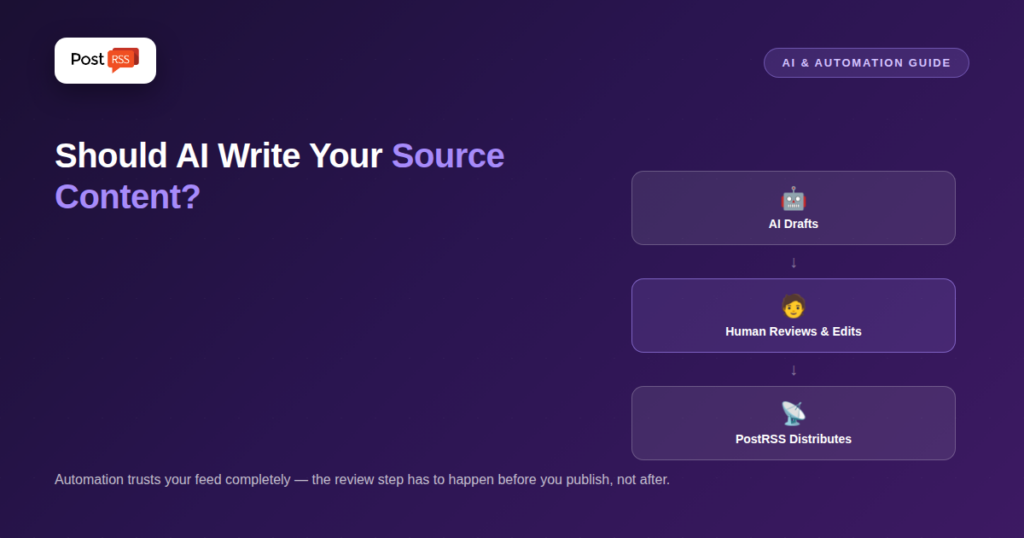
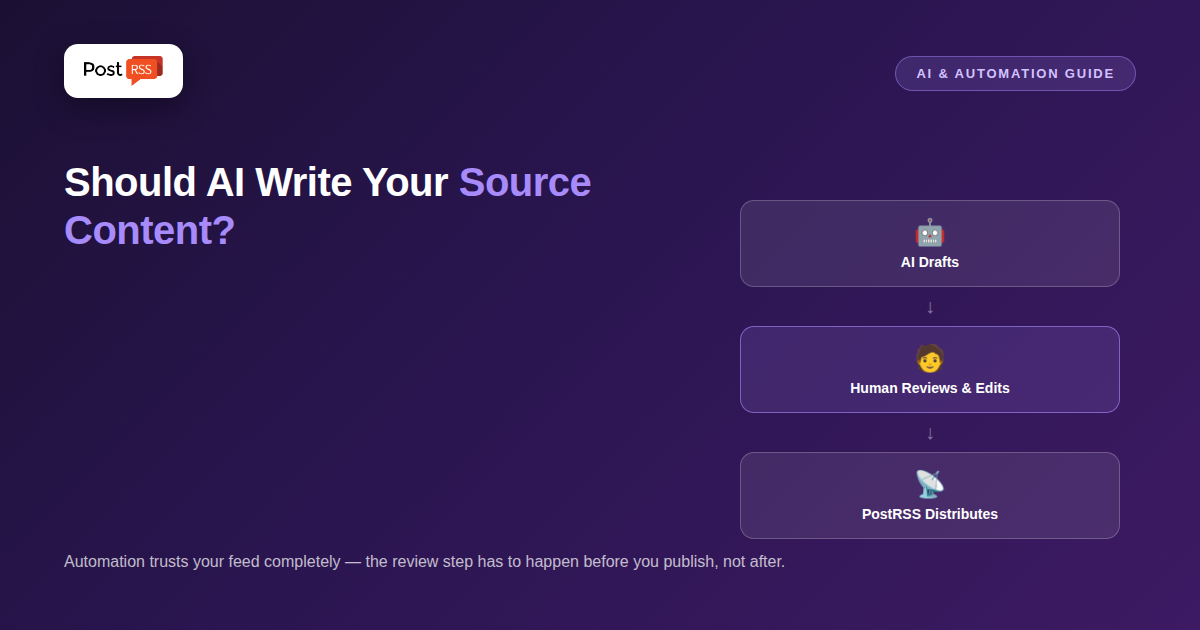
The appeal of combining AI drafting with full RSS automation is obvious: content can move from idea to distributed-everywhere in a fraction of the time a fully manual process requires. But speed and quality control aren't inherently opposed here — a well-designed workflow keeps most of that speed advantage while still inserting a genuine review step, since editing an AI draft for voice, specificity, and accuracy takes meaningfully less time than writing from scratch. The teams that get this balance wrong tend to fall into one of two traps: skipping review entirely to chase maximum speed, or distrusting AI assistance so completely that they abandon a genuinely useful drafting tool. The middle path — AI drafts, human edits, automation distributes — captures most of the speed benefit without inheriting AI's specific failure modes.
RSS automation has no opinion about the quality of what it distributes — it's a distribution mechanism, not an editorial layer, and expecting it to catch content-quality problems is a category error about what the tool is actually for. This isn't a shortcoming specific to PostRSS or any particular automation tool; it's true of RSS-based automation generally, since the entire model depends on trusting the source feed completely. The quality control has to happen where content is written and published, not downstream where it's distributed.
If you're already running RSS automation and using AI tools as part of your content production process, the highest-leverage change is usually establishing a clear human review step before publishing to your source site, not changing anything about the automation itself. See our companion piece on making auto-posted captions sound human, not robotic for related guidance on avoiding generic-sounding automated content.
Not necessarily — AI is genuinely useful for drafting and structure; the important part is a human review and edit step before that content is published and picked up by automation, not avoiding AI assistance altogether.
No — PostRSS distributes whatever is published to your connected feed exactly as written; content quality control needs to happen at the point of publishing on your own site, before the automation picks it up.
Reviewing a month of your own automated posts for repetitive structure, vague claims without specific details, and a general interchangeable feel compared to competitors is a practical way to self-assess without needing special tools.
No — routine, factual content like schedule changes carries less risk than opinion pieces or data-driven claims, where generic AI phrasing and factual errors are both more noticeable and more damaging to credibility.
For routine business content, explicit disclosure usually isn't necessary or expected; for content trading on personal expertise or first-hand experience, it's worth either genuinely reflecting real authorship or being honest about how it was produced, since credibility risk is higher there specifically.
Yes — readability isn't the same as accuracy or brand fit, and AI tools can produce confident, well-written text that's still factually wrong or off-voice, which only a human review step reliably catches before automation distributes it everywhere.
RSS automation doesn't make content better or worse; it simply makes sure whatever's published reaches every connected platform reliably and immediately. That neutrality is exactly why the human review step matters more, not less, once AI tools are part of how content gets written — the combination of fast AI drafting and fast automated distribution is powerful when a real editorial checkpoint sits between them, and risky when neither side is actually being checked.