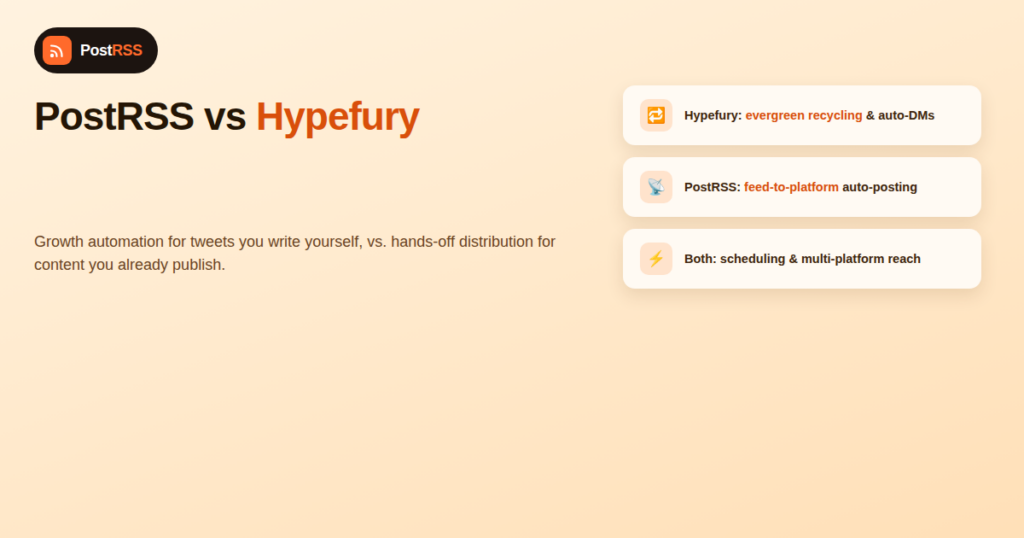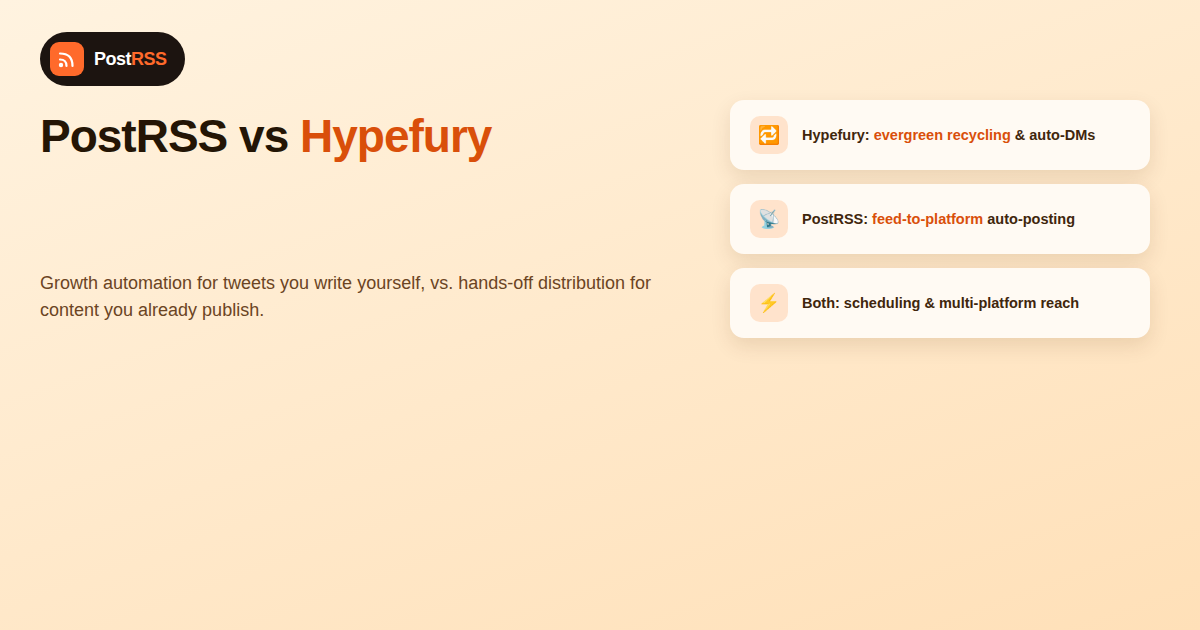
Hypefury and PostRSS both get mentioned in “best X automation tool” roundups, but they’re built to solve different problems for different kinds of accounts. Hypefury is a growth toolkit for people actively building a personal brand on X through original tweets and threads. PostRSS is a distribution engine for turning an existing content feed — a blog, podcast, or site — into consistent posts across many platforms. Here’s how they actually differ, and which one matches what you’re trying to do.
Hypefury grew out of the “grow your X account” niche, and its feature set reflects that focus. Beyond basic scheduling, it includes automatic evergreen recycling (re-queuing your best-performing older tweets so they keep getting exposure instead of disappearing after 24 hours), an “Auto Plug” feature that appends a follow-up tweet — often a lead magnet, newsletter link, or product mention — to your best-performing posts automatically, “Auto DM” workflows that send a direct message to anyone who replies with a keyword or retweets a post, and a thread finisher that helps convert a long tweet into a properly formatted thread. It also supports cross-posting the same content to LinkedIn and Threads, and gives detailed analytics on which posts and hooks are actually driving growth.
Everything about Hypefury assumes you’re the one generating the ideas and writing the tweets. Its automation targets what happens after you post — recycling, follow-up messaging, cross-posting — rather than generating the post itself from an external source.
PostRSS starts one step earlier in the pipeline: instead of you writing a tweet and then automating what happens after, it takes new items from a feed you already publish to — a WordPress blog, podcast RSS, YouTube channel, or similar — and automatically turns each one into a post across Facebook, X, LinkedIn, Pinterest, VKontakte, Telegram, and other connected accounts. There’s no growth-hacking layer like auto-DMs or recycled-tweet queues; the entire job is reliable, automatic distribution of content that already exists elsewhere, so a publisher never has to manually copy a new article into five different platforms.
Hypefury’s feature set is worth understanding in more detail because it’s genuinely different from a typical scheduler. The “Auto Plug” feature watches your posts for ones that cross an engagement threshold and automatically appends a follow-up tweet — commonly a newsletter signup link, a product page, or a call to check out a related thread — capitalizing on a moment of high visibility without you having to notice it happening in real time and react manually. The “First Comment” feature similarly auto-posts a link in the first reply to a tweet, a common workaround for X’s historical tendency to suppress posts that contain outbound links in the main body. Its evergreen queue lets you tag certain tweets as “recyclable” and set a rotation interval, so a well-performing tip from eight months ago can resurface to an audience that’s grown since it was first posted, without you manually digging through your own history to find it.
Together these features are optimized around a single account’s growth trajectory over months and years — the kind of compounding, engagement-driven strategy that only makes sense when a human is actively steering the account’s voice and topics.
PostRSS’s mechanics are optimized around a different variable entirely: coverage and reliability across a growing number of accounts and content sources rather than growth on any single one. That means feed polling that catches new items quickly after publishing, per-platform formatting so an item posts correctly whether it’s headed to X, Facebook, or Pinterest, image extraction so visual platforms get an actual picture rather than a bare link, and staggered scheduling so a burst of new items doesn’t flood every connected account at once. None of this tries to optimize what happens after a post goes live the way Hypefury’s Auto Plug or recycling does — the job ends at reliable, correctly formatted delivery.
| Feature | Hypefury | PostRSS |
|---|---|---|
| Core purpose | Grow an X account through engagement automation | Distribute existing content automatically across platforms |
| Content origin | You, writing original tweets and threads | An RSS/Atom feed, WordPress site, YouTube channel, etc. |
| Evergreen recycling | Yes — automatically re-queues top-performing tweets | No — posts reflect new feed items, not recycled ones |
| Auto-DM / lead capture | Yes — automated DMs triggered by replies or retweets | No — not a lead-generation or engagement tool |
| Primary platforms | X (Twitter), with LinkedIn and Threads cross-posting | Facebook, X, LinkedIn, Pinterest, VKontakte, Telegram, Discord, and more |
| Growth analytics | Deep — hook performance, follower growth correlation | Basic — distribution and posting logs |
| Best for | Individual X creators building a personal brand | Blogs, publishers, and businesses syndicating content |
Hypefury’s recycling feature deserves a closer look because it’s often the single biggest reason creators choose it: rather than a tweet living and dying in a few hours, Hypefury keeps a rotation of your strongest historical content circulating indefinitely. That works well for evergreen advice, tips, and personal-brand content that doesn’t go stale. It works poorly for anything time-sensitive — recycling a three-month-old “breaking news” tweet or an expired promotion looks careless rather than efficient. PostRSS doesn’t have an equivalent feature because its use case is the opposite: every post it generates comes from something genuinely new in your feed, so staleness isn’t a problem it needs to solve the same way.
A content creator who also runs a blog is the clearest case for using both. Hypefury handles the personal X presence — original takes, recycled evergreen tips, DM-based lead capture for a newsletter — while PostRSS quietly makes sure every new blog post also reaches Facebook, LinkedIn, Pinterest, and other accounts the moment it’s published, without competing for the same X account’s posting slots or diluting the curated feel Hypefury is designed to protect. Running both isn’t redundant; they’re automating two different halves of a content operation.
Hypefury prices around growth features and account count — you’re paying for tools that actively help an account grow followers and engagement over time. PostRSS prices around distribution volume — feeds connected, accounts posted to, and posting tasks per month — because its value comes from reliable coverage at scale rather than growth optimization on any single account. If your goal is literally “grow this one X account,” Hypefury’s pricing maps to that goal more directly; if your goal is “make sure this content reaches everywhere it should,” PostRSS’s model fits better.
It’s worth flagging that aggressive engagement-automation features — automatic DMs triggered by replies, auto-follow/unfollow patterns, or heavy recycling — sit closer to the kind of behavior platforms periodically crack down on than straightforward RSS-based distribution does. Posting new content from a feed you own is unambiguously legitimate publishing activity. Automated mass-DM campaigns, even well-intentioned ones, occasionally run into platform rate limits or policy tightening, so anyone using that side of Hypefury’s toolkit should keep an eye on X’s current developer and automation policies rather than assuming a feature that works today will always be exempt from enforcement.
The clearest way to decide between these two is to be honest about where your time actually goes. Hypefury assumes you’re willing to spend time each week thinking about hooks, replying to engagement, and deciding what’s worth turning into a thread — its automation removes friction from that process but doesn’t remove the process itself. PostRSS assumes the opposite: that you’d rather spend zero ongoing time on distribution and would rather that budget go entirely into producing the underlying content (the blog post, the podcast episode, the product update) once, with everything downstream handled automatically. Neither assumption is wrong; they just serve different stages of a content operation. A solo creator early in building an audience often benefits more from Hypefury’s active-growth mechanics, while an established publisher with a steady content pipeline gets more value from PostRSS’s hands-off reliability.
Hypefury isn’t built around ingesting an RSS feed and auto-generating posts from it — its automation focuses on what happens to tweets you write yourself: recycling, cross-posting, and DM follow-ups, not converting an external feed into new content.
No — PostRSS is built to distribute new items from a feed as they’re published, not to re-queue older posts indefinitely. If evergreen recycling of your best content is the specific feature you need, that’s Hypefury’s core strength, not PostRSS’s.
Hypefury, since its value depends on you actively writing and growing an account through original content and engagement tactics. PostRSS assumes you already have a content source elsewhere to distribute; it isn’t a growth tool for an account starting from zero content.
No. Hypefury’s analytics are built specifically to correlate hooks, timing, and formats with follower growth. PostRSS’s reporting focuses on confirming what was distributed where and when, which is a simpler, distribution-focused kind of visibility.
Yes, they operate independently — Hypefury’s DM automation runs against engagement on your manually written posts, while PostRSS’s distribution runs against your separate content feed. There’s no functional conflict running both against the same X account.
It can work if someone is willing to manually turn each post into tweets and manage the recycling queue, but most multi-author blogs publish at a volume and cadence that manual composition doesn’t scale well against, which is the gap RSS-based automation is built to close.
PostRSS supports a broader platform list overall, including visual and messaging platforms like Pinterest and Telegram that Hypefury doesn’t target, though Hypefury covers X, LinkedIn, and Threads specifically well for text-based cross-posting of manually written content.
Not if you apply automation to the right content. Replacing your personal, opinion-driven tweeting with auto-generated posts would likely hurt engagement, since audiences respond to a distinct voice. Using automation specifically for a separate blog or content feed — while keeping your personal posting habits intact — adds distribution without touching the growth mechanics Hypefury-style tools are built to protect.
Because these tools store fundamentally different things — Hypefury holds your written tweet queue, recycling rules, and DM automations; PostRSS holds your feed connections and platform mappings — there’s no meaningful “migration” between them the way there might be between two similar schedulers. Most people who end up using both simply set each one up independently against the account or accounts it’s suited for, rather than trying to export settings from one into the other.
Hypefury and PostRSS both touch X, but they automate different halves of a content strategy. Hypefury is a growth engine for content you write yourself, built around recycling, DMs, and engagement analytics. PostRSS is a distribution engine for content you already publish elsewhere, built around reliability and platform coverage. Match the tool to whether you’re actively growing a personal voice on X or making sure an existing content feed reaches its full audience — and if you’re doing both, there’s no reason not to run them side by side.