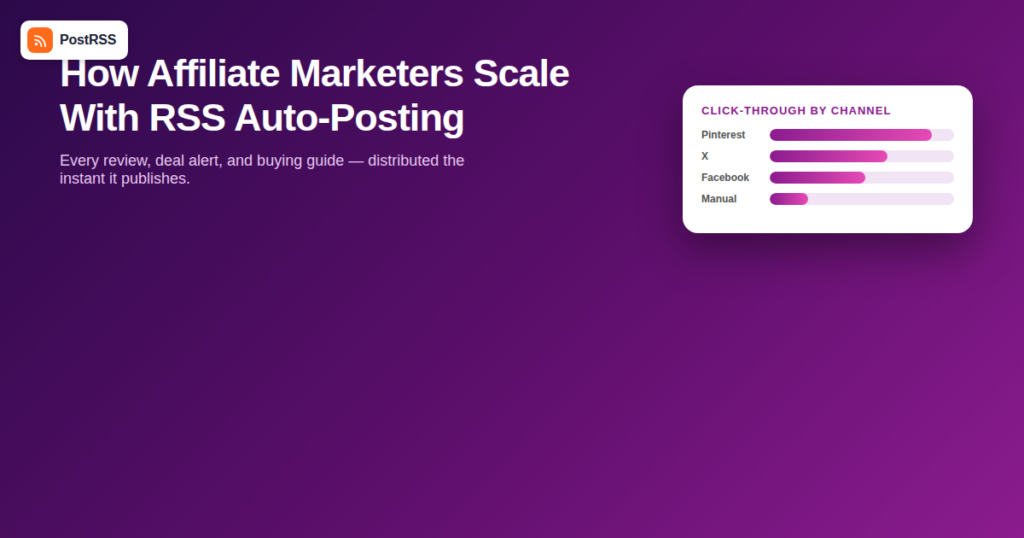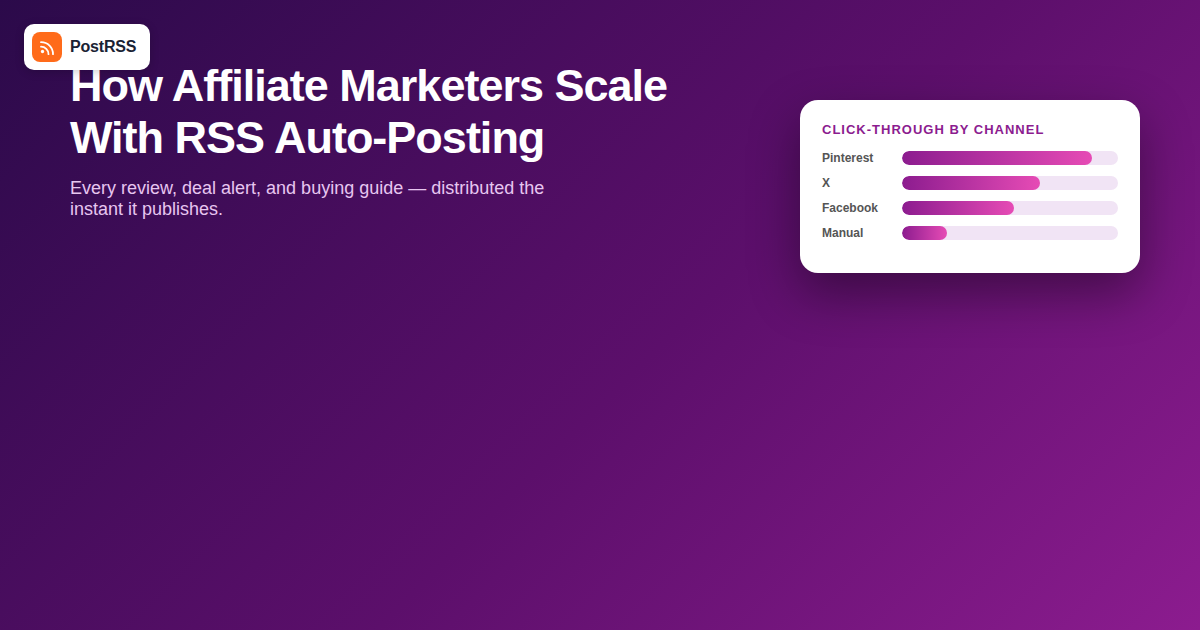
Affiliate marketers live and die by publishing volume and distribution speed. A review site, deal aggregator, or niche content hub only earns commissions when people actually click through to the merchant, and that click-through depends heavily on getting new content in front of an audience fast — before a deal expires, before a competitor covers the same product, before interest in a seasonal topic fades. Most affiliate publishers write consistently but distribute inconsistently, manually posting to social media whenever there’s time between writing the next piece.
RSS auto-posting closes that specific gap. Every new post, deal alert, or product review published to an affiliate site already generates an RSS feed. Connect it once to an RSS-to-social automation tool, and every new article distributes automatically to Facebook, X, Pinterest, and other connected platforms the moment it publishes — turning a publish-and-hope workflow into a publish-and-distribute one.
This is a fundamentally different problem from most content marketing use cases, because affiliate revenue is directly tied to timely distribution in a way most business blogging isn’t — a review that ranks well in search still needs an initial traffic push to gain momentum, and a deal that isn’t shared within its useful window has effectively lost its entire commission potential regardless of how well it was written.
Every new product review or comparison guide is worth distributing the moment it publishes, since organic search rankings take time to build — social distribution is often the only meaningful traffic source for a brand-new post in its first days or weeks.
Time-limited deal content benefits the most from automation of anything on this list, since a deal post published at 9am but not shared to social until 4pm has already lost several hours of its useful life. Auto-posting removes that lag entirely.
Holiday gift guides, “best of” seasonal roundups, and back-to-school buying guides follow a predictable annual calendar, giving affiliate publishers a content stream that’s easy to plan and automate months in advance.
Head-to-head comparison posts and “best alternatives to X” content tend to perform particularly well on Pinterest and X, where users actively search for purchase-decision help, making this content type especially worth prioritizing for automated distribution.
| Platform | Best Content Type | Notes |
|---|---|---|
| Buying guides, gift guides, product roundups | Long content lifespan — a well-pinned post can drive click-throughs for months | |
| X | Deal alerts, time-sensitive discounts | Fastest platform for content with a short useful window |
| Reviews, roundups, seasonal guides | Group and Page distribution both matter for niche affiliate communities | |
| B2B software or tools-focused affiliate content only | Skip entirely for consumer product affiliate sites |
Auto-posting affiliate content works within the same platform policies as any other content, but a few rules matter more specifically for this use case:
| Factor | Manual Posting | RSS Auto-Posting |
|---|---|---|
| Time cost per published post | 5-15 minutes across platforms | Near zero after setup |
| Speed for time-sensitive deals | Hours of delay is common | Minutes from publish to distribution |
| Consistency across a high publishing volume | Degrades as post volume increases | Scales with no added time cost |
| Coverage across all platforms | Usually one or two platforms get priority | All connected platforms simultaneously |
| Opportunity cost | Time spent posting is time not spent writing new content | Writing time is fully preserved |
For a solo affiliate publisher, that opportunity cost row matters most: every minute spent manually posting to social is a minute not spent researching the next product, negotiating a merchant relationship, or writing the next review — the activities that actually generate new revenue rather than just distributing what already exists.
A typical affiliate publisher setup looks like this: connect the site’s main RSS feed to Pinterest, X, and Facebook. If the site covers multiple verticals (say, tech deals and home goods deals on the same domain), category-based routing keeps each platform’s audience seeing only relevant content, rather than a tech-focused X account suddenly posting home goods deals. From there, the only ongoing task is writing and publishing — every new post distributes itself the moment it’s live, with no separate social media step required at all.
Most social platforms treat a post’s useful lifespan in hours or days. Pinterest behaves differently — a well-optimized pin can keep surfacing in search and recommendations for months after the original publish date, which makes it uniquely valuable for affiliate content that stays relevant long after publication, like evergreen buying guides and gift guide roundups that get re-discovered every holiday season.
This changes the automation calculus slightly for affiliate publishers compared to other industries covered elsewhere on this site. Where a deal alert benefits most from speed (getting to X and Facebook within minutes), an evergreen buying guide benefits more from consistent, ongoing pin volume than from being fastest to publish — both of which the same feed-based automation handles without requiring separate manual workflows for each content type.
A common trap for new affiliate publishers is treating social distribution as a one-time push per article rather than an ongoing channel. Since RSS auto-posting distributes each new post exactly once, at publish time, it’s worth thinking about a few complementary habits that maximize what that single distribution event returns:
Not inherently. Platforms generally treat organic affiliate link posts the same as any other link post through their standard API. Risk comes from posting patterns that look spammy — extremely high frequency, cloaked links, or identical repeated content — not from affiliate links themselves.
This depends on your jurisdiction’s specific advertising disclosure rules, but the safest practice is including a brief disclosure in the social caption itself when the platform allows it, not just relying on a disclosure buried in the linked article.
Yes, if your site organizes content by category, most auto-posting tools support routing specific categories to specific platforms or accounts, which is the standard approach for multi-niche affiliate publishers.
As fast as possible — deal-driven affiliate content is one of the most time-sensitive categories that exists, since both the deal itself and the competitive advantage of covering it first both erode with every hour of delay.
No — RSS auto-posting handles distribution of whatever links are already in your published content. Link management, cloaking, and tracking are separate concerns handled by your own linking setup before content ever reaches the automation layer.
Yes, arguably more so — a small publisher benefits most from removing manual overhead relative to their limited available time, even if the total post volume is modest.
Each site’s feed connects independently, so a publisher running several niche sites can manage all of them through one automation dashboard, each site’s content routed to its own dedicated social accounts.
They can share the same underlying feed connection, but it’s worth being deliberate about platform routing — deal alerts benefit most from fast platforms like X, while evergreen guides benefit from Pinterest’s longer content lifespan. Routing by content category, where supported, lets both content types get distributed on the platform where they’ll perform best rather than treating every post identically.
Generally yes, if the update changes the post’s publish or modified date in a way your feed reflects — this is a useful way to give strong older content a second distribution cycle without writing anything new from scratch.
Affiliate marketing revenue depends directly on getting content in front of an audience quickly and consistently, and manual social posting is one of the biggest hidden time costs for solo and small-team publishers. RSS auto-posting turns every new review, deal alert, or buying guide into automatic, immediate distribution across every connected platform, freeing up the time that actually drives revenue: writing the next piece of content, not manually re-posting the last one. For a business where speed and consistency directly translate into commission revenue, that trade is close to the highest-leverage automation decision an affiliate publisher can make.