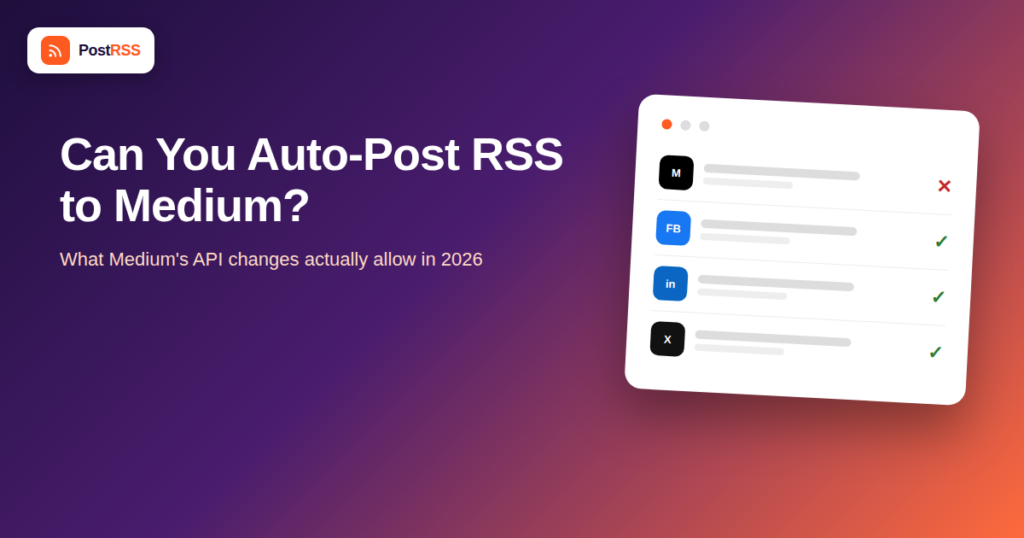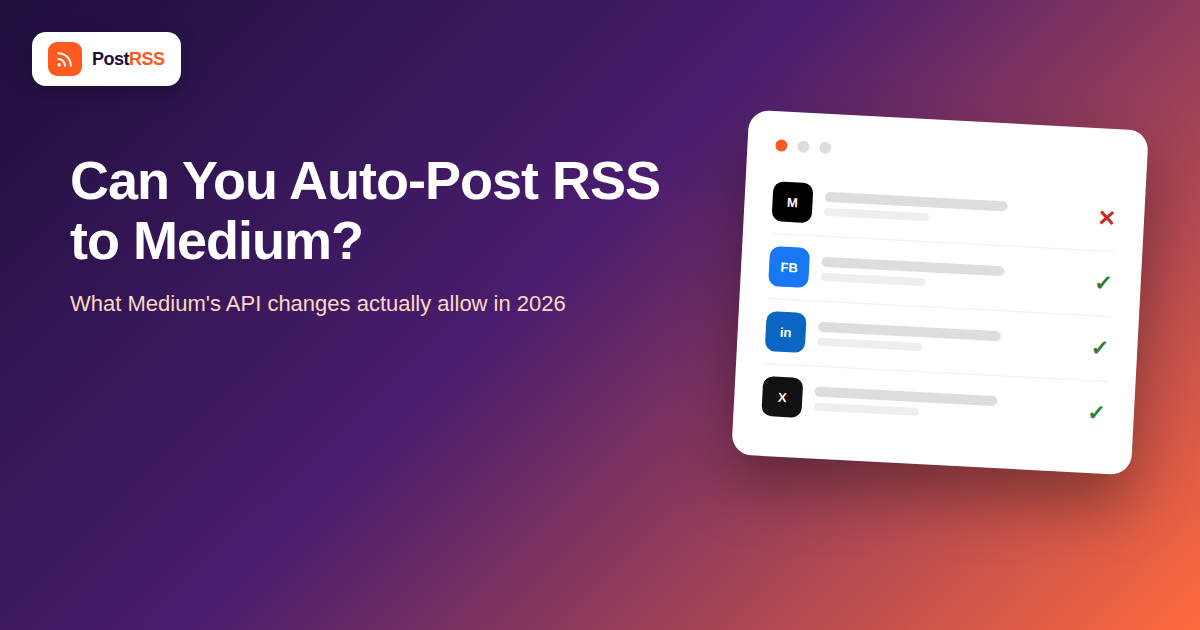
Short answer: not the way you can auto-post to Facebook, X, or LinkedIn. Medium does not offer a self-serve publishing API that lets a third-party automation tool watch your RSS feed and push new articles onto your Medium profile the moment they go live. That capability existed in a limited form years ago, and Medium deliberately shut the door on it. If you have been searching for a way to keep a Medium account perfectly in sync with your blog without touching it, this guide explains exactly why that is not possible in 2026, what your realistic options are, and how to get the reach benefits of Medium without the manual busywork.
Medium used to offer “integration tokens” — a simple, self-service way for a logged-in user to generate an API key and hand it to a third-party tool, which could then create draft or published posts on that user’s behalf. Zapier, IFTTT, and a handful of dedicated RSS-to-Medium services were all built around this token system.
Medium deprecated that self-serve token flow. Publishing access now requires applying for API credentials directly with Medium and getting manual approval, which the company grants sparingly and mostly to large publishing partners, not to individual bloggers or general-purpose automation platforms. For everyday users, the practical result is the same as having no API at all: there is no button you can click in an automation tool to connect your Medium account the way you connect a Facebook Page or an X profile.
This is also why so many older tutorials, YouTube videos, and forum answers claiming you can “auto-post RSS to Medium in five minutes” are now out of date. They describe a workflow that quietly stopped functioning once the underlying token system was pulled.
Medium didn’t remove every path for republishing content — it just kept the ones that require a human in the loop:
None of these is “automatic” in the sense of a feed being polled and new items appearing on Medium without anyone touching a keyboard.
| Method | Automation Level | Setup Effort | Reliability |
|---|---|---|---|
| Medium’s “Import a story” tool | Manual, one click per article | Low | High — officially supported |
| Copy-paste from your CMS | Fully manual | Medium (reformatting needed) | High, but time-consuming |
| Legacy Zapier/IFTTT Medium applets | Was automatic | N/A | Broken — no longer functional for most accounts |
| Approved Medium API partner integration | Fully automatic | Very high (requires application) | High, but out of reach for most site owners |
| Auto-posting your Medium feed to social networks | Fully automatic | Low | High — this is the reverse workflow, and it works |
If you do use Medium’s Import tool to mirror an article, pay attention to the canonical URL field it sets automatically. This tells Google that your original post — the one on your own domain — is the “real” version, and the Medium copy is a syndicated duplicate. Getting this right matters more than people think: publishing the same article on two domains without a canonical signal can dilute rankings and create the exact duplicate-content confusion that search engines are built to penalize. If you’re weighing the SEO trade-offs of republishing content across multiple platforms at all, it’s worth reading up on SEO best practices for syndicated posts before you make cross-posting a habit, rather than after you’ve already mirrored fifty articles with the wrong settings.
The most efficient setup we see site owners land on isn’t a workaround for Medium’s API — it’s a division of labor. Treat your own blog as the single source of truth and let automation handle distribution everywhere that actually supports it:
This way, the channels that support real automation get it, and the one channel that doesn’t (Medium) gets a deliberate, low-frequency manual touch instead of being ignored or forced into a broken workaround.
Yes, and this is where a lot of the confusion comes from. Every Medium profile and publication has its own public RSS feed (typically something like medium.com/feed/@yourusername). That means if your workflow is the reverse of what this article is about — you write on Medium first and want those stories to automatically appear as posts on your social accounts — that part is fully supported by ordinary content syndication tools, because you’re treating Medium as a source feed, not a publishing destination. The limitation covered in this guide is specifically about pushing content into Medium automatically, not pulling content out of it.
If you built a Medium auto-posting workflow years ago and it silently broke, you’re not imagining it and you didn’t misconfigure anything. Here’s what typically happened:
There isn’t a fix to restore the old behavior — the underlying access model is gone. The realistic path forward is the manual-import workflow described above, or applying directly to Medium if your organization has a genuine case for partner-level API access.
It helps to understand the mechanism, because it explains exactly where Medium falls outside it. An RSS automation tool works by periodically polling your feed’s URL, comparing the list of items against what it has already seen by GUID, and firing an API call to each connected destination whenever a new item shows up. That final step — the API call — is where everything hinges. Facebook, X, LinkedIn, Pinterest, and VKontakte all expose a “create post” endpoint that a third-party app can call on your behalf once you’ve granted permission through OAuth. Medium simply doesn’t expose that endpoint to ordinary users anymore. The polling half of the system works identically no matter what; it’s the publishing half that Medium has locked behind a partner application.
This is also why the workaround isn’t “find a different tool” — every tool that claims otherwise is either using a grandfathered account with old-style access, or quietly not doing what it advertises. The limitation sits with Medium’s platform, not with the sophistication of the automation software.
Since importing to Medium takes deliberate, per-article effort, it’s worth being selective rather than mirroring everything you publish. A few criteria that tend to separate the articles worth the five minutes from the ones that aren’t:
That depends on your goals. Medium still has meaningful built-in readership through its recommendation algorithm and topic tags, which is genuinely different from posting a link on a social network where visibility depends on your own following. For writers trying to reach cold audiences interested in a specific topic, an occasional manually-imported article can be worth the five minutes it takes. For businesses primarily trying to drive traffic back to their own site and convert visitors, the effort is usually better spent making sure every other channel — the ones that do support real automation — is actually running instead of sitting half-configured.
Yes, but it now requires a formal application and manual approval from Medium rather than a self-serve token you can generate from your account settings. It’s designed for publishing partners, not general RSS automation.
Those integrations relied on Medium’s old self-serve integration tokens, which Medium deprecated. The automation platforms haven’t done anything wrong on their end — the access method they depended on no longer exists for most accounts.
Medium’s own editor supports saving drafts, but native scheduled publishing and third-party scheduling tools for Medium are limited compared to platforms with open publishing APIs.
Not if you set the canonical URL correctly when importing, which points search engines back to your original article as the authoritative version. Skipping that step is what causes duplicate-content issues.
Yes — since Medium provides a public RSS feed for profiles and publications, that feed can be used as a source for ordinary RSS-to-social automation, which is the opposite workflow from what this article covers.
A small number of tools have obtained partner-level API access from Medium directly, but they’re the exception, and most general-purpose RSS or social scheduling tools cannot connect to Medium as a publishing destination.
Publish on your own site first, use Medium’s Import a story tool with the correct canonical URL, and do it in a weekly batch rather than per-article, since there’s no way to make the step itself faster than one click per article.
Medium intentionally closed the self-serve API path that used to make RSS-to-Medium auto-posting possible, and no configuration change or third-party trick brings that functionality back. The realistic 2026 approach is to accept Medium as a manual, occasional channel — using its own Import tool with correct canonical tags — while putting your automation budget where it actually pays off: keeping your RSS feed flowing automatically into the social networks that still support it. If your Medium stories are the source content instead of the destination, that direction works with standard RSS automation right now, no workaround required.