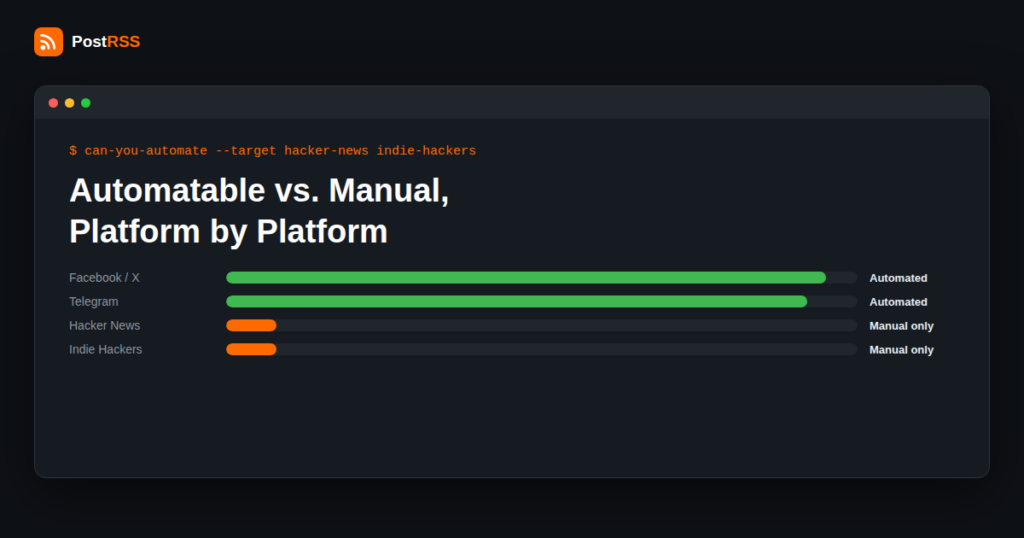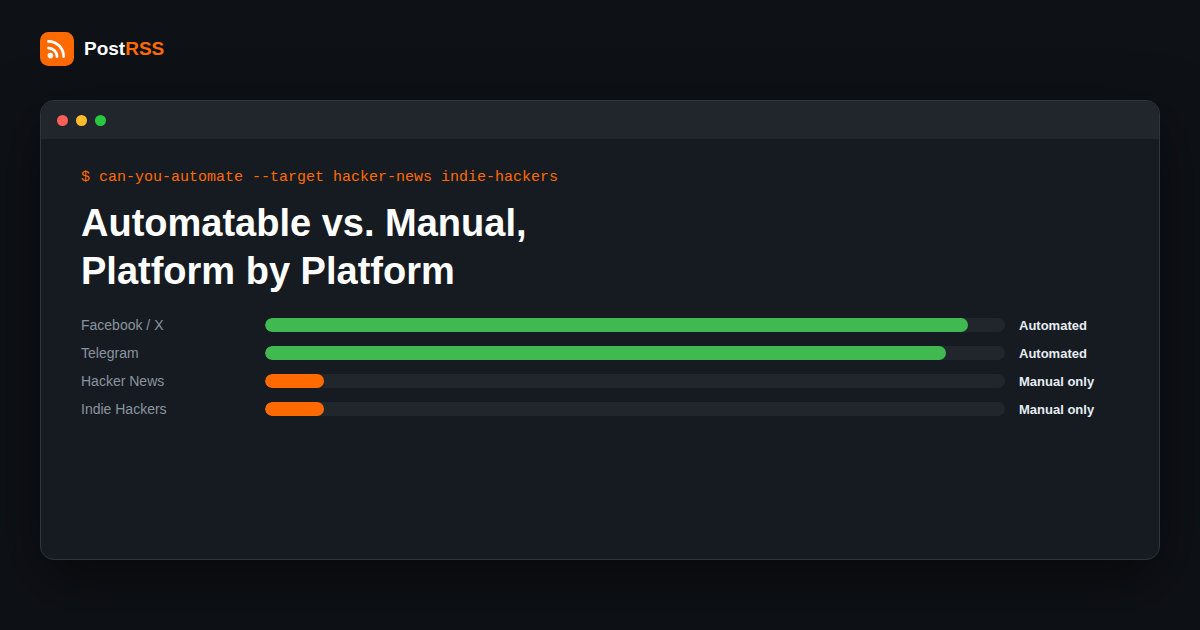
Ask any developer or indie maker who has automated their blog’s distribution to Facebook, X, and LinkedIn whether the same trick works on Hacker News or Indie Hackers, and the honest answer is: not the way you’d hope. Both communities are built around manual, personally-vouched submissions, and both actively police anything that looks automated. This guide explains what each platform’s technical access actually allows, why automated posting backfires even where it’s technically possible, and what a realistic distribution workflow looks like instead.
Hacker News runs a public, Firebase-backed API that developers have used for years to build readers, dashboards, and analytics tools. It’s genuinely excellent for one direction of data flow: reading. You can pull top stories, new submissions, comment threads, and user activity in near real time.
What it does not include is any endpoint for submitting a new story. Posting to Hacker News only happens through the website’s own “submit” form, tied to a logged-in account, with no official programmatic path around it. This isn’t an oversight – it’s a deliberate design choice that keeps submission tied to an accountable human account rather than an anonymous script.
Indie Hackers, owned by Stripe, works the same way from an automation standpoint. There is no public API for creating posts, milestones, or “Show IH” submissions programmatically. Every post – whether it’s a product launch, a revenue update, or a discussion thread – goes through the website’s manual posting interface, tied to a real account with a visible history of participation.
Indie Hackers’ moderation culture leans even more heavily on authenticity than Hacker News does: the platform’s whole value proposition is founders sharing real numbers and real stories, which is precisely the kind of content that loses credibility the moment it looks templated or auto-generated.
| Factor | Hacker News | Indie Hackers |
|---|---|---|
| Public submission API | No | No |
| Ranking depends on | Upvotes + comment velocity in first hours | Upvotes, comments, and founder engagement |
| Self-promotion tolerance | Low – flagged and killed by moderators/community if it reads as promotional | Moderate, but repetitive or copy-pasted content is called out quickly |
| Automation detection | Active moderation team + community flagging | Small, close-knit community notices repeat patterns fast |
Even if a workaround existed to script a submission, both communities are small and observant enough that a post lacking any real founder voice or follow-up engagement tends to sink immediately, regardless of how it got there. The mechanism that makes both platforms valuable – genuine builders talking to other genuine builders – is also what makes them resistant to broadcast-style automation.
Hacker News does publish read-only RSS feeds (including a front-page feed and per-story comment feeds), which are useful for tracking what’s trending in your niche or watching for mentions of your product. This is the mirror image of what most people ask for – not posting out, but pulling in.
The most effective workflow treats your blog or changelog’s RSS feed as the source of truth, with your content distribution automation handling every channel that supports it – and a person manually submitting the same URL to Hacker News or Indie Hackers, with a title and framing written specifically for that community.
If a Hacker News or Indie Hackers post takes off, the traffic spike itself is a genuine milestone worth writing up. That recap post, once published on your own site, flows out through your existing RSS automation to your other channels automatically – the same pattern that works well for Product Hunt launches and other one-off events that can’t be automated directly.
Hacker News activity peaks during US business hours on weekdays; Indie Hackers skews toward when its largely US and Europe-based indie founder audience is active. Neither benefits from being folded into a generic “post everywhere at 9am” automation rule – manual, well-timed submission consistently outperforms anything scheduled in bulk.
| Channel | Approach |
|---|---|
| Facebook, X, LinkedIn, Telegram | Fully automated via RSS the moment content publishes |
| Hacker News | Manual “Show HN” or link submission, written for that specific audience, founder replies to every comment |
| Indie Hackers | Manual post with real numbers and context, cross-linked from your own site |
| Your own recap of what happened | Written once, then automated back out to every other channel |
On both platforms, a brand-new account submitting a single link and disappearing is one of the clearest signals of low-effort self-promotion, and both communities have effectively trained themselves to spot it. Hacker News’s karma system and Indie Hackers’ visible comment and post history exist precisely so other members can judge whether someone is a genuine participant or a drive-by marketer. This is the deeper reason automation doesn’t transfer well here: the credibility that gets a post noticed is built through months of commenting on other people’s threads, answering questions, and showing up when you have nothing to promote – none of which an RSS feed or scheduling tool can manufacture on your behalf.
Founders who treat Hacker News and Indie Hackers as long-term relationship-building channels, rather than a distribution target to check off alongside Facebook and X, consistently get better results than those who show up only on launch day.
Both communities are sensitive to headlines that read like marketing copy. A title lifted directly from a press release or an SEO-optimized blog headline – the kind that works well for a social media auto-posting feed – often gets flagged or rewritten by moderators on Hacker News, or simply ignored on Indie Hackers. What tends to work instead:
The founders who get the most out of Hacker News and Indie Hackers usually didn’t start participating the week of their launch. A more durable approach looks like this: comment genuinely on other people’s posts for weeks or months before you ever submit your own; answer questions in your area of expertise without linking to your own product; and only submit your own work once you have enough visible history that a first-time reader can tell you’re a real participant, not a marketing account. None of this is automatable, but it compounds – unlike a scheduled post that reaches an audience once, a reputation built through real participation keeps paying off on every future submission.
Hacker News and Indie Hackers aren’t unique in resisting automation – Reddit runs into similar issues, where subreddit rules and community moderators penalize obviously automated or repetitive self-promotion, even though Reddit’s technical API does permit programmatic posting in a way Hacker News and Indie Hackers simply don’t. The difference is one of degree: Reddit at least offers a door that’s technically open but socially guarded, while Hacker News and Indie Hackers don’t offer a programmatic door at all. Any platform built around community trust and voting – rather than a simple reverse-chronological feed like a Facebook Page or an X timeline – tends to resist broadcast-style automation for the same underlying reason: the ranking signal depends on real people finding something valuable enough to engage with, not just seeing that it exists.
Beyond the practical impossibility of using an API that doesn’t exist, there’s a real reputational cost to trying workarounds like browser automation or hired click farms to submit and upvote your own content. Hacker News moderators actively investigate vote manipulation and will shadowban accounts or entire domains – meaning future submissions, even completely organic ones, quietly stop appearing on the front page without any visible notice to the poster. Indie Hackers’ smaller, tighter-knit community tends to notice suspicious patterns even faster, and a founder caught gaming the system can lose credibility that’s difficult to rebuild in a community built around trust. The cost of getting caught almost always outweighs whatever short-term traffic a manipulated submission might have generated.
No. Hacker News’s public API is read-only. Submitting a story requires a logged-in account using the site’s own submission form, with no official programmatic alternative.
Technically possible, but strongly discouraged – both Hacker News and Indie Hackers actively detect and penalize automated or bot-like submission behavior, and getting caught can result in shadowbans or account removal that affect your ability to participate at all in the future.
No. All posts on Indie Hackers go through its website interface, tied to an individual founder account with a visible posting and comment history.
Yes – Hacker News’s official RSS feeds and its public read API make it straightforward to track new submissions, comments, and mentions, even though posting itself isn’t automatable.
Yes, just not pointed at Hacker News directly. Use your automated distribution for every channel that supports it, and treat the Hacker News submission as the one deliberate, manual step – similar to how a Product Hunt launch works.
That would require Hacker News or Indie Hackers to open a public write API for submissions, which runs counter to how both platforms police authenticity and self-promotion. Until that changes, manual, community-aware submission remains the only real path.
Treating them like just another distribution channel to plug into an existing automation stack. Both communities reward genuine, one-off participation and penalize anything that reads as broadcast content – the opposite of what makes RSS automation valuable everywhere else.
One pattern worth calling out specifically: Indie Hackers thrives on revenue and growth milestone posts – “$10k MRR after 8 months,” “how we got our first 100 customers.” These make excellent source material for your own blog first, written with the full context and numbers your regular audience expects, and then adapted into a shorter, more direct Indie Hackers post afterward. Publishing the long-form version on your own site also means it’s the version that feeds your RSS-driven distribution to every other channel, while the Indie Hackers post itself stays a manual, community-specific adaptation rather than a duplicate copy-paste.
Hacker News and Indie Hackers both lack a public submission API by design, and both communities actively push back against anything that looks automated – because manual, accountable participation is the mechanism that keeps either platform useful. The realistic approach is to let RSS automation handle every channel built for continuous broadcast, and treat a Hacker News or Indie Hackers post the way you’d treat a Product Hunt launch: a rare, manual, carefully-timed event that you personally show up for, with the recap afterward feeding back into your regular automated distribution.
What changed in the networks, what broke, and how to fix it before it costs you reach.
 English
 Lietuviškai
 Deutsch
 Français
 Русский
 Español
 Polski
 Italiano
 Українська
 Čeština
 Português
 日本語
日本語 Latviešu valoda
 Eesti
Eesti Magyar
 Bahasa Indonesia
 Türkçe
 हिन्दी
 Ελληνικά
 العربية
 ไทย
ไทย Tiếng Việt
 Română
 Bahasa Melayu
 বাংলা
বাংলা