66টি সোশ্যাল নেটওয়ার্কে RSS: Facebook, Instagram, X, LinkedIn, Telegram এবং আরও অনেক কিছু ব্লগ অ্যাফিলিয়েট যোগাযোগ
Short answer: A theatre company or community theatre can publish its season announcements, audition calls, rehearsal stories and ticket updates on its own website, and let an RSS auto-posting tool share each new post to Facebook, X, LinkedIn, Telegram, Bluesky, Mastodon and other channels automatically. Audiences, volunteers and funders see an active company without anyone copying posts into several apps. The time saved goes into what theatre marketing needs most: good photos, honest stories and timely reminders before each run.
Theatre lives on short, intense windows. A production may run for two weekends, or a few weeks at most, and most tickets are sold in the weeks just before opening and during the run itself. If the audience does not hear about a show at the right moment, the moment passes. Unlike a shop, a theatre cannot sell last month’s performance.
At the same time, most theatre companies have very little marketing capacity. In a community theatre, the person running social media may also be the stage manager, the treasurer or a volunteer with a day job. Professional companies often have one small marketing team juggling the current show, the next season, fundraising and education programmes. Posting the same update separately on four or five channels is exactly the kind of repetitive work that gets dropped when rehearsals get busy.
A theatre also speaks to several audiences at once. Ticket buyers want dates and prices. Performers and crew want audition notices. Volunteers want to know when help is needed front of house. Funders, sponsors and local councils want evidence that the company is active and reaching the community. Schools want education programmes. A steady stream of posts from one source can serve all of them.
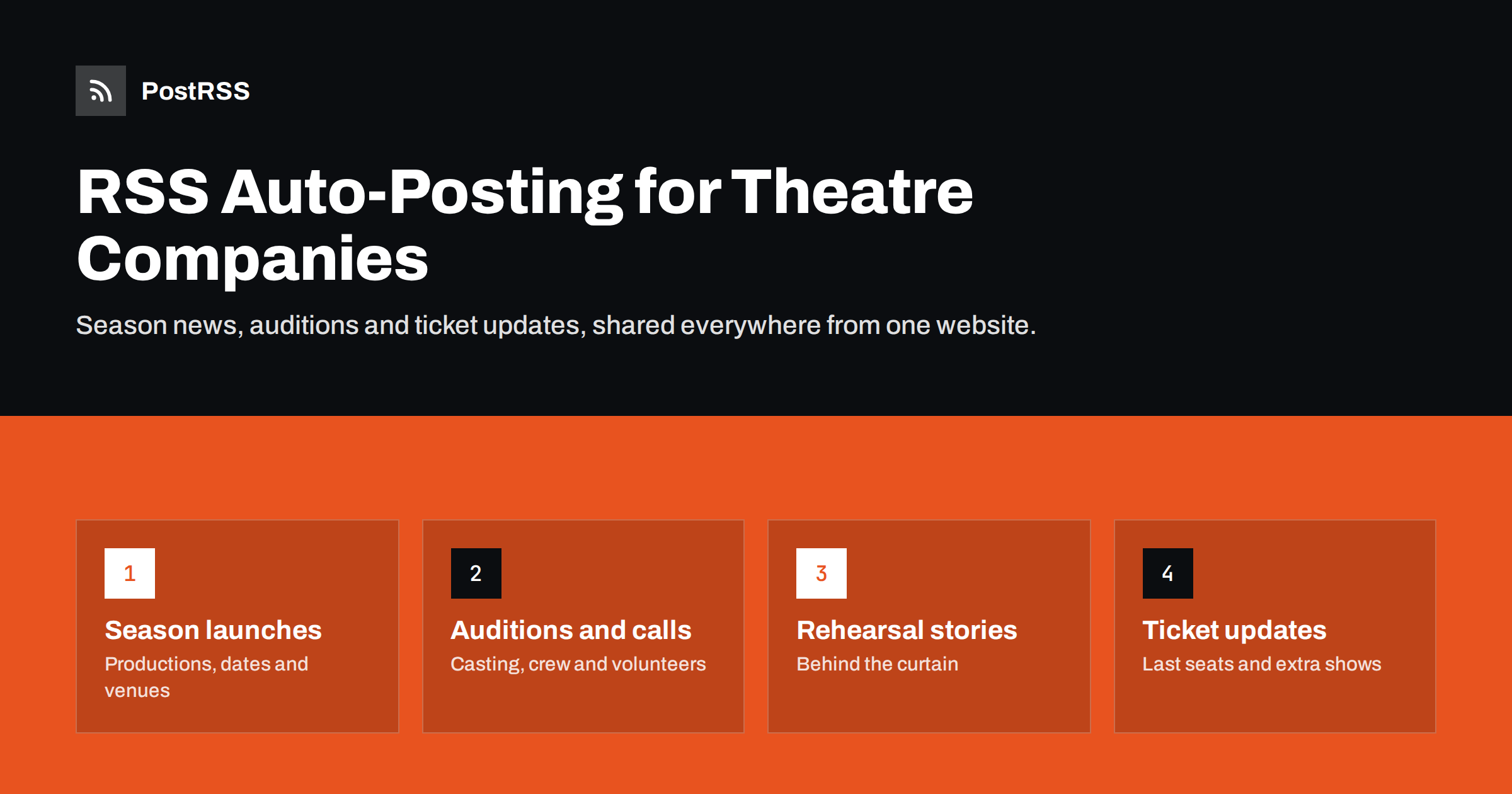
Good theatre content mixes information with story. Useful post types include:
Each of these works well as a short post on the website news page or blog. The website holds the detail and the ticket link; the social posts carry the headline, the image and the link to it.
Many companies post only on social networks, often on one platform chosen years ago. That has two problems. First, people who do not use that platform miss everything. Second, the information disappears into a feed and cannot be found later: a volunteer looking for last year’s audition dates or a funder checking your activity finds nothing on your own site.
When every update starts on the website, you build a permanent record of your work. Each production has a page, each audition call has a post, and the archive shows funders and partners years of activity. Search engines can find the pages, so someone searching for “community theatre auditions” in your town can land on your call. Social channels then become the distribution layer, pointing people back to the page with the full detail and the ticket link.
Most website builders already provide an RSS feed for the news or blog section. WordPress, Squarespace, Wix and similar systems create one automatically. If your site uses separate sections for productions and news, each may have its own feed, which is useful for sending different content to different channels.
The setup takes an hour or less and needs no programming:
/feed/ অথবা /rss. Opening it in a browser shows a structured list of your latest posts.Images matter enormously for theatre. A striking production photo or poster makes people stop scrolling. Set a strong featured image on every post, check that your site outputs it correctly in its social preview tags, and avoid posters crammed with small text, which become unreadable in a social feed.
Not every post belongs everywhere. An audition call for a specific age group is noise for most ticket buyers. A funding announcement may suit LinkedIn better than a family-focused Facebook Page. There are a few simple ways to keep content where it belongs:
A small community theatre might start with one feed to its Facebook Page and one other channel. A larger company with education programmes and a professional network might use three or four feeds routed to different audiences.
Theatre marketing follows a predictable rhythm, and automation helps you keep it without last-minute panic:
You can write several of these posts in advance and schedule them on the website. With posting windows on the automation side, updates go out when your audience is likely to see them, for example in the early evening when people plan their weekend, rather than at midnight after a technical rehearsal.
Theatre marketing budgets are small, so it helps to know which channels actually bring people to the box office. Automation makes this easier, because every post follows the same pattern and can carry the same tracking.
The simplest method is to add UTM parameters to the links in your automated posts, for example utm_source=facebook এবং utm_medium=social, so your website analytics can show which network sent each visit to a production page. If your ticketing system runs on your own site or passes those parameters through, you can go one step further and see which channels led to bookings. Even without that, visits to production pages by source are a useful signal.
Look at the results after each production rather than after each post. Questions worth asking include:
Keep the answers in a short note with the production name and dates. After two or three productions, patterns usually emerge, and you can adjust the channels you connect, the time windows you use and the kinds of posts you write. Just as important, you can show funders and your board concrete evidence of how the company reaches its audience, which is often requested in grant reports.
Also listen to the box office. Asking “how did you hear about us?” at the door or in the booking form gives qualitative evidence that no analytics tool can provide, and it often reveals word of mouth that started with a shared post.
PostRSS is an RSS auto-posting service running since 2014. It checks your website feed every 5 minutes (every minute on Enterprise plans) and publishes each new item, with its image and link, to the networks you connect. The features page lists 66 networks, including Facebook Pages, X, LinkedIn, Telegram, Viber, Bluesky, Mastodon, Threads and Discord, with Instagram currently listed as being tested. Note that Facebook allows automated posting to Pages only, not to Groups.
For theatres, the useful parts are one feed to many targets with separate settings, keyword filters to include or exclude items, hashtags built from your post categories, UTM parameters for tracking ticket-page visits in your analytics, and posting windows on paid plans. A free plan is available, and paid plans add more targets and networks; see the PostRSS pricing page.
Theatre depends on reaching the right people at the right moment, usually with very little staff time. Put every announcement, audition call and ticket update on your website first, give each post a strong image, route content to the channels that fit each audience, and let RSS auto-posting handle the distribution. The company stays visible between and during productions, and the people who make the show can focus on the show.
Yes. It reduces social media to one habit: publish the update on the website. The rest happens automatically, which suits volunteers with limited time. Many website builders create the feed without any technical work.
Yes, if you use a separate category feed for auditions or keyword filters in your auto-posting tool. Connect that feed only to channels where performers follow you, such as a group chat or a specific page.
No tool can currently automate posting to Facebook Groups, because Meta closed that publishing API in April 2024. Automated posts can go to a Facebook Page, and you can share them into the group by hand when it matters.
Around productions, several posts a week are normal: rehearsal stories, cast introductions and ticket updates. Between productions, one or two posts a week about education work, auditions or company news keep the channels alive.
Usually yes, especially for children and young performers. Follow your safeguarding policy, get consent from performers or guardians, and check any restrictions in the licence for the play or musical.
What changed in the networks, what broke, and how to fix it before it costs you reach.
 English
 Lietuviškai
 Deutsch
 Français
 Русский
 Español
 Polski
 Italiano
 Українська
 Čeština
 Português
 日本語
日本語 Latviešu valoda
 Eesti
Eesti Magyar
 Bahasa Indonesia
 Türkçe
 हिन्दी
 Ελληνικά
 العربية
 ไทย
ไทย Tiếng Việt
 Română
 Bahasa Melayu
 বাংলা
বাংলা