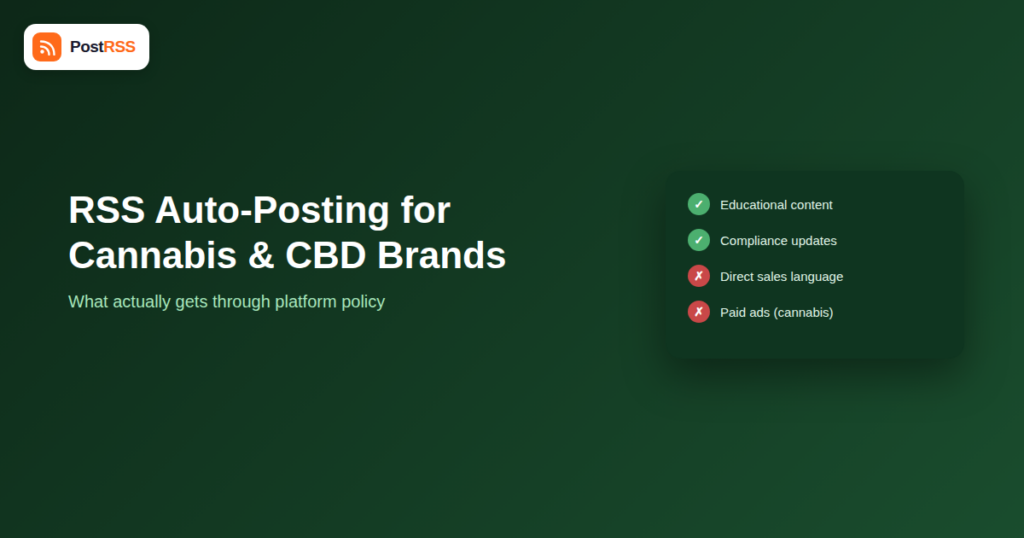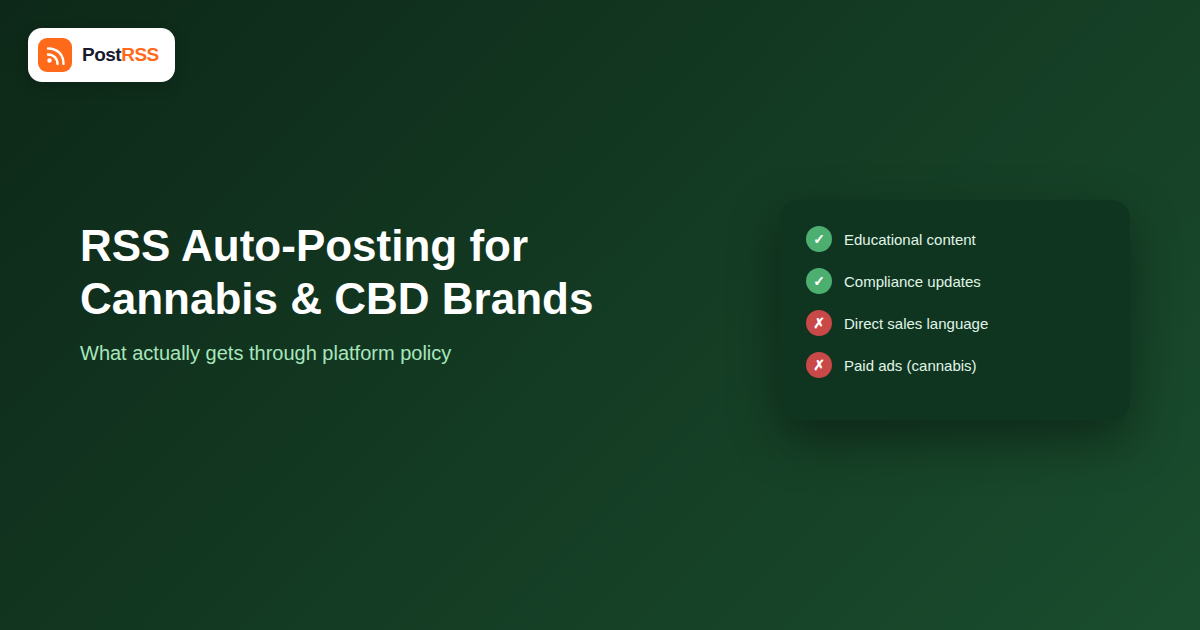
Cannabis and CBD businesses run into the same wall almost immediately when they try to market on social media: the platforms that drive the most traffic for every other local business — Facebook and Instagram in particular — restrict cannabis-related advertising and, in many cases, limit organic content too, regardless of whether the business is fully licensed and compliant with state law. That doesn’t mean automation is off the table. It means the strategy has to account for what actually gets through, platform by platform, rather than assuming RSS auto-posting works identically for a dispensary as it does for a coffee shop.
This guide covers what Meta, X, Pinterest, and LinkedIn actually allow for cannabis and CBD content in 2026, where the real restrictions are advertising-specific versus organic-content-specific, and how to build a compliant automated distribution strategy around those limits.
The core issue isn’t state law — it’s that major social platforms operate under U.S. federal advertising policy and payment processor rules that still treat cannabis (and to a lesser degree, CBD) as a restricted substance category, regardless of state-level legalization. Meta’s advertising policies explicitly prohibit ads for “the sale or use of illegal or recreational drugs,” and cannabis, even where state-legal, falls under this because it remains a Schedule I substance federally. This is a policy and payments decision made by platforms operating nationally and internationally, not a reflection of any individual state’s legal status.
CBD occupies a slightly different, generally more favorable position: hemp-derived CBD with under 0.3% THC was federally legalized under the 2018 Farm Bill, which gives it a meaningfully cleaner legal footing than cannabis generally, even though platforms still don’t treat it identically to an unrestricted product category. Even so, most platforms still restrict CBD advertising and apply extra scrutiny to organic content that promotes ingestible CBD products, largely due to FDA regulatory uncertainty around health claims.
This distinction matters enormously for anyone planning an automated content strategy, because RSS auto-posting produces organic content — regular posts to a Page or profile timeline — not paid ads. The two are governed by different rules on most platforms.
| Platform | Paid ads for cannabis/CBD | Organic posts about cannabis/CBD |
|---|---|---|
| Facebook / Instagram (Meta) | Prohibited for cannabis; CBD ads require special authorization, rarely granted | Allowed with restrictions — no direct sales language, no product purchase links, age-gating recommended |
| X (Twitter) | Restricted; cannabis ads not permitted in most regions | Generally allowed for licensed businesses; enforcement is inconsistent |
| Prohibited for cannabis; CBD ads restricted | Allowed for educational/lifestyle content; direct product sales pins often removed | |
| Restricted, varies by region | Generally allowed, especially B2B and industry-news content |
The practical takeaway: organic auto-posting is meaningfully more permissive than paid advertising across every major platform, which is exactly the lane RSS-based automation operates in.
Across Meta’s platforms specifically — where enforcement is strictest — a few content categories consistently perform without triggering removal or restriction:
What consistently gets flagged or removed: direct sales language (“20% off edibles this weekend”), explicit pricing and purchase links in the post copy itself, and any imagery that reads as promoting consumption rather than the brand or business generally.
Since auto-posting tools pull directly from your website’s RSS feed, the cleanest way to stay compliant is making sure the blog posts and articles themselves are written in a way that’s safe to auto-post as-is — educational framing, no direct sales language, no explicit pricing — rather than trying to filter or rewrite content after the fact.
Not every platform needs identical treatment. Educational and compliance content can flow to LinkedIn and X with fewer edits, while content headed to Facebook and Instagram may need stricter review given Meta’s more aggressive enforcement. Most auto-posting tools let you route specific categories or tags to specific platforms, which is the mechanism to use here.
Fully unattended automation works well for clearly educational or news content. For anything closer to a promotional announcement — a new product line, a sale, a limited-time offer — a quick manual review before it goes out, even if the rest of your pipeline is automated, reduces the risk of a takedown or, worse, a platform-level restriction on the account.
LinkedIn and X currently apply lighter organic-content restrictions than Meta’s platforms. For B2B cannabis businesses (cultivation equipment, compliance software, wholesale) LinkedIn in particular is often underused relative to how permissive it actually is for this content category.
Even where organic cannabis and CBD content is allowed, most platforms expect (and some formally require) that the audience skews toward legal purchasing age. This affects an automated strategy in a few concrete ways:
None of this affects how RSS automation itself works — these are account and platform-level settings configured once, independent of the ongoing content pipeline.
If your business operates across several states with different cannabis legal statuses — for example, a CBD brand that ships nationally but a cannabis brand licensed only in specific states — content strategy sometimes needs to vary by audience. A national CBD brand can generally run one consistent organic content strategy nationwide, since hemp-derived CBD’s federal legal status doesn’t vary state to state. A multi-location cannabis dispensary chain, on the other hand, may want separate location-specific accounts rather than one national Page, both for practical reasons (each location has different products, hours, and local promotions) and because it keeps content clearly tied to markets where it’s actually legal to operate. Multi-location automation strategies generally apply here too — a per-location RSS feed or content tag lets you route location-specific content to the right accounts automatically rather than managing each location’s posting by hand.
Beyond individual post removal, platforms can apply account-level consequences for repeated policy violations: reduced organic reach even for compliant future posts, temporary posting restrictions, or in serious repeated cases, full account suspension. Because a suspended Page often can’t be quickly replaced (follower counts and history don’t transfer), it’s worth erring conservative rather than testing platform tolerance with borderline promotional content, especially on Meta’s platforms where enforcement has gotten measurably stricter over the past several years. Rebuilding an audience from zero after a suspension can set a cannabis or CBD brand’s marketing back by a year or more, which is a much larger cost than the marginal reach lost from being conservative about a handful of borderline posts.
Rather than treating every RSS item identically, most successful cannabis and CBD social strategies split content into three tiers, each with its own automation treatment:
| Tier | Example content | Automation approach |
|---|---|---|
| Tier 1: Fully automatable | Educational articles, industry news, compliance updates, company milestones | Auto-post to all platforms with no manual review |
| Tier 2: Automate with light review | New product announcements, store openings, event coverage | Auto-post to LinkedIn and X directly; queue for a quick check before Meta platforms |
| Tier 3: Manual only | Direct sales, discounts, limited-time promotions | Handle manually, outside the RSS pipeline entirely |
This tiered structure keeps the bulk of your content calendar — which for most cannabis and CBD businesses really is Tier 1 material like education, culture, and brand-building content — running on full autopilot, while keeping a human in the loop specifically for the narrower slice of content that carries genuine policy risk.
Paid Facebook ads for cannabis sales are prohibited under Meta’s advertising policy regardless of state legality, since Meta’s policy is written around federal drug scheduling, not state law. Organic (unpaid) posts face different, generally lighter restrictions.
Direct purchase links for ingestible CBD products are more likely to be restricted or flagged than links to educational content, given ongoing FDA scrutiny of CBD health claims. Routing traffic through an educational blog post that links to products, rather than posting the product page directly, tends to be more resilient.
Not inherently — the platform’s content policy applies the same way whether a human or a tool publishes the post. The risk factor is content quality control, which is why a review step for promotional content matters more here than in less-regulated industries.
Instagram follows the same underlying Meta policy as Facebook, so the same organic-vs-paid distinction and the same content guidelines apply across both platforms consistently.
A handful of cannabis-specific platforms and directories exist (Weedmaps and Leafly being the best known), but they function more as directories and review platforms than general-audience social networks, and most don’t currently support third-party RSS auto-posting the way mainstream platforms do.
Platform policy has moved slowly relative to state-level legalization, largely because federal scheduling and payment processor rules haven’t changed at the same pace. It’s reasonable to expect gradual loosening over time, but nothing suggests a near-term change significant enough to alter the current organic-vs-paid strategy.
No — CBD’s federal legal status under the Farm Bill is meaningfully different from cannabis, and platforms generally apply somewhat lighter organic restrictions to CBD content, though ingestible CBD products still draw more scrutiny than topicals or general brand content.
Not directly — payment processing restrictions and social platform content policies are separate systems run by different companies. However, both stem from the same underlying federal classification issue, so a business dealing with one is very likely to run into the other as well, and it’s worth planning for both from the start rather than treating them as unrelated problems.
Cannabis and CBD businesses can absolutely run automated, RSS-driven content distribution — the key is understanding that platforms distinguish sharply between paid advertising (heavily restricted) and organic content (meaningfully more permissive), and building your source content and platform routing around that distinction from the start. Keep automated content educational and brand-focused, add a manual review step for anything promotional, and lean into platforms like LinkedIn and X where organic restrictions are currently lighter than on Meta’s properties. Get the source content right and the tiering right once, and the rest of the distribution can run on autopilot indefinitely, the same way it would for any other regulated industry.