من RSS إلى 66 شبكة تواصل اجتماعي: Facebook، وInstagram، وX، وLinkedIn، وTelegram، والمزيد المدونة برنامج التسويق بالعمولة اتصل بنا
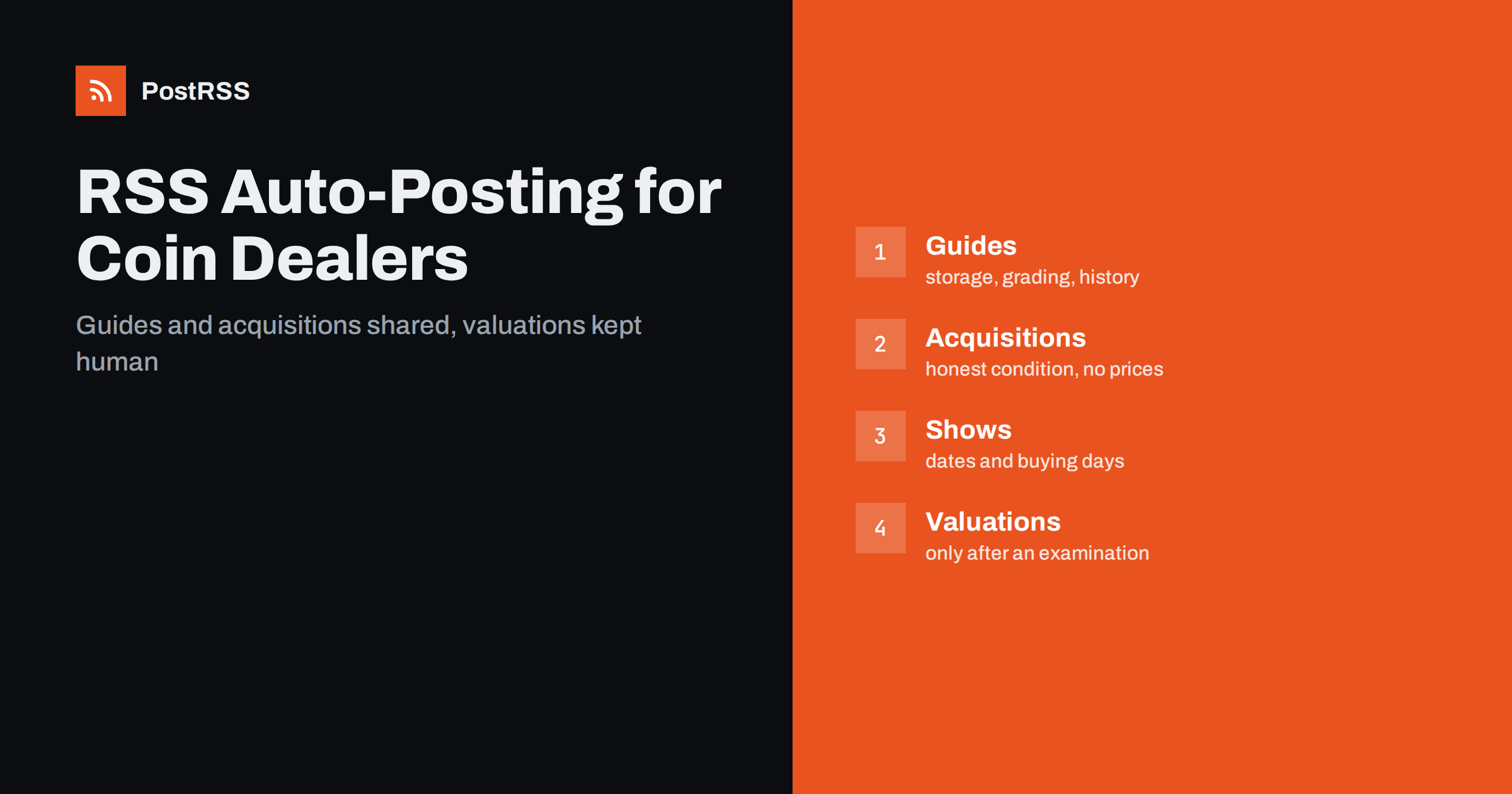
Short answer: RSS auto-posting lets coin dealers and collectibles shops share new acquisitions, collection highlights, show appearances, educational guides, buying days and opening hours on social media automatically. Publish each item as a page on your website, let an auto-poster read the RSS feed, and every new page appears on your Facebook Page, Telegram channel and other networks with its link and image. Collectors see what has arrived without anyone retyping it, while prices, valuations, authenticity opinions and every promise about the market stay with the expert who can stand behind them.
A coin shop is a place of knowledge. Customers arrive with a jar of old coins from a grandparent, a question about a banknote or a hunt for the last piece of a set. The dealer examines, explains and negotiates, and the best dealers build a reputation that lasts decades. That reputation depends on honesty about condition, rarity and value. A feed cannot give an opinion about a coin, and it should not try. What it can do is spread the pages that show the shop’s expertise: guides, new acquisitions, event dates and the stories behind the pieces. This guide explains what to publish, how to connect your website to an auto-poster and why prices and valuations must stay out of automation.
The advice fits many kinds of business that deal in collectible objects:
Each has a changing selection, a set of opening hours or show dates and a website where news can be listed. That page becomes the source for every other channel.
Most of what a dealer knows can be turned into a short page:
Each page is written once and appears on your website, where a person who searches for a dealer nearby, or for the history of a coin, can find it. The feed then announces it automatically.
Many shops already use a system that creates feeds:
/feed/ and one for every category, such as /category/guides/feed/. If you are unsure of the address, see how to find your WordPress feed link.Use categories to separate audiences: acquisitions, guides, events, buying days and jobs. Each category has its own feed, and each feed can go to the channel where it works best; guides and acquisitions to the Facebook Page, show dates to a collectors’ channel, jobs to LinkedIn. Routing by category is explained in category filtering for auto-posting.
| Content | Automate? | Notes |
|---|---|---|
| Guides and background stories | Yes | Written or reviewed by the dealer |
| Acquisitions and collection highlights | Yes | Clear photographs, honest condition, no prices |
| Show dates, buying days and hours | Yes | Date, place and how to book |
| Prices, valuations and offers | No | Move to a conversation with the dealer |
| Authenticity opinions | No | Only after an examination by an expert |
| Market predictions | No | Nobody can promise how a market will move |
A simple rule: if it is general information that helps many people and sits on a finished page of your website, automate it. If it concerns one object, one price or an opinion about value, it needs a human channel.
Collectible values move, and the price of precious metals changes by the minute. A feed that carried prices would be wrong before it reached the network, and a post that implied that a coin will gain in value could mislead a buyer. Never promise that an item is an investment, and do not post offers that depend on a daily market price. Keep prices in your own shop system or in a conversation, and make clear on your permanent pages how you set buying and selling prices in general terms. Rules for dealers, for advertising and for the handling of precious metals and antiquities differ from place to place, so follow your local regulations. These points are general guidance, not legal advice.
Counterfeits and altered pieces are a real part of the hobby, and trust is the dealer’s main asset. Describe condition in the terms that your trade uses, show front and back with good lighting and mention any repair, cleaning or damage. Do not state that an object is genuine unless you have examined it and can stand behind the statement. For pieces with a known origin, publish the provenance that you can document, and say so when you cannot. A page that is modest and exact earns more respect from serious collectors than one that is full of superlatives. If a buyer asks about authenticity in a comment, reply by suggesting a visit or a message, and do not give an opinion about a photograph of someone else’s coin.
Many new collectors start because of a gift, a family find or a news story. They search for simple questions: what is this worth, how do I clean it, where do I sell it. A page that answers them calmly, without judgement, builds a long relationship. Explain, for example, why cleaning a coin can damage its value, how to store pieces in suitable holders and how to find out what a piece is before asking what it costs. Share such pages as evergreen content and repeat them a few times a year, using a new introduction each time. This is more valuable than a stream of new stock posts, and it brings people who later become buyers.
Photography is the main tool of the trade online. Use a neutral background, even light and enough resolution to show the details that collectors check: edges, surfaces, marks and signatures. Show scale with a ruler or a familiar object. Do not use filters that change colour, because colour is part of condition. For items from a private collection, ask the owner before you publish a picture. A feed can carry the photograph as the featured image of the page, and the auto-poster will use it as the preview image. See how to control which image gets auto-posted to choose the right one.
A shop that handles valuable objects should think about security before it thinks about publicity. Do not post when the owner will be away, do not show the layout of the vault or the safe, and avoid describing the exact route of a delivery or a show appearance in advance beyond what the public needs. Share the dates of shows and buying days, but not the details of how cash or stock is moved. Scammers also watch collectors’ pages, so say clearly on a permanent page that the shop will never ask for payment through a private message, and tell customers how to check that a message really comes from you.
Most dealers do best with a Facebook Page and a simple email list that uses the same pages. Two active channels beat five forgotten ones.
/feed/, and check that it lists recent items.PostRSS has been automating RSS posting since 2014. It checks your website feeds as often as every minute and publishes each new page, with its real image and link, to the channels you connect, from Facebook Pages and Telegram to LinkedIn, Bluesky, Mastodon and many more among its 66 supported networks. You can choose how each post is built, filter items by keywords, add UTM parameters and post only within chosen hours or at exact times in your time zone. See the PostRSS features page for everything it does and the pricing page for plan limits. More ideas for local businesses are under the Local Business tag.
A coin and collectibles dealer sells knowledge and trust as much as objects. RSS auto-posting shares each new guide, acquisition story and show date automatically on your Facebook Page and other channels. Give every page honest photographs and a modest description, keep one permanent page for grading, shipping and returns, leave prices, valuations and authenticity opinions to a conversation with the expert and let the dealer spend the day with the collectors who come to learn.
Yes. If your website has a blog or news section, its RSS feed can be connected to an auto-poster that shares each new page on your Facebook Page and other channels. Prices and valuations should stay in a conversation.
Educational guides, background stories, notable acquisitions, show and buying day dates and opening hours. Keep prices, offers and personal details out of public posts.
It is better not to. Values change quickly, and a price in a post may be wrong by the time a collector reads it. Invite people to ask for a current quote.
Only if you have examined it and can stand behind the statement. Describe condition honestly and mention any repair or cleaning.
Yes. PostRSS reads any valid RSS or Atom address that is reachable without a login. Paste the address, connect your channels and new pages are shared as soon as they appear.
What changed in the networks, what broke, and how to fix it before it costs you reach.
من تطوير Internet Solutions، الفريق الذي يقف وراء PostRSS. كل منتج يوفّر وقتك بطريقته الخاصة.
 English
 Lietuviškai
 Deutsch
 Français
 Русский
 Español
 Polski
 Italiano
 Українська
 Čeština
 Português
 日本語
 Latviešu valoda
 Eesti
 Magyar
 Bahasa Indonesia
 Türkçe
 हिन्दी
 Ελληνικά
 العربية
 ไทย
 Tiếng Việt
 Română
 Bahasa Melayu
 বাংলা