RSS to Facebook, Instagram, X, LinkedIn, Telegram and 11 more networks المدونة برنامج التسويق بالعمولة اتصل بنا
Craft beverage marketing rarely looks like a big brand’s marketing department, and it doesn’t need to in order to be effective — consistency and speed matter more than production value for this kind of announcement. A small craft brewery might release a new seasonal beer every few weeks, host a taproom event most weekends, and post distribution news whenever a new bar or bottle shop picks up their product — all while running a taproom, managing a brewing schedule, and, more often than not, without a dedicated marketing hire. Wineries and craft distilleries face the same math: frequent, genuinely newsworthy updates, and no spare hours to manually copy each one into Instagram, Facebook, and X.
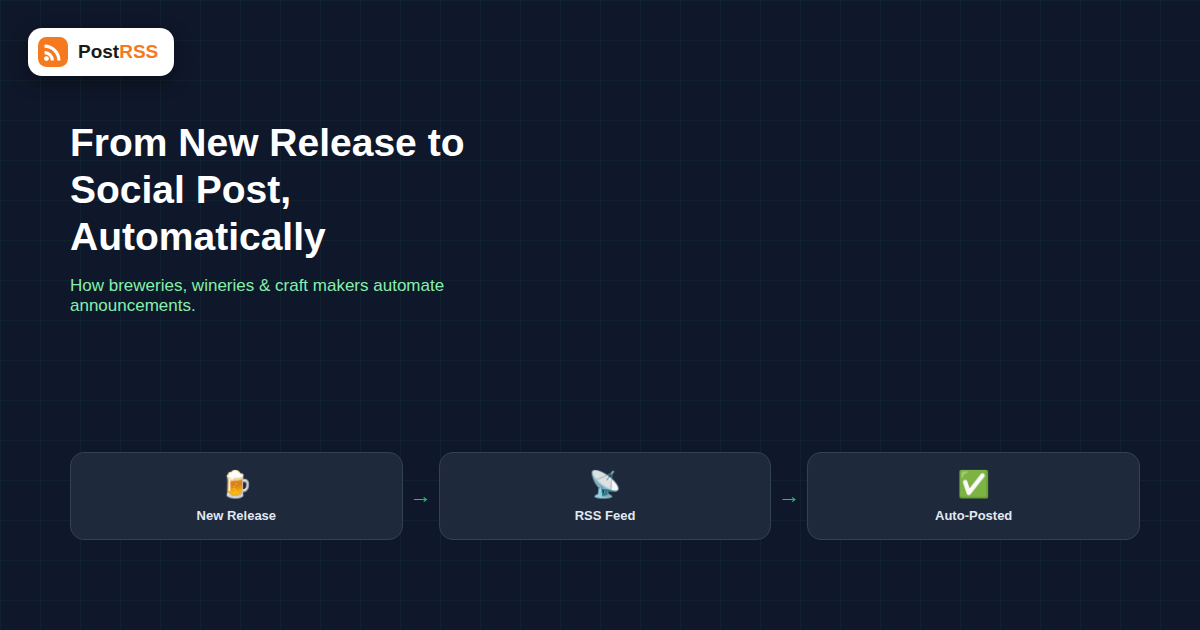
Craft beverage makers already tend to publish structured, frequent updates on their own website — a “New Releases” page, a taproom events calendar, a “Where to Find Us” distribution list. Each of those is a natural fit for an RSS feed, and once a feed exists, RSS feed automation can turn every new entry into a social post automatically, the same day it’s added to the site, without anyone needing to think about social media separately from updating the website.
Restaurant and retail social media guides often assume someone on staff has at least a little bandwidth for marketing between shifts. Small production-focused businesses like breweries and wineries frequently don’t have that slack built in at all — the same two or three people brewing, running the taproom bar, and managing the tasting room schedule are usually also the ones who’d otherwise be typing out an Instagram caption. That’s less a marketing problem and more a staffing-and-time problem, which is exactly the category of problem automation is well suited to solve, since it doesn’t compete for the same limited hours as the people-facing parts of the job.
| Content Type | Best Platform Fit | What to Include |
|---|---|---|
| New release announcements | Instagram, Facebook | Product name, style/varietal, availability date, high-quality photo |
| Taproom / tasting room events | Facebook, X | Date, time, ticket link (if any), a clear “this ends” expectation |
| Distribution / stockist news | Facebook, LinkedIn | New retailer or bar name, location, product carried |
Most breweries and wineries run on a standard CMS (WordPress, Squarespace, or a specialized brewery website platform), all of which can typically expose a working RSS feed for a specific content type or category without custom development. A few practical setup choices make a real difference:
Many craft beverage brands operate a single taproom but distribute regionally, which creates an audience mismatch risk: a customer in another state doesn’t need to see “Live Music Friday at our taproom” content, and a local regular doesn’t need “Now available in 40 new stores across the tri-state area” clogging their feed every week. Two practical approaches:
Limited and seasonal releases are, by design, meant to create urgency — a small-batch sour or a single-vineyard vintage that won’t be repeated. That makes posting delay a genuine cost in a way it isn’t for evergreen content: if the announcement goes out to social media six hours after the taproom line has already started forming, the marketing value of “we just dropped this” has already been spent by word of mouth instead. This is one of the clearer cases in local business marketing where automated, near-immediate posting has a measurable advantage over a manual social media routine squeezed in between brewing shifts.
| Symptom | Likely Cause | Fix |
|---|---|---|
| Release posts show no photo | Product page published before the photo was uploaded | Require a featured image before the release page can be published |
| Event posts missing the date | Date only appears in a calendar widget, not the feed content | Include the date as plain text in the post title or body |
| Distribution posts reaching the wrong audience | All content routed through a single feed to every account | Split feeds by category (releases, events, distribution) and route accordingly |
| Duplicate posts about the same release | Editing the post after publish regenerates its feed entry | Finalize copy before publishing rather than editing live posts repeatedly |
For most craft beverage brands, the practical starting point isn’t building something new — it’s making sure whatever they already update (a taproom events calendar, a “new releases” page, a distributor list) is structured as an actual page or post type that a CMS can generate a feed from, rather than, say, a single static PDF or a caption typed directly into Instagram with no equivalent record on the website. Brands that already treat their website as the source of truth for releases and events have the easiest path to automation, since the feed is really just exposing structured data that already exists rather than requiring a new workflow layered on top of the brewing and taproom schedule.
Not everything belongs on autopilot. A few things are still worth handling manually even with automation running for everything else:
Breweries and wineries that grow into multiple taprooms or tasting rooms face a version of the multi-location problem larger retail and restaurant chains deal with: each location has its own hours, events, and occasionally its own limited releases, but the brand still wants a consistent overall presence. A workable pattern that avoids either flooding a single account or losing location-specific relevance:
This mirrors how larger multi-location businesses in retail and hospitality generally solve the same problem, just at a smaller scale that’s realistic for a growing craft beverage brand to maintain without a dedicated social media team per location.
Usually not. Most website platforms used by breweries and wineries (WordPress, Squarespace) generate RSS feeds automatically for blog posts and can typically be configured to produce a category-specific feed for releases or events without custom code.
It depends on whether your audience is primarily local or regional/national. If it’s mixed, tagging each content type separately in your feed lets you route them differently rather than forcing every follower to see both.
Automation posts what’s live at the time it checks the feed; it has no way to know an event has passed unless the source listing is updated. Removing or clearly marking past events on the website itself is the most reliable safeguard.
On a standard polling plan (checking every 15-30 minutes), most limited releases still get meaningful lead time before selling out. For genuinely minutes-long drops, a faster-polling tier or a manual “check now” trigger closes that gap further.
Support varies by platform and account type; check your specific auto-posting tool’s supported network list, since Instagram’s API has historically had more restrictions around automated publishing than Facebook or X.
Not structurally — they go through the same feed and posting pipeline as any other release. What’s worth doing manually is making sure the collaboration partner is tagged correctly in the post, since that’s a relationship detail an automated system won’t add on its own unless it’s written into the source content.
LinkedIn tends to be the better fit for that kind of trade-facing update, since it reaches buyers and distributors rather than the taproom’s regular consumer audience.
No — automation handles the distribution mechanics (getting the update out consistently and quickly), not the judgment calls about what’s worth announcing in the first place. The content decisions still deserve the same care they always did.
Not really. A check-in or ratings app tracks consumer activity around a beer or wine after release, but it isn’t your own structured record of releases and events, and it’s not something a general-purpose auto-posting tool can pull an RSS feed from. Keeping your own website as the source of truth for new releases and events still gives you the most control over how and when that information reaches your own social accounts.
Most small breweries and wineries land somewhere around two to five posts a week across release announcements, event reminders, and the occasional distribution update, which is enough to stay visible without training followers to tune the account out.
Yes, mainly because it removes the risk of forgetting entirely during a busy production week. Low posting volume is exactly the situation where a single missed manual post — simply because everyone was occupied elsewhere — represents a large share of that month’s planned content, so automation acts more as a safety net than a volume tool here.
Craft beverage makers already generate exactly the kind of frequent, structured updates that RSS auto-posting handles well — new releases, taproom events, and distribution news — without needing to add a social media manager to an already-stretched small team. Set up separate feeds by content type once, attach real photos, and let automated distribution handle the repetitive part of getting the word out, so the people actually running the taproom and the brewhouse can spend their limited time on the parts of the business that genuinely need a human — pouring pints, answering questions at the bar, and deciding what’s worth brewing next.
What changed in the networks, what broke, and how to fix it before it costs you reach.
 English
 Lietuviškai
 Deutsch
 Français
 Русский
 Español
 Polski
 Italiano
 Українська
 Čeština
 Português
 日本語
日本語 Latviešu valoda
 Eesti
Eesti Magyar
 Bahasa Indonesia
 Türkçe
 हिन्दी
 Ελληνικά
 العربية
 ไทย
ไทย Tiếng Việt
 Română
 Bahasa Melayu
 বাংলা
বাংলা