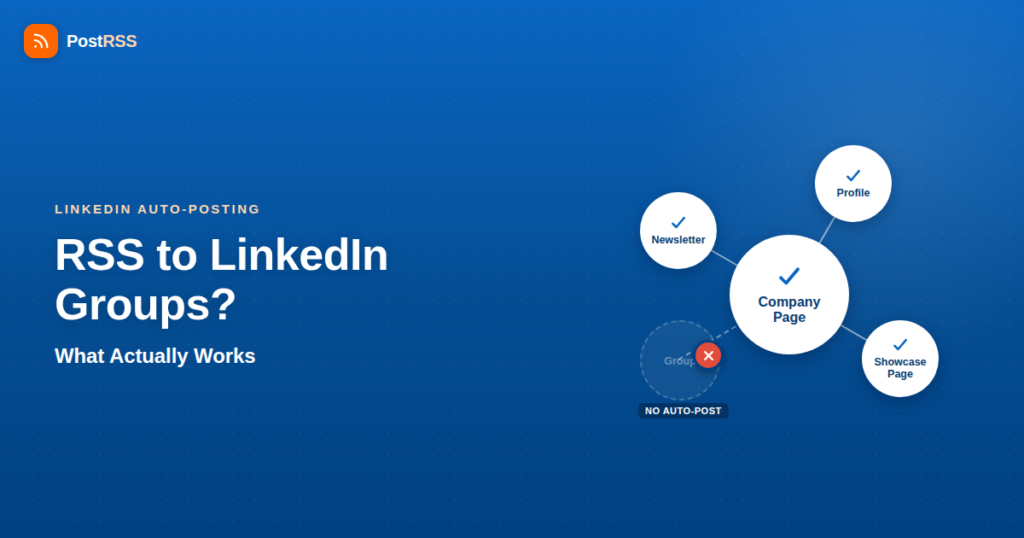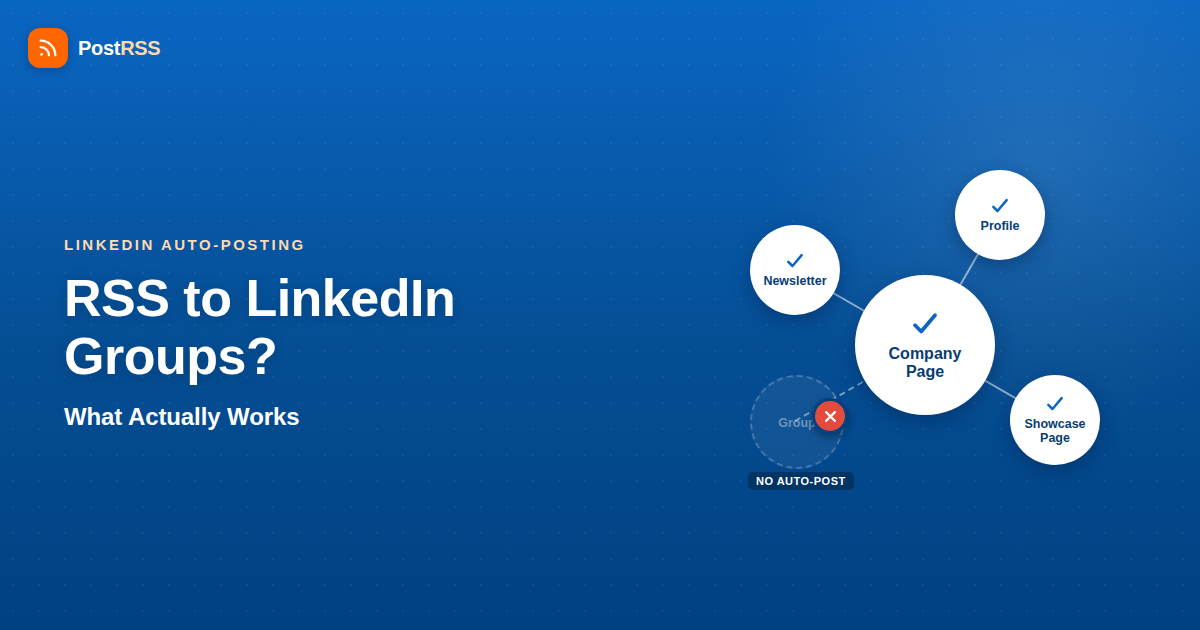
No — not directly, and not reliably. If you run a LinkedIn Group and you’re hoping to point an RSS feed at it the same way you’d point one at a Company Page or a personal profile, the honest answer is that LinkedIn’s API does not currently offer a supported way for third-party tools to publish posts into a Group on your behalf. This isn’t a PostRSS limitation, a Zapier limitation, or a Buffer limitation. It’s a LinkedIn platform limitation that applies to every automation vendor equally, because LinkedIn simply doesn’t expose the endpoint anymore.
That’s a frustrating answer if you’ve built an engaged Group around your niche and you want your blog’s new posts to show up there automatically the way they show up in your other channels. So let’s go through what actually happened to Group posting access, why LinkedIn treats Groups so differently from Pages, and what you can realistically do instead — including where automation still helps even though it can’t touch the Group directly.
LinkedIn used to have a Groups API. Early in the platform’s developer history, third-party apps could read group content and, for a period, post into groups programmatically. That access didn’t survive LinkedIn’s broader API lockdown. Starting around 2015 and accelerating through 2018–2019, LinkedIn progressively deprecated and then shut off group-related endpoints for the general developer ecosystem as part of a wider effort to control what third-party apps could do on the platform — the same wave of restrictions that also tightened profile-sharing permissions and killed off a lot of the loosely-governed “connect your LinkedIn and post anything” tools that existed in the platform’s earlier, more open years.
Today, LinkedIn’s developer platform is organized around a small number of API products, each requiring its own application and approval: the Marketing Developer Platform (organization/Company Page posting, ads), Sign In with LinkedIn, and the Community Management API (which covers organization-level posting and some profile-sharing use cases for approved partners). None of these products include a public, general-access scope for posting into a Group. If you browse LinkedIn’s current API documentation looking for a “groups.write” or equivalent permission, you won’t find one available to typical third-party integrations — it isn’t a matter of digging deeper or requesting a higher tier; the surface simply isn’t there for the vast majority of developers, RSS automation tools included.
This is worth being blunt about because plenty of marketing content on the internet still describes “LinkedIn Group automation” in vague terms that imply it’s a solved problem, or that it just requires the right paid tool. It doesn’t, and it isn’t. Any tool claiming to auto-post into LinkedIn Groups today is either using a workaround that violates LinkedIn’s Terms of Service (browser automation that simulates a logged-in human clicking “Post” — the kind of activity LinkedIn actively detects and suspends accounts over), or is quietly describing something else, like posting from your profile with a link that happens to reference a group.
It helps to understand the “why,” because it explains why this isn’t likely to change. A few things distinguish Groups from Pages in LinkedIn’s eyes:
None of this is a rumor or a guess about LinkedIn’s motivations — it’s the pattern visible in what LinkedIn has shipped (and not shipped) in its developer documentation over the past several years. The practical upshot for anyone running an RSS-to-social workflow is that LinkedIn Groups remain the one major destination on the platform that automation tools cannot reach through an official, sanctioned API path — regardless of how good the tool otherwise is at everything else.
Here’s the comparison that matters when you’re deciding where to point your RSS feed on LinkedIn:
| Destination | API auto-posting support | Typical audience | Best use case |
|---|---|---|---|
| Personal Profile | Limited/partial. Supported only through approved apps using the correct member-sharing scope; most general-purpose RSS tools cannot post to arbitrary personal profiles without a per-user LinkedIn app review, and LinkedIn restricts high-frequency automated posting from individual accounts. | Your direct connections and followers | Personal thought leadership, occasional shares — not high-frequency automated feeds |
| Company Page | Yes, reliably. This is the one LinkedIn destination with genuine, stable third-party API support (organization posting under the Marketing/Community Management APIs), which is why it’s the standard target for RSS-based tools. | Followers of the brand/organization page | Automated blog-to-LinkedIn distribution, consistent brand publishing, B2B content marketing |
| Group | No. No public API scope exists for posting into a Group as a third-party app. The only ways in are manual posting by a member/admin, or ToS-violating browser automation. | Group members only (visibility gated by group settings) | Manual, curated discussion; not a target for automated feeds |
The pattern is consistent with the rest of the platform’s API design: LinkedIn built durable, supported automation for the destination that serves its advertiser and brand-publishing business (Company Pages), gave partial and more restricted support to personal profiles, and left Groups without a public posting path at all.
If you administer or actively post in a LinkedIn Group, here’s what’s actually available to you, roughly in order of how sustainable each option is:
Because Groups are meant to be curated conversation spaces, manual posting isn’t just the only compliant option — it’s arguably the right one. A human skimming your RSS feed and choosing which items are genuinely relevant to that specific community, then adding a line of context before posting, will get better engagement than a firehose of every blog post you publish. If your Group is small enough that this is a five-minute weekly task, it’s worth just doing it by hand.
This is the most practical hybrid workflow, and it’s what most B2B teams actually end up doing. Set up LinkedIn Company Pages automation so every new blog or feed item goes out to your Page automatically and consistently. Then, for the subset of posts that are actually relevant to your Group’s specific audience, an admin manually shares that Page post (or its link) into the Group with a sentence of framing. You get consistent automated distribution on the Page, and considered, non-spammy participation in the Group — without needing an API that doesn’t exist.
Rather than trying to push content automatically into the Group, flip the funnel: use your automated Company Page and profile posts to promote the Group itself. A recurring post inviting engaged readers to join the discussion in your Group turns your existing automation into a Group-growth channel, even though it can’t publish inside the Group directly.
For active Groups, a designated moderator checking the feed source once or twice a week and posting the two or three items genuinely worth a member’s time keeps the Group from feeling both empty and spammy — the two failure modes of Group content strategy. This is manual work, but it’s bounded and predictable, unlike trying to hack together a Selenium script to fake automated posting (which risks the LinkedIn account itself, not just the automation).
Some tools market themselves as able to “auto-post to LinkedIn Groups” by running a headless browser that logs into a real LinkedIn account and simulates clicking through the UI. This isn’t API access — it’s automating a human session, which LinkedIn’s Terms of Service prohibit and which LinkedIn’s abuse-detection systems are specifically built to catch. The risk isn’t hypothetical: accounts running this kind of automation get rate-limited, flagged, or suspended, which is a much worse outcome than simply not automating Group posts at all. If a tool claims true, compliant Group auto-posting via API, that claim doesn’t match what LinkedIn’s current developer platform actually exposes.
It’s worth being equally clear about where LinkedIn automation does work well, since that’s most of what a tool like PostRSS is actually used for on this platform. LinkedIn automation through an RSS-based tool is genuinely solid for:
Personal profile posting sits in a middle zone: some approved integrations can post to an individual’s own profile with that person’s explicit authorization, but it’s a narrower, more tightly scoped permission than Page posting, and most general RSS-automation tools either don’t offer it at all or offer it in a limited form. If a platform advertises “auto-post to LinkedIn,” check specifically whether that means Company Pages, personal profiles, or both — the API realities behind each are different, and Groups, as covered above, aren’t part of that conversation at all right now.
Most teams that run both a Company Page and an active Group end up with some version of this setup:
This isn’t a workaround that pretends to be automation — it’s an honest division of labor: let software handle the channel that supports it (the Page), and let a person handle the channel that’s designed to need one (the Group).
Not through LinkedIn’s official API, no. No general-access endpoint exists for posting into a Group as a third-party application. Any tool claiming otherwise is either using unofficial browser automation that risks the connected LinkedIn account, or describing something adjacent — like auto-posting to a Page and then manually sharing into the Group.
Yes, in its earlier, more open developer-platform era, LinkedIn’s Groups API allowed broader third-party access, including posting. That access was progressively deprecated as LinkedIn tightened its API surface starting around the mid-2010s, and it hasn’t been reintroduced since.
No. LinkedIn’s current API products (Marketing Developer Platform, Community Management API, Sign In with LinkedIn) are organized around Company Pages, ads, and authentication — none of them include a Group-posting scope, regardless of approval tier or partnership level. This is a product gap in LinkedIn’s platform, not a pricing or access-tier issue.
Admin access to a Group controls what you personally can do inside LinkedIn’s own interface — it doesn’t create an API pathway for a third-party app to act on your behalf. Company Page posting works because LinkedIn built and maintains a specific API product for it. Group posting doesn’t work because no equivalent product exists, independent of what permissions you hold as a human user.
Yes. Tools that log into a real LinkedIn session and simulate UI clicks to post content violate LinkedIn’s Terms of Service around automated activity, and LinkedIn’s abuse detection is specifically tuned to catch this pattern. The realistic risk is account rate-limiting or suspension, which is a worse outcome for your presence on the platform than simply posting into the Group manually.
Yes — the value of a Group was never really about volume of posts, it’s about concentrated, on-topic discussion among people who chose to join. A smaller number of manually curated, well-framed posts tends to outperform a high-frequency automated feed in a space designed for conversation. Treat automation as the tool for your Page’s reach, and the Group as the tool for depth with a smaller, more engaged audience.
Your LinkedIn Company Page. That’s the destination with real, stable API-based automation support, and it’s what RSS-to-social tools including PostRSS are built to publish to reliably. From there, use manual sharing to selectively bring relevant posts into your Group rather than expecting the feed to reach it directly.
If you came here hoping for a tool or a setting that auto-posts your RSS feed straight into a LinkedIn Group, the honest answer is that it doesn’t exist right now, for anyone — not because automation vendors haven’t built it, but because LinkedIn hasn’t exposed the API surface to build it on. Groups are member-gated, moderator-curated conversation spaces by design, and LinkedIn’s developer platform reflects that by withholding a public posting endpoint for them, the same way it has for years now.
What does work, reliably and today, is automated posting to a LinkedIn Company Page — that’s the channel LinkedIn actually supports for third-party tools, and it’s where an RSS-based automation setup belongs. The realistic path for Groups is a hybrid one: automate the Page, and let a human selectively and briefly curate what makes it into the Group, framed for that specific audience rather than dumped in wholesale. It’s a bit more manual work than a pure “connect and forget” automation, but it also produces better Group content — which, for a space that lives or dies on member trust, matters more than posting frequency ever will.