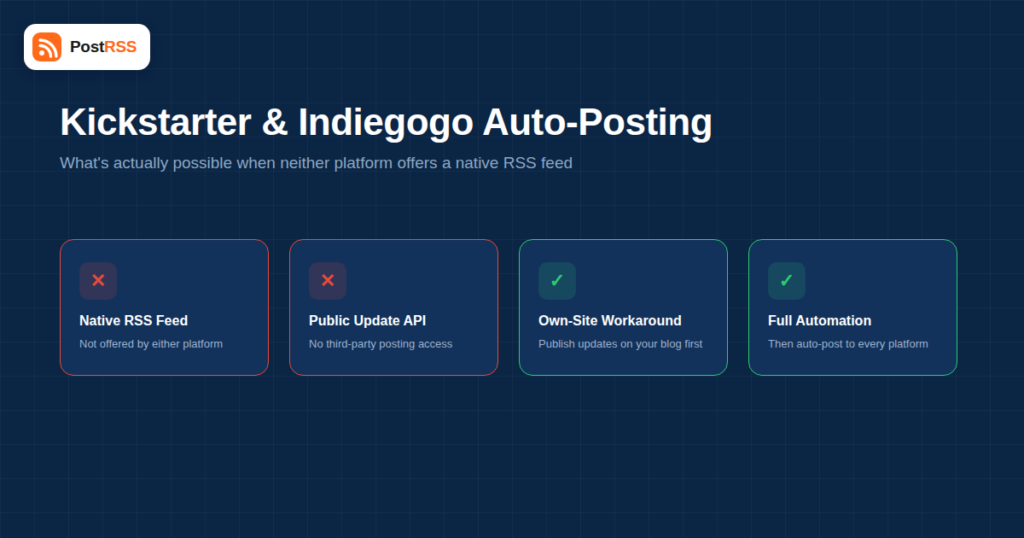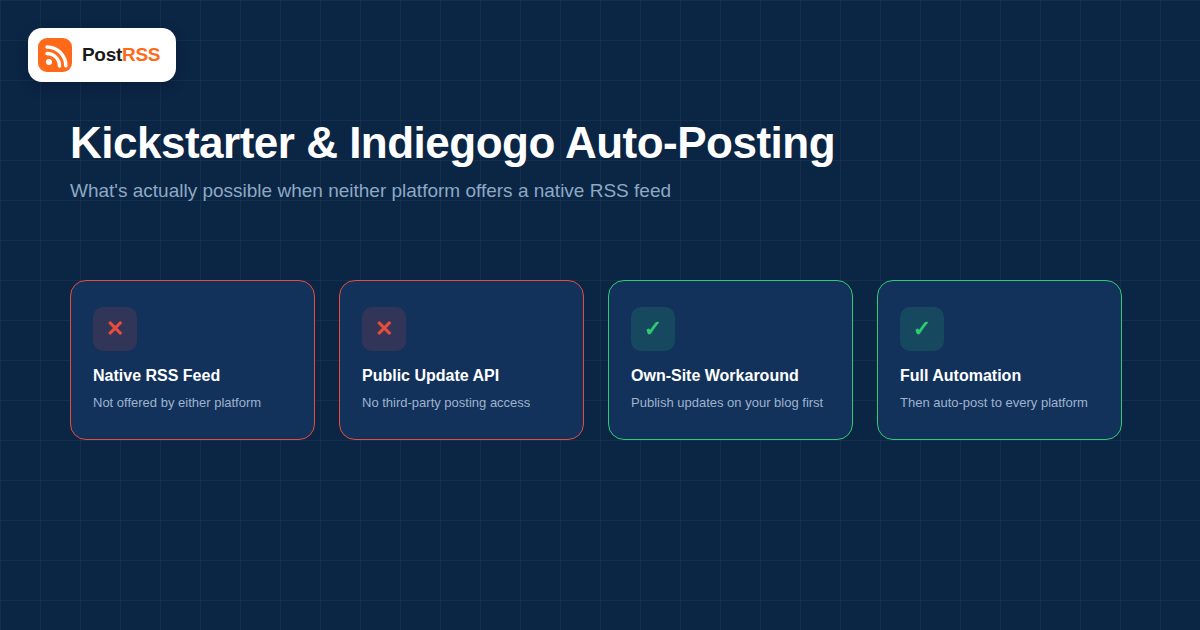
Crowdfunding creators live and die by momentum, and nothing kills momentum faster than a campaign update that goes out to backers on Kickstarter or Indiegogo but never reaches the wider audience on Facebook, X, or LinkedIn who might back the project if they just knew it existed. The obvious fix would be to treat a campaign page like a blog and auto-post every update the way you would any other RSS feed. The honest answer is that neither Kickstarter nor Indiegogo makes this as simple as WordPress or Substack do — but there are real, working ways to get most of the way there. Here’s what’s actually possible in 2026.
No, not in the straightforward sense you’d get from a blog or newsletter platform. Neither platform publishes an official, documented, per-project RSS feed that lists your campaign updates in standard XML format the way a WordPress site or a Substack publication does. This surprises a lot of creators coming from a content marketing background, because RSS feels like it should be a basic feature for any platform built around ongoing updates.
What does exist is a patchwork of third-party and community tools that generate unofficial feeds by scraping public campaign or category pages — useful for browsing new projects in a niche, but not reliable enough to build a business-critical automation workflow around, since they depend on a page structure the platform can change without notice.
Some Kickstarter creators have historically been able to generate a private feed link tied to a specific project’s update stream, shared directly with backers via email rather than published as a standard subscribe-anywhere RSS URL. This is not the same thing as a public, auto-posting-friendly feed: it’s typically scoped to backers who already pledged, may require an access token in the URL, and isn’t something Kickstarter documents or guarantees will keep working the same way release to release. Treat it as a backer communication tool, not an automation input.
| Platform | Official RSS Feed | Public API for Updates | Realistic Automation Path |
|---|---|---|---|
| Kickstarter | Not offered | No public API for third-party posting tools | Manual cross-post, or a custom webhook/scraper workaround |
| Indiegogo | Not offered | No public API for third-party posting tools | Manual cross-post, or a custom webhook/scraper workaround |
Both platforms are built around driving traffic to the campaign page itself, not around syndicating content out to other channels. That’s a deliberate product decision, not an oversight — every pledge happens on-platform, so neither company has a strong incentive to make it trivial for creators to build automated off-platform funnels.
The most reliable pattern used by experienced crowdfunding creators sidesteps the platform limitation entirely: post the campaign update on your own website or blog first — even a simple one-paragraph post — and let that trigger your existing RSS-to-social automation. You then paste the same update into Kickstarter or Indiegogo’s native update tool for backers. This takes an extra thirty seconds per update, but it means your automation is running against a feed you fully control, rather than depending on an undocumented workaround that could break at any time.
This approach has a real side benefit too: an update hosted on your own domain is fully indexable by search engines and gives you a permanent, SEO-friendly record of the campaign’s progress that isn’t locked inside a platform you don’t control.
If you’re comfortable with a more technical setup, some creators use browser automation or monitoring services that watch a specific campaign page for changes and fire a webhook when new content appears. This can work, but it’s fragile: it depends on the page’s HTML structure staying consistent, it can trigger false positives when unrelated parts of the page change, and it requires ongoing maintenance whenever Kickstarter or Indiegogo redesigns their update pages. For most creators, this is more operational overhead than the thirty-seconds-per-update habit of posting to your own site first.
| Content Type | Can Be Auto-Posted via RSS Today |
|---|---|
| Campaign update text you also publish on your own site | Yes |
| Native Kickstarter/Indiegogo update posted only on-platform | No — no public feed exists |
| Comments or backer Q&A threads | No |
| Funding milestone changes (e.g., stretch goals unlocked) | Only if you also announce it on your own site |
| New reward tier additions | Only if you also announce it on your own site |
Searching for “Kickstarter RSS feed” turns up several third-party tools and open-source projects that generate feeds from public search or category pages. These are genuinely useful for discovering new projects in a niche, but they are not built to track a single campaign’s own update stream, and relying on one as the backbone of your marketing automation is a fragile bet on a tool you don’t control and that the platform didn’t sanction.
The workaround described above — publishing updates to your own site first — takes almost no time to set up, but only if it’s in place before the campaign goes live. Trying to retrofit it during a busy launch week, when you’re also answering backer questions and watching the pledge counter, is when it tends to get skipped entirely.
Content posted exclusively inside Kickstarter or Indiegogo’s update tool disappears from view once the campaign ends and rarely gets indexed well by search engines. A parallel copy on your own site gives that content a permanent, discoverable home long after the campaign wraps up.
For creators who don’t want to maintain even a simple blog, a general-purpose automation platform can sometimes bridge the gap by watching an email inbox — many creators have campaign updates forwarded to their own email as a notification — and triggering a post from there. This is more fragile and more manual to configure than a standard RSS-based setup, and it’s worth comparing against a dedicated auto-posting tool before investing time in a custom workflow, since a purpose-built RSS pipeline is usually far less brittle than an email-parsing chain built for a different job.
Crowdfunding campaigns live and die on two windows: the first 48 hours, when the platform’s own algorithm decides how much organic visibility to give you, and the final 72 hours, when urgency drives a second wave of pledges. Both windows benefit enormously from consistent, multi-platform social presence — and both are exactly when a founder is too busy running the campaign to manually post updates everywhere by hand. Setting up the auto-posting workflow before launch day, rather than scrambling to build it mid-campaign, is the difference between it actually getting used and it becoming one more thing on a list that never happens.
Short campaigns are exactly where this workflow pays off fastest, not slowest. A 14-day Kickstarter run only has so many chances to remind people the campaign exists, and every update — a stretch goal unlocked, a new reward tier, a production milestone — is a fresh opportunity to pull in someone who missed the launch. If setting up the automation takes fifteen minutes and each update after that takes zero extra effort to distribute across four platforms, the math works out in favor of doing it even for the shortest campaigns. The break-even point is roughly two updates: after that, every additional update is essentially free reach you’d otherwise have to generate manually.
For pre-launch campaigns building an audience before the “Notify Me” page even goes live, the same principle applies even earlier — a blog documenting the product’s development, auto-posted from day one, gives search engines and social followers something to find months before the campaign itself exists.
Since Kickstarter and Indiegogo don’t expose granular referral data the way a typical e-commerce checkout would, the most practical way to measure whether auto-posted updates are pulling in traffic is to add UTM parameters to the campaign link inside each social post your automation generates, and check your website analytics (or a link-tracking layer) for clicks broken out by platform and by individual update. This won’t tell you exactly who pledged because of a specific post, but it will show you which platforms and which types of updates — funding milestones tend to outperform routine production updates — are worth prioritizing in how you word future posts.
No. As of 2026, Kickstarter does not publish an official per-project RSS feed for campaign updates. Any feed you find advertised as a “Kickstarter RSS” is either a third-party category/search feed or an unofficial workaround, not a first-party feature.
Kickstarter’s public API access for third parties is extremely limited and not designed for pulling live update content into external auto-posting tools. It’s not a practical path for most creators.
Publish each update as a short post on your own website first, then connect that site’s RSS feed to your auto-posting tool. This gives you a reliable, fully-controlled source that works exactly like any other blog automation.
No — most backers only see the platform version anyway (via email or the campaign page), and having a public version on your own site is useful for people who haven’t backed yet but are watching your progress.
Yes, if you publish the launch announcement on your own site (or trigger it manually the moment the campaign goes live) and let that feed the automation — the same pattern applies to every update after launch.
Yes. Most crowdfunding platforms, including newer entrants, follow the same pattern of keeping updates on-platform without a public RSS export, so the “publish on your own site first” workaround generalizes well beyond just Kickstarter and Indiegogo.
For most solo creators and small teams, no — the maintenance burden of a scraper that breaks every time the platform changes its page layout usually outweighs the thirty seconds saved per update by not cross-posting manually. Agencies running many campaigns at once are more likely to find the engineering investment worthwhile, since the fixed cost of maintaining a scraper gets spread across dozens of clients rather than a single campaign.
Kickstarter and Indiegogo were never built to be RSS-friendly, and that’s not changing anytime soon — both platforms want updates to stay on-platform where pledges happen. But that doesn’t mean auto-posting is off the table. Publish your updates on a page or blog you control first, connect that feed to your social accounts, and you get all the reach benefits of automation without depending on a workaround that could break the next time either platform redesigns its site.
What changed in the networks, what broke, and how to fix it before it costs you reach.