RSS to 66 social networks: Facebook, Instagram, X, LinkedIn, Telegram and more Блог Партнерська програма Контакти
If your site runs RSS auto-posting into Facebook, Instagram, X, or any other large platform, and either your business or your audience touches the EU, two pieces of EU tech regulation are worth understanding at a basic level: the Digital Markets Act (DMA) and the Digital Services Act (DSA). Neither one regulates RSS feeds or auto-posting tools directly, but both shape the platforms your automated posts land on, and that has real, practical consequences for how those platforms behave. This article covers what each law actually does, where the two are commonly confused, and — most importantly for anyone running automation — exactly where the practical impact does and doesn’t reach your own setup.
Both laws entered into force over the past several years as part of the EU’s broader push to regulate large online platforms more directly, following years of scrutiny over market dominance, content moderation practices, and algorithmic opacity. They’re often mentioned together because they were developed and enforced roughly in parallel, but they solve different problems and it’s worth keeping them separate in your head rather than treating “DMA/DSA” as one combined rule.
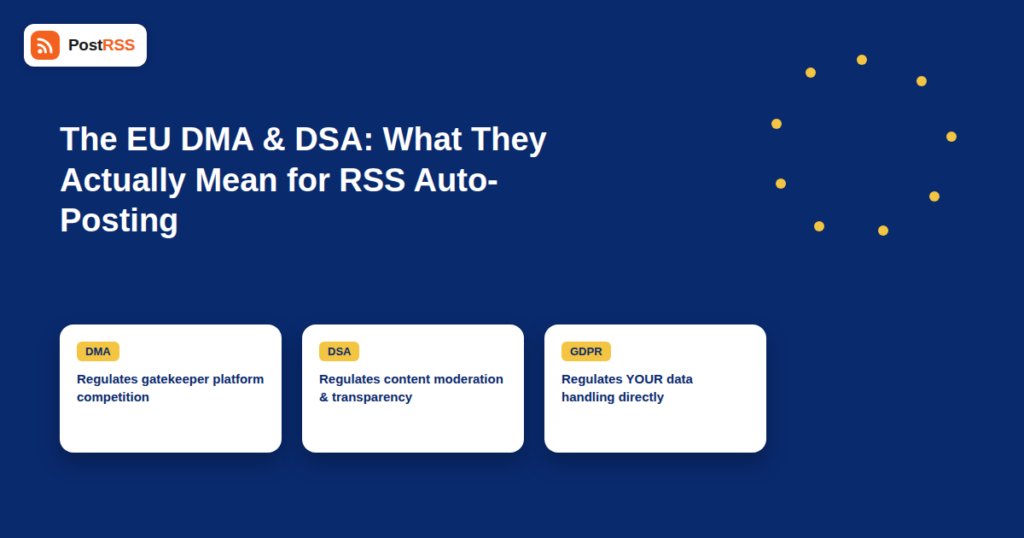
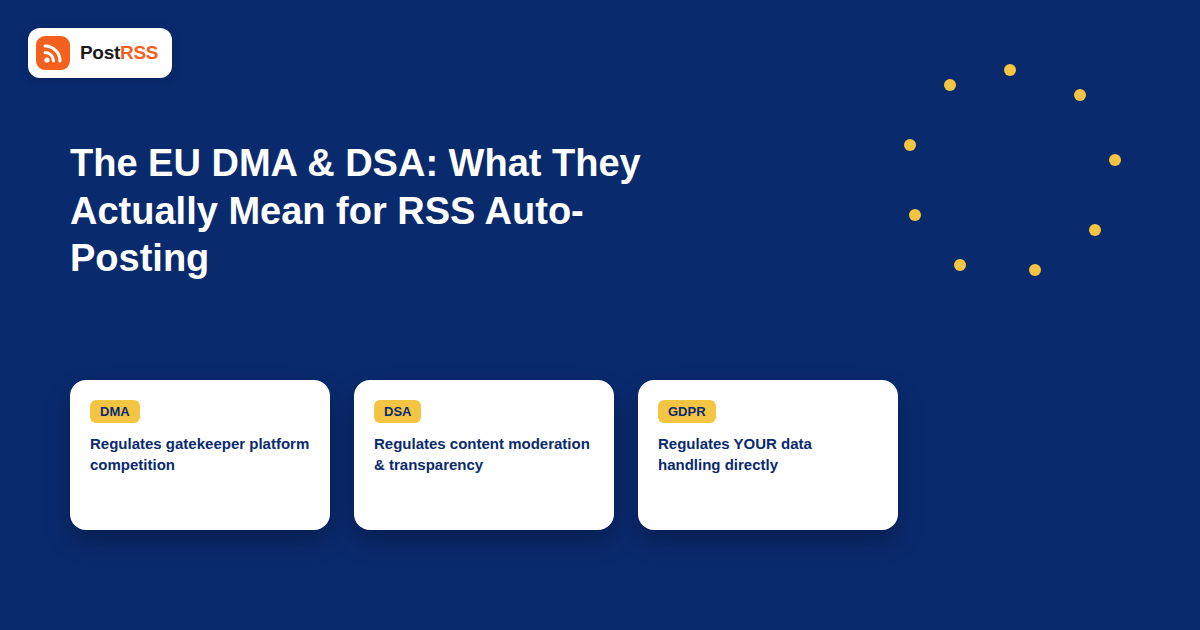
These are two separate pieces of EU legislation with different targets. The DMA regulates “gatekeeper” platforms — the small number of very large tech companies the EU has designated as having outsized market power — and focuses on competition: interoperability requirements, restrictions on self-preferencing, and limits on how gatekeepers can bundle or favor their own services. The DSA is broader and applies to a wider range of online platforms and services; it focuses on content moderation, transparency around recommendation algorithms, advertising disclosure, and user rights around content removal and appeals.
| Digital Markets Act (DMA) | Digital Services Act (DSA) | |
|---|---|---|
| Focus | Market competition, gatekeeper power | Content moderation, transparency, user rights |
| Who it applies to | Designated “gatekeeper” platforms only | A broader range of online platforms and services |
| Relevance to auto-posting | Indirect — affects platform behavior and interoperability | Indirect — affects moderation and algorithmic transparency on networks you post to |
| Who it regulates directly | The platforms themselves | The platforms themselves |
No. Neither the DMA nor the DSA imposes obligations on RSS feeds, RSS readers, or tools like PostRSS that automate posting from a feed to social networks. Both laws target the platforms you’re posting to — Facebook, X, Instagram, and similarly large services — not the publishing tools feeding content into them. If you’re running RSS auto-posting today without any DMA- or DSA-specific compliance steps, that isn’t an oversight; there generally isn’t a specific compliance obligation attached to the auto-posting side of the equation in the first place.
Part of the DMA’s goal is forcing designated gatekeepers to open up certain functionality to third parties that previously required special partnerships or approval. In practice, this has meant some platforms have had to adjust API access rules, which occasionally affects how automation tools authenticate or interact with a network. When a platform changes its API in response to regulatory pressure, that’s typically absorbed on the auto-posting tool’s side — PostRSS adjusts to a platform’s API changes the same way it would for any other platform update, regardless of whether the change was voluntary or regulatory in origin.
The DSA requires large platforms to be more transparent about how content is moderated and how recommendation algorithms rank what users see. For a site running RSS automation, this mostly shows up as slightly more visibility into why a post did or didn’t perform well — some platforms now disclose more about ranking factors than they did before the DSA took effect — rather than as a new rule you personally need to follow when publishing.
The DSA tightened rules around how platforms must label advertising and who’s shown it. If any of your auto-posted content includes paid or sponsored elements, the labeling obligation sits with however that content gets marked as an ad on the platform itself — a separate step from the auto-posting workflow, not something RSS distribution changes.
If your audience is substantially EU-based, or your business operates within the EU, you’re more likely to notice platform-level changes tied to DMA and DSA enforcement before a purely US-facing site would, simply because EU users may see different interfaces, disclosures, or interoperability options than users elsewhere. None of that changes what RSS auto-posting itself does — it still takes a new feed item and posts it to your connected targets — but it can occasionally mean feature availability or interface details differ slightly between EU and non-EU accounts on a given platform.
Since the DMA and DSA took effect, most of what site owners running RSS auto-posting have actually noticed falls into a handful of categories: platforms adding new consent prompts or interface changes visible mainly to EU users, occasional API adjustments tied to gatekeeper obligations under the DMA, and more detailed ad-transparency labels appearing on sponsored content under the DSA. None of these changes required a publisher to file paperwork, register with a regulator, or alter their auto-posting configuration — they surfaced as platform updates that any automation tool, PostRSS included, adapts to the same way it adapts to any other unannounced platform change. If you’ve been running auto-posting through this period without incident, that’s the expected outcome, not a sign you’ve been non-compliant with something you missed.
It’s worth contrasting this with GDPR, which does place direct obligations on site owners — consent for tracking, data processing agreements, the right to access and delete personal data. GDPR compliance is something a site owner actively implements: cookie banners, privacy policies, data handling procedures. The DMA and DSA don’t have an equivalent direct-obligation layer for publishers; they’re aimed at reshaping how the platforms themselves operate. If you’re looking for a regulation-driven checklist to apply to your own RSS auto-posting setup, GDPR is where that checklist actually exists — the DMA and DSA simply don’t generate one for the publisher side of the equation.
Occasionally a platform will publicly attribute an API or feature change to DMA or DSA compliance — this has happened with messaging interoperability requirements and some data-portability features. If a target you’re posting to announces a change like this, the practical response is the same as for any platform update: confirm your connection still authenticates correctly, watch for any new permission prompts during reconnection, and check whether the change affects posting behavior specifically (most don’t, since interoperability and portability obligations tend to target the platform’s core product rather than its posting or publishing API). Auto-posting tools that integrate directly with a platform’s API, including PostRSS, handle these adjustments as ordinary maintenance rather than requiring the publisher to do anything beyond normal reconnection if a target ever prompts for it.
No. Neither law places compliance obligations on RSS auto-posting tools or the sites using them. Any effects are indirect, showing up as changes to how the platforms themselves behave.
The DSA governs how platforms moderate and disclose information about content, not what an individual publisher is permitted to post. Standard platform content policies still apply the same way they did before the DSA, and auto-posted content is treated no differently than manually posted content once it reaches the platform.
It’s possible in principle if a platform changes its API in response to a DMA ruling, but this would be handled the same way any other platform-side API change is handled — PostRSS adjusts its integration, and you wouldn’t need to take any action beyond normal reconnection if a target ever requires it. This has historically been rare and disruptive changes of this kind are the exception rather than the norm.
No — GDPR is a separate, older regulation focused specifically on personal data protection. It’s the regulation most directly relevant to a site owner’s own compliance obligations; the DMA and DSA target large platforms’ market behavior and content practices instead, and the three laws are enforced independently of one another.
Both laws primarily target the large platforms’ obligations toward EU users, regardless of where the platform or the publisher posting to it is based. A non-EU business posting to EU users through a covered platform may still see platform-level effects, even without being directly regulated itself.
Possibly, if the platform itself applies different labeling or transparency disclosures to EU accounts — that’s a platform-level decision, not something RSS auto-posting controls or changes on its end.
No — the DMA specifically targets designated “gatekeeper” platforms that the European Commission has formally named, based on scale and market position. Smaller platforms and services fall outside that designation and aren’t subject to the same obligations.
It’s not impossible in principle, since regulation evolves, but as of now both laws are structured around platform-level obligations rather than publisher- or tool-level ones. If that changed, it would be a significant shift from the current framework rather than an incremental extension of it.
The DMA and DSA regulate the big platforms you’re posting to, not the RSS feed or automation tool doing the posting. If you’re running RSS auto-posting today, there’s no new compliance checklist specific to these two laws that applies to your workflow — the practical impact, when there is one, shows up as a platform-side change (an API adjustment, a new disclosure requirement, a labeling rule) that PostRSS and other tools absorb on their end. The regulation genuinely worth tracking for your own site’s obligations remains GDPR, since that’s the one that actually governs what you do with user data, not what a platform does with its market power or its content moderation. If you’re posting to EU audiences and want a general rule of thumb: watch your own data-handling practices closely, and treat platform-level regulatory changes as something to notice and adapt to if they surface, rather than something to proactively audit your auto-posting setup against.
What changed in the networks, what broke, and how to fix it before it costs you reach.
 English
 Lietuviškai
 Deutsch
 Français
 Русский
 Español
 Polski
 Italiano
 Українська
 Čeština
 Português
 日本語
日本語 Latviešu valoda
 Eesti
Eesti Magyar
 Bahasa Indonesia
 Türkçe
 हिन्दी
 Ελληνικά
 العربية
 ไทย
ไทย Tiếng Việt
 Română
 Bahasa Melayu
 বাংলা
বাংলা