RSS у 66 соціальних мереж: Facebook, Instagram, X, LinkedIn, Telegram та інші Блог Партнерська програма Контакти
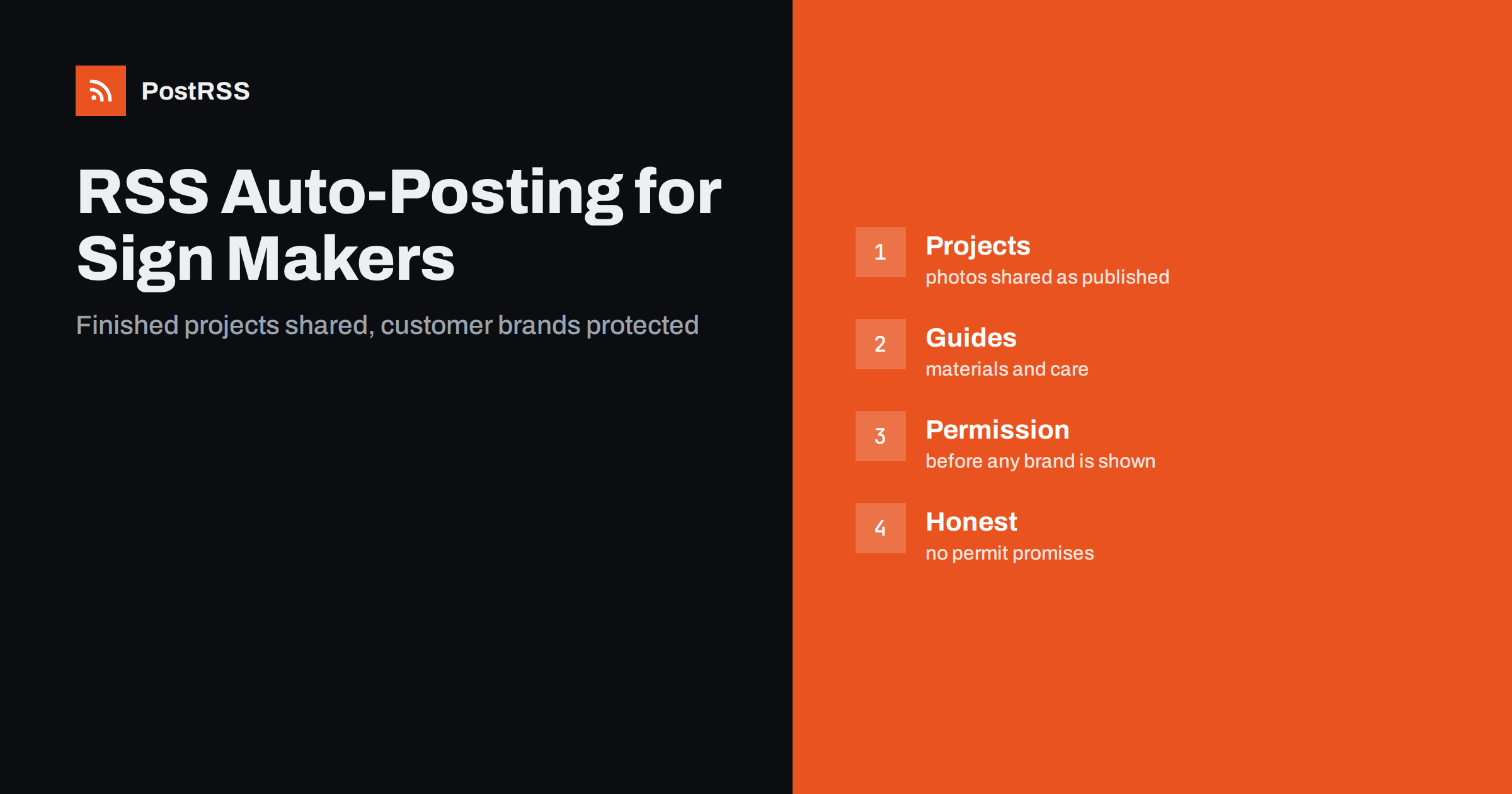
Short answer: RSS auto-posting lets sign makers and signage companies share finished projects, product pages, installation guides, permit tips and seasonal offers on social media automatically. Publish each item as a page on your website, let an auto-poster read the feed, and every new page appears on your Facebook Page, LinkedIn page, Pinterest boards and other networks with its photo and link. Local businesses, property managers and event organizers see real work, and the posts stay accurate because customer names, unapproved artwork and promises about permits or delivery dates are kept out of every automated post.
Signs are among the most visible products a business can buy, and they are also among the most visual. A new storefront sign, a set of vehicle graphics, a wayfinding system for a clinic or a banner for a festival is a photograph waiting to be shared. Yet most sign shops are busy with design proofs, production schedules and installation crews, and the website and social media pages are updated when someone finds time. A feed removes that dependency. Whenever a new project page, product page or guide is published on the website, the auto-poster picks it up and sends a post with the photo and a link. This guide explains what a sign maker can publish, how to organize categories, where to be careful with customers and regulations, and how to connect everything in an afternoon.
The advice suits many kinds of businesses that design, make and install visual communication:
Each has a different audience, but the website is the natural source for every channel.
The raw material is already in your files. Most of it needs only a photograph and a few honest sentences:
Every page is a post. A photograph of a finished channel-letter sign at dusk says more than a paragraph of promises, and it appears on social networks without anyone having to upload it again.
Most sign shops already use a system that produces feeds:
/feed/ and one for every category, such as /category/storefront-signs/feed/. If you are unsure of the address, see how to find your WordPress feed link.Use categories to separate topics: storefront signs, vehicle graphics, banners, interior signage, guides and news. Each category has its own feed, and each feed can go where it works best. Pinterest boards suit finished projects, LinkedIn suits wayfinding and corporate work, and a Facebook Page suits local customers. Routing by category is explained in category filtering for auto-posting.
| Content | Automate? | Notes |
|---|---|---|
| Finished project pages with photos | Yes | After the customer agrees to be shown |
| Product pages and ordering guides | Yes | Sizes, materials and lead times that are always true |
| Care and maintenance guides | Yes | Evergreen advice |
| Seasonal and event offers | Yes | Add the end date to the page |
| Customer artwork and brand proofs | No | Belongs to the customer until approved |
| Permit details and legal advice | No | Rules differ by location |
A simple rule: if a page helps many future customers choose a sign, automate it. If it concerns one customer’s unreleased brand, one permit file or one private price, it needs a private conversation.
A sign carries a brand, and a brand belongs to its owner. Before you publish a project, check that the customer agrees to be shown, particularly when the job involves a new logo, a rebrand that has not been announced or a location that has not opened. Put the permission in your order terms so that it becomes a routine step and not a special request. Remove anything that is not meant to be public: the street address of a new store, the name of the person who approved the proof or the price of the job. Photograph the finished sign in good light, and check the picture for people, license plates and neighboring brands that should not appear. If you show a mockup, label it as a design proposal and not as an installed sign. A page built on permission protects the relationship that brings repeat work.
Sign rules differ widely: local councils and cities set limits on size, height, lighting, materials and placement, and some districts require approval for every change. A guide that says what is allowed in one town may be wrong in the next. Write general guides that explain how to find the rules, who to ask and what information the authority is likely to need, and avoid statements such as this sign is legal everywhere or no permit is required. In the same way, be modest about structural, electrical and wind-load claims. State the standard you follow only if it applies, and leave engineering decisions to the people who are qualified and responsible for them. Warranties and lifetime estimates need the same honesty: say what the manufacturer states and under which conditions. Accurate pages build trust with property managers and public bodies, who read your claims closely.
Photographs of finished work do most of the selling, and the text should help a buyer decide. Name the type of sign, the materials, the size and the setting. Explain the reason behind a choice, such as why a halo-lit letter was used for a building with a dark facade. Keep each page focused on one project or one question and finish with a clear way to ask for a quote. A feed uses the title, the summary and the featured image of each page, so write a title that reads well in a post and add a featured image that is sharp and shows the whole sign. Avoid pages that consist only of a gallery with no words, because a post with no context attracts likes but not requests.
Demand for signs follows the calendar of other businesses. New businesses open in spring, restaurants and shops refresh their look before the holidays, events need banners weeks in advance, and political and charity campaigns have fixed dates. Plan pages a little ahead of each wave: a vehicle graphics series before the delivery season, banner guides before the event season, window graphics before the holidays. Use the scheduling features of your website to prepare pages in advance and let the feed announce them when they go live. Choose posting hours in the time zone of your customers, and keep working hours in mind if you want people to call.
Most shops do best with a Facebook Page and Pinterest, plus the website and a quote form that works. Two active channels beat five forgotten ones.
/feed/, and check that it lists recent pages with their photographs.PostRSS has been automating RSS posting since 2014. It checks your website feeds as often as every minute and publishes each new page, with its real image and link, to the channels you connect, from Facebook Pages and Pinterest to LinkedIn, Bluesky, Telegram and many more among its 66 supported networks. You can choose how each post is built, filter items by keywords, add UTM parameters and post only within chosen hours or at exact times in your time zone. See the PostRSS features page for everything it does and the pricing page for plan limits. More ideas for local businesses are under the Local Business tag.
A sign maker sells visibility, so a business that makes signs should be easy to see. RSS auto-posting shares every project, product page, guide and seasonal offer automatically, as soon as it is published on your website. Get permission before showing a customer’s work, keep unreleased artwork and private prices out of posts, do not make promises about permits, write captions that name the materials and the setting, track the results with UTM parameters and let your hours go to design and installation and not to the keyboard.
Yes. If your website has a projects or news section, its RSS feed can be connected to an auto-poster that shares each new page on Facebook, Pinterest, LinkedIn and other channels with its photograph.
Pinterest and a Facebook Page work well because the content is visual. LinkedIn helps for corporate and wayfinding work. Start with two channels and add others later.
It is wise to ask. A sign carries a brand, and some projects are not public yet. Add permission to your order terms and remove private details such as prices.
Write general guides that explain how to find the local rules and who to ask. Rules differ by place, so avoid claims that a sign is allowed everywhere.
Yes. PostRSS reads any valid RSS or Atom address that is reachable without a login. Paste the address, connect your channels and new pages are shared as soon as they appear.
What changed in the networks, what broke, and how to fix it before it costs you reach.
Створено Internet Solutions — командою PostRSS. Кожен продукт заощаджує ваш час по-своєму.
 English
 Lietuviškai
 Deutsch
 Français
 Русский
 Español
 Polski
 Italiano
 Українська
 Čeština
 Português
 日本語
 Latviešu valoda
 Eesti
 Magyar
 Bahasa Indonesia
 Türkçe
 हिन्दी
 Ελληνικά
 العربية
 ไทย
 Tiếng Việt
 Română
 Bahasa Melayu
 বাংলা