RSS у 66 соціальних мереж: Facebook, Instagram, X, LinkedIn, Telegram та інші Блог Партнерська програма Контакти
Short answer: choose PostRSS networks by the goal of your feed, not by how many the plan lists. For business-to-business reach, start with LinkedIn, Bluesky and Mastodon. For a local business, use a Facebook Page and a Telegram channel, with Pinterest for visual trades. For developers, add Mastodon, Discord, Matrix and the developer blog platforms. For creators and publishers, use Pinterest, Threads, Tumblr and your own blog platforms. PostRSS supports 66 networks, and most goals need only three to five of them.
The number 66 sounds impressive, and it is easy to read it as a task: connect everything. That is the wrong way to use it. Every network you add is a channel that needs a clear purpose, a fitting message and an audience that actually reads it. A feed that goes to twelve networks without a plan produces twelve weak channels. A feed that goes to four networks chosen for a goal produces four strong ones. This guide groups the networks that PostRSS supports by what people try to achieve, names the plan that unlocks each group and gives a short method for choosing. The lists are taken from the live pricing and features pages of PostRSS at the time of writing, and those pages remain the source to trust.
Write down one sentence: what should the posts do? Examples are bring buyers from the region to the shop, reach decision makers in a field, build a community of users, drive readers to a blog or keep the team informed. The sentence decides the networks. A shop that wants local buyers has little use for a developer chat, and a software team that wants contributors gains little from a Page for local families. Once the goal is clear, the choice becomes a matter of matching.
Then ask three practical questions. Where does the audience already spend time? Does the network show links and pictures in a way that suits your content? Can you keep an eye on replies? The last one matters, because PostRSS posts for you but does not answer comments. A channel that nobody watches is a risk, however easy it was to connect.
For business-to-business content the core is LinkedIn. PostRSS can post to a LinkedIn profile and to a company page, and it is available from the Professional plan. Add Bluesky and Mastodon, which are available on every plan, including Free as its single target, and which have active communities of professionals in technology, science and media. X is available from the Professional Plus plan and suits short alerts in fields where people follow hashtags. For internal audiences, a webhook target sends each new item to Slack or Microsoft Teams, and the team chat networks include Microsoft Viva Engage, Google Chat and Webex. Webhooks are included from the Start plan.
A local business wins with proximity, pictures and regular news. The Facebook Page is the main channel, since local people look there for opening hours, offers and events. PostRSS posts to Pages only, not to personal profiles or groups, because Meta closed that interface in 2024. A Telegram channel suits regulars who want the news on the phone, and it is available on every plan. Pinterest boards help visual trades such as food, decoration, crafts and weddings, and they are available from the Professional plan. Google Business Profile is on the list as well, currently labelled as being tested, which means that it is built and waits for the app approval of the platform. Do not plan around it until the label disappears.
Technical communities live in open and self-hosted places. Mastodon and Bluesky are strong for this audience. Discord and Matrix suit chat communities, and both are available from the Start plan. The Fediverse list adds Misskey, Pixelfed, Lemmy and PieFed and Nostr, and the blog and publishing list includes DEV and Forem, Ghost, Discourse and Micro.blog. Team chat tools such as Mattermost, Rocket.Chat and Zulip can receive release notes, which is handy for open-source projects. Qiita and Hatena Blog serve Japanese developers and are available from the Professional plan. This is the goal with the widest range of niche networks, and most of them are on the Start plan.
Creators care about discovery and about sending readers to their own site. Pinterest is strong for pictures that stay useful for months. Threads and Tumblr suit short posts and visual stories. Bluesky and Mastodon reach readers who like to follow people. If you publish text, the blog platforms can carry a copy of your article: WordPress, Blogger, Ghost, WriteFreely, Telegraph and others are on the list, and some, such as Telegraph and Blogger, are available from Start. Reading queues such as Instapaper, Readwise Reader and Are.na are an unusual group: they save your items for readers who want to read later. TikTok is on the Professional list as a draft in the TikTok app, so it works for creators who finish the post by hand.
Audiences in other regions use other networks. PostRSS supports VKontakte, Draugiem.lv, MAX, Viber, LINE, WeChat, Feishu, DingTalk, WeCom, Hatena Blog, Livedoor Blog, FC2 Blog and the Persian-language channels Bale, Eitaa and Rubika, among others. Most of them are available from the Professional plan, and WeChat from Professional Plus. OK.ru and BAND are being tested. If you want to reach a country, learn which network its people use before you assume that everyone is on the same platforms as you. PostRSS posts the words of your feed, so write in the language of the audience. The site and the web app are available in 25 languages.
Not all posts are public. A company, a school or a club may want its news to appear in a chat that people already use. The team chat group has thirteen networks, and the messaging group has Telegram, Discord, Viber and more. Many of the team chat tools are available from the Start plan, which makes this the cheapest goal to serve. For a public community, a Telegram channel or a Discord server is the usual choice.
Knowing the limits saves time. PostRSS does not post to Facebook groups or personal profiles, because Meta closed the Groups publishing interface in April 2024. Instagram is on the list but labelled as being tested, and Reddit is labelled as temporarily unavailable. Read the label next to a network before you promise it to a client or build a plan around it. The article on which plan supports which platform gives a longer overview.
| Plan | Цілі | Goals it serves well |
|---|---|---|
| Безкоштовний | 1 | Test one channel: a Facebook Page, a Telegram channel, Bluesky or Mastodon |
| Старт | 1 | One focused channel from 35 networks, including Discord, Matrix, team chats and blogs |
| Professional | 10 | LinkedIn, Pinterest, Threads, regional messengers and several channels at once |
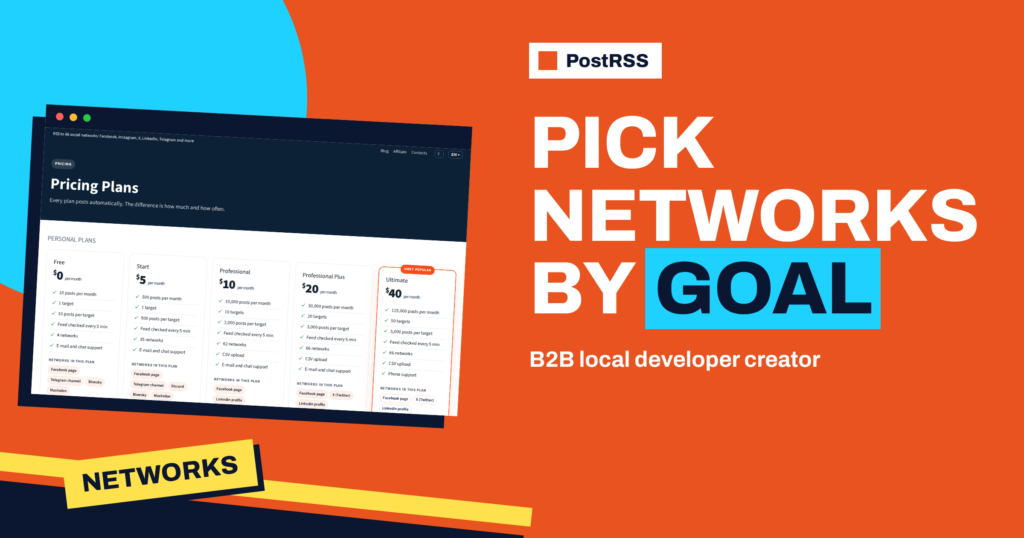
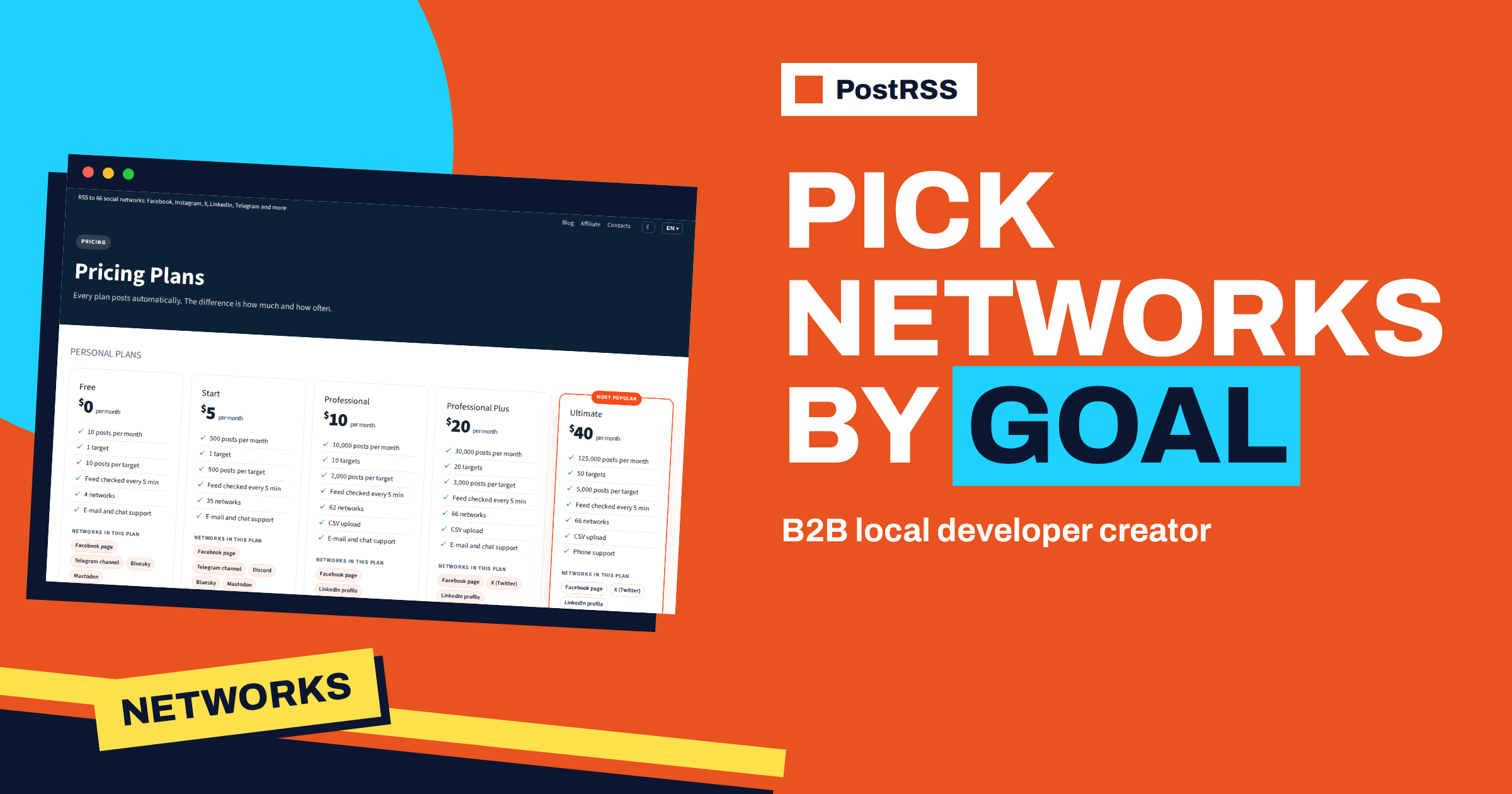
| Professional Plus | 20 | X, WeChat and all 66 networks, with room for several brands |
The numbers of posts and targets are on the pricing page. Remember that each item published to one target counts as one post, so a feed that goes to five targets uses five posts for each article.
The article on choosing the right plan extends this method to the plan itself.
A goal rarely uses a network in the same way as another. With keyword filters on each source, you can send the product news to LinkedIn, the offers to the Page and the technical notes to Mastodon from one feed. Filters search the title, the description and the categories, and items that a filter removes are not posted and do not count against the allowance. The guide to include and exclude keyword filters explains the matching rules.
Goals change, and so do audiences. Once a quarter, open your analytics and the reports of PostRSS and ask which networks send readers and which only fill the allowance. Add your own query parameters to the links, with a source name for each network, to see the difference. Drop a channel that nobody reads, and use its target for one that works. The article on tracking RSS automation with UTM parameters shows a simple scheme.
A dental practice wants local patients. It uses a Facebook Page for news and offers, and a Telegram channel for patients who prefer messages. Two targets, no more. The practice avoids professional networks, because patients are not looking for dentists on them.
A software tools company wants users and contributors. It posts release notes to Mastodon and Bluesky, to a Discord channel for the community and to a Matrix room for open-source contributors, and it sends the same feed through a webhook to its internal chat. Because most of these networks are available from Start, the company can test the setup at a low level before moving up for LinkedIn.
A food blogger wants readers who come back. She posts each recipe to Pinterest boards by dish type, to a Facebook Page and to Threads, and she copies the article to a blog platform. Three or four targets, a plan from Professional upwards, and filters that send desserts to the dessert board.
Many accounts have more than one goal: a shop that wants local buyers and also wholesale partners, a club that wants members and visitors. Do not mix the goals in one channel. Give each its own source and target, with filters that keep the content apart, so that the wholesale news goes to LinkedIn and the offers to the Page. The extra target costs a place in the plan, but the channels stay clear, and clear channels are easier to measure and to improve.
The right network list is the shortest one that serves your goal. Decide what the posts should do, match two or three networks to it, check the plan and the labels, and let filters give each channel the content it needs. Add more only when the first channels run well. The full list is on the features page, and the plans are on the pricing page.
66 networks, plus webhooks for Slack, Microsoft Teams, Zapier, Make and n8n. Which of them you can connect depends on your plan.
The Free plan posts to one target: a Facebook Page, a Telegram channel, Bluesky or Mastodon.
LinkedIn profiles and pages are available from the Professional plan. X comes with the Professional Plus plan.
No. PostRSS posts to Facebook Pages only, because Meta closed the Groups publishing interface in April 2024.
As few as serve your goal. Two or three well chosen and watched networks usually do more than a dozen that nobody reads.
What changed in the networks, what broke, and how to fix it before it costs you reach.
Створено Internet Solutions — командою PostRSS. Кожен продукт заощаджує ваш час по-своєму.
 English
 Lietuviškai
 Deutsch
 Français
 Русский
 Español
 Polski
 Italiano
 Українська
 Čeština
 Português
 日本語
 Latviešu valoda
 Eesti
 Magyar
 Bahasa Indonesia
 Türkçe
 हिन्दी
 Ελληνικά
 العربية
 ไทย
 Tiếng Việt
 Română
 Bahasa Melayu
 বাংলা