RSS у 66 соціальних мереж: Facebook, Instagram, X, LinkedIn, Telegram та інші Блог Партнерська програма Контакти
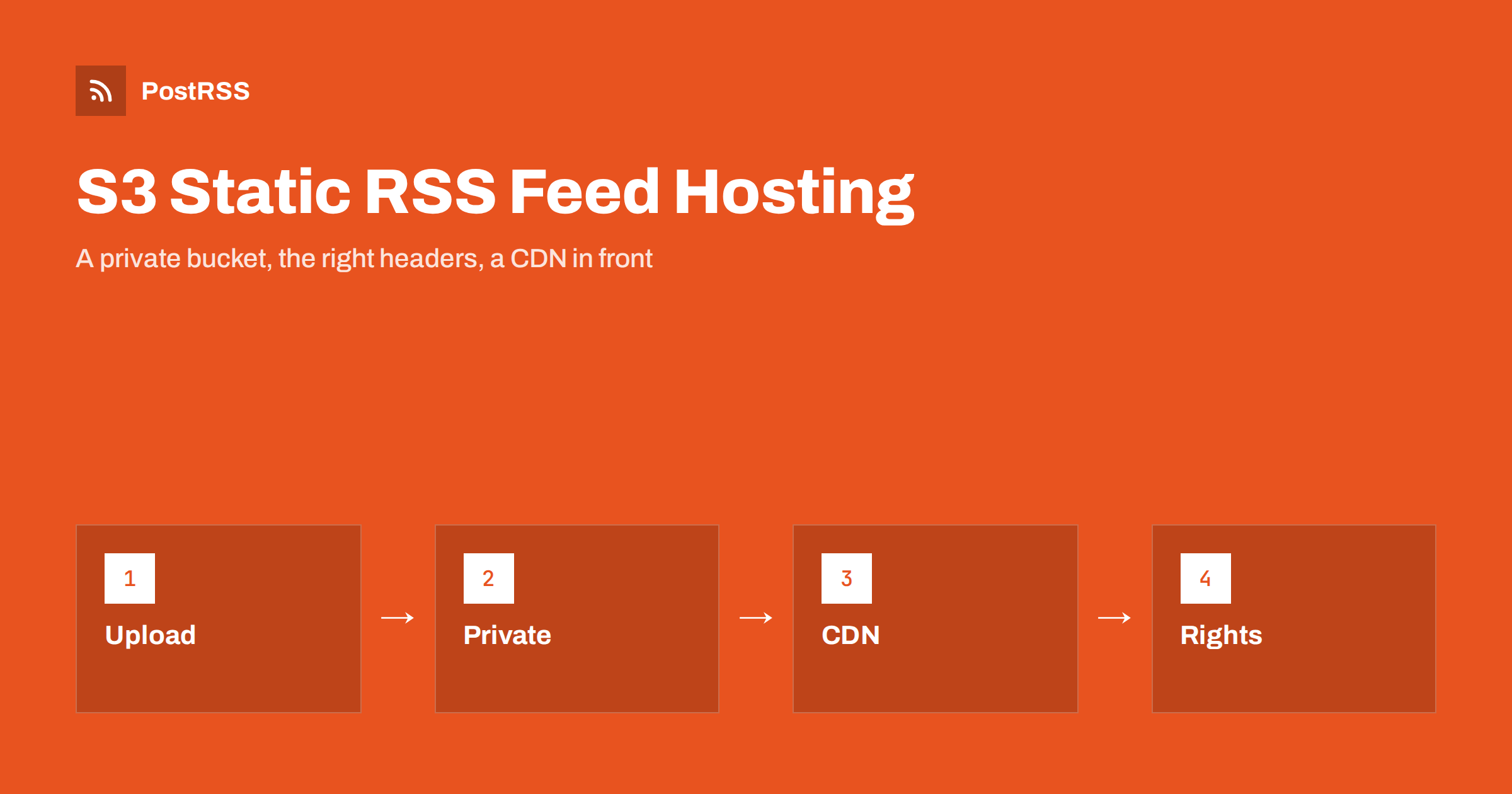
Short answer: Amazon S3 can host a static RSS feed cheaply and reliably, if you set the right metadata when you upload it. Generate the XML with a script, upload it with the RSS content type and a short cache lifetime, keep the bucket private and let a content delivery network read it, because the plain website endpoint of a bucket offers no secure connection. Give the uploader an access policy that can write one object only, keep old addresses alive with redirects, never compress the stored file for clients that did not ask for it, test the headers with curl and then connect the public address to an auto-poster so that every new article reaches your social channels.
Many feeds do not need a server. If your articles come from a static site generator, a content system with a publish hook or a script that reads a database, the feed is a single file that changes a few times a day. Object storage is built for exactly that: it holds the file, serves it to anyone, scales without effort and costs very little for a small document. Amazon S3 is the best-known service of this kind. The catch is that a storage bucket is not a web server. It does not know that your file is an RSS feed unless you tell it, it does not compress for you, its website endpoint speaks only plain HTTP and its permissions are easy to get wrong in both directions: too open, or so closed that tools see an error. This guide shows a complete set-up in simple steps, explains the settings that matter and lists the mistakes that cause stale or unreachable feeds.
A static feed has several advantages. There is no application to patch, no database to protect and no process that can crash at night. The load is predictable, because the same small file is returned to every request. The storage service handles validators for you, so tools that send a conditional request receive a short answer when nothing changed. And the cost is tiny: a feed of a few hundred kilobytes read thousands of times a day is a trivial amount of data. The price you pay is that the feed is only as fresh as your last upload, so the publishing process must upload a new file whenever content changes. For a site that publishes a few times a day, that is easy to arrange.
| Setting | Where it lives | Recommended value |
|---|---|---|
| Content type | Object metadata, set at upload | RSS type with UTF-8 charset |
| Cache lifetime | Object metadata, set at upload | A few minutes |
| Public access | Bucket policy or origin access | Private bucket read by a CDN |
| Secure connection | Content delivery network | HTTPS with your own domain |
| Uploader rights | Access policy | Write one object only |
| Compression | Content delivery network | Automatic for feed types |
Create a bucket in the region that suits you and leave the setting that blocks public access switched on. This is the default for new buckets, and it protects you from the classic mistake of exposing files by accident. The bucket will hold only a few files: the feed itself and, if you wish, redirect objects for old addresses. A private bucket does not mean a private feed. The feed becomes public through a content delivery network that has permission to read the bucket, which is described below. Choose a bucket name that does not reveal anything sensitive, because names are part of the address of the origin.
Storage serves whatever metadata is stored with the object. If you upload a file without a content type, it may be served as a generic binary type, and many tools will refuse to treat it as a feed. Set the type and the cache lifetime in the same command.
aws s3 cp feed.xml s3://example-feed-bucket/feed.xml --content-type "application/rss+xml; charset=utf-8" --cache-control "public, max-age=300"The type is the one that tools expect, as explained in the guide to the content type header. The cache header tells browsers and networks to keep the file for five minutes. If you upload from a script, use the same two values in the call of your library. Note that the sync command applies a guessed type from the file extension, which for an xml file is not the RSS type, so for the feed file use the copy command with an explicit type, or add a rule for the file.
import boto3
s3 = boto3.client("s3")
s3.put_object(
    Bucket="example-feed-bucket",
    Key="feed.xml",
    Body=xml_bytes,
    ContentType="application/rss+xml; charset=utf-8",
    CacheControl="public, max-age=300",
)
Upload the finished document in one call. Storage replaces the old object only when the new upload completes, so readers never see a half-written file. That removes the need for the temporary file trick that is required on a normal disk.
The credentials that your publishing process uses can be stolen from a build server, a laptop or a log. Limit the damage by giving them the right to write one object and nothing else. The policy below allows the upload of the feed file and nothing more.
{
  "Version": "2012-10-17",
  "Statement": [
    {
      "Effect": "Allow",
      "Action": ["s3:PutObject"],
      "Resource": "arn:aws:s3:::example-feed-bucket/feed.xml"
    }
  ]
}
If you need several feeds, list each one or use a folder prefix. Prefer short-lived credentials from a role over a long-lived key, and store any key you must use in a secret store, never in the repository. A person who obtains write access to a feed can inject text and links that every auto-poster will faithfully share, which is described in the guide to feed security.
The website endpoint of a bucket serves only plain HTTP. Modern tools and browsers expect HTTPS, and a feed address that starts with an insecure scheme may be refused or flagged. The standard solution is to place a content delivery network in front of the bucket, attach your own domain name and certificate and let the network read the private bucket through an access identity that you control. The network also adds compression and a cache that absorbs repeated requests. The settings for a feed behind such a network are covered in the Cloudflare Workers guide for one provider, and the same ideas apply to the others: a short lifetime, no query strings in the cache key and no bot rules that block polling tools. Never make the bucket public just to avoid this step, because a public bucket exposes every object that you ever put in it.
An XML feed is repetitive text and shrinks to a fraction of its size when compressed. Storage does not compress responses on the fly. You can store a compressed object with a content encoding header, but then every client receives compressed bytes, even a tool that did not ask for them, and some will fail. It is safer to store the plain file and let the content delivery network compress it for clients that accept it. Background on size and speed is covered in the feed compression guide. If the feed grows large, reduce the number of items at the source: readers and auto-posters need only the latest ones.
Storage returns an ETag and a Last-Modified date for every object, and it answers a matching conditional request with a 304 status and no body. That saves bandwidth and processing for every tool that polls the feed. The mechanism is described in the guide to ETags and conditional requests. One detail needs attention: if you upload the same content again, the validator may stay the same, which is fine, but if your generator inserts a build timestamp, every upload changes the file and every reader downloads it again. Take the last build date from the newest item, not from the clock.
Keep one address for the feed and use it everywhere: in the link tags of your pages, in your notes and in the auto-poster. If an old address must keep working, create a small object at the old key with a redirect target in its metadata, or use the redirect rules of the website configuration, or handle the redirect in the content delivery network. Point each old address directly at the final one, because a chain of two or three redirects is a common reason for a feed that works in a browser and fails elsewhere. The meaning of each status is explained in the guide to feed status codes.
The last piece is the trigger. For a static site generator, add an upload step to the build that runs after the feed is created. For a content system, use a publish hook that generates the XML and calls the upload. For a scheduled job, run the generator on a timer, as described in the guide to a static feed with a cron script. Whatever you choose, make the step fail loudly if the new file has no items, so that an empty feed never replaces a good one, and send an alert when the upload fails. A feed that silently stops updating is worse than an error, because nobody notices for days. If you use a serverless function for the generation, the guide to a feed on Lambda shows a similar flow from the other side.
curl -sI https://feeds.example.com/feed.xml
curl -sI -H 'Accept-Encoding: gzip' https://feeds.example.com/feed.xml
curl -sI -H 'If-None-Match: paste-the-etag-here' https://feeds.example.com/feed.xml
curl -sI http://example-feed-bucket.s3.amazonaws.com/feed.xmlA longer routine is in the feed validation guide, and a shorter one in debugging a feed with curl.
PostRSS has been publishing RSS and Atom feeds to social networks since 2014. Paste the address of your feed, connect your accounts and choose how each post is built from the title, the description or the page title. PostRSS checks the feed as often as every minute and shares each new entry, with its image and link, to the channels you choose among 66 supported networks, messengers, team chats and blogs, including LinkedIn, X, Bluesky, Mastodon and Telegram. Keyword filters, UTM parameters and posting windows let you tune each channel. See the PostRSS features page and the plan limits on the pricing page. More developer guides are under the Technical Guide tag.
Object storage gives a static feed a home that needs no server care. Keep the bucket private, upload the file with the RSS content type and a short cache lifetime, give the uploader the right to write one object, serve the feed through a network that provides HTTPS and compression, keep old addresses alive with redirects, refuse to replace a good feed with an empty one and alert yourself when an upload fails. Test the public address from outside, then connect it to an auto-poster, so that every article you publish reaches your social channels without surprises.
Yes. Upload the XML file with the RSS content type and a short cache lifetime, keep the bucket private and serve the file through a content delivery network that provides HTTPS.
The object probably has a generic content type. Upload it again with the RSS type and a UTF-8 charset in the metadata, and check the answer headers with curl.
The website endpoint of a bucket serves plain HTTP only. Put a content delivery network with your own domain and certificate in front of the bucket to get HTTPS.
Give them the right to write only the feed object, prefer short-lived role credentials, store any key in a secret store and review who can run the publishing job.
Yes. PostRSS reads any valid RSS or Atom address that is reachable without a login. Paste the public address, connect your channels and new articles are shared as soon as they appear.
What changed in the networks, what broke, and how to fix it before it costs you reach.
Створено Internet Solutions — командою PostRSS. Кожен продукт заощаджує ваш час по-своєму.
 English
 Lietuviškai
 Deutsch
 Français
 Русский
 Español
 Polski
 Italiano
 Українська
 Čeština
 Português
 日本語
 Latviešu valoda
 Eesti
 Magyar
 Bahasa Indonesia
 Türkçe
 हिन्दी
 Ελληνικά
 العربية
 ไทย
 Tiếng Việt
 Română
 Bahasa Melayu
 বাংলা