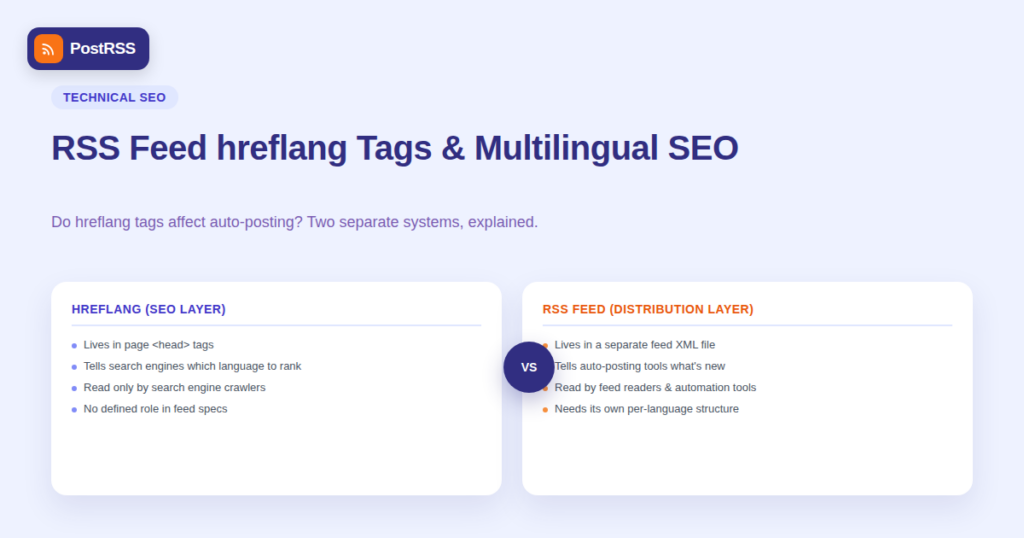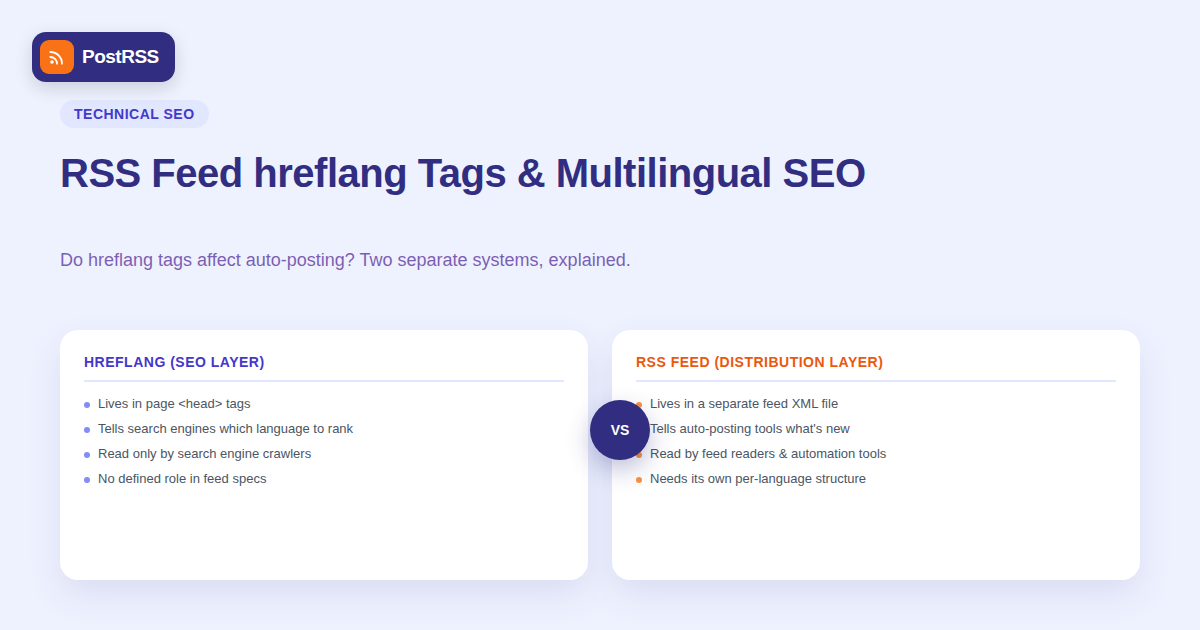
Sites running content in multiple languages often ask the same technical SEO question once they start automating distribution: does hreflang — the tag search engines use to serve the right language version of a page — have any bearing on how an RSS feed gets read or auto-posted? The short answer is that hreflang and RSS operate in almost entirely separate systems, but the way they intersect still matters for anyone running multilingual auto-posting. This guide covers exactly where the two connect, where they don’t, and how to structure a multilingual feed setup correctly.
This question tends to come up at a specific moment: a site has already invested in proper multilingual SEO — hreflang tags, translated URLs, localized content — and is now looking at extending that same content to automated social distribution. The instinct to check whether the two systems need to be reconciled is a reasonable one, even though the actual answer turns out to be more about parallel structure than direct technical dependency.
The hreflang attribute is an HTML link tag (or HTTP header) that tells search engines which language and regional variant of a page to show a given searcher — for example, telling Google that a French-Canadian visitor searching in French should see /fr-ca/ instead of the default /en/ version of the same content. It lives in your page’s <head> as a set of <link rel="alternate" hreflang="x"> tags, one per language/region variant, pointing at each other so search engines can map the full set of equivalent pages together.
Crucially, hreflang is a pure search-indexing signal. It has no defined role in RSS, Atom, or any feed specification — feed readers, podcast apps, and auto-posting tools don’t parse or act on hreflang tags at all, because feeds and hreflang solve completely different problems: hreflang tells Google which URL to rank for which searcher, while RSS tells a subscriber (human or automated) “here’s what’s new.”
Since hreflang doesn’t touch feeds directly, the real question for multilingual sites is how to structure RSS itself so an auto-posting tool sends the right language content to the right audience. There are two common patterns:
| Pattern | Nasıl Çalışır? | Best For |
|---|---|---|
| Separate feed per language | Each language has its own dedicated feed URL (e.g. /en/feed, /fr/feed) | Sites with distinct audiences per language/region |
| Single combined feed, language field per item | One feed includes all languages, with a <language> or custom tag per item | Smaller sites, unified content calendars |
The separate-feed pattern is almost always the better choice for auto-posting specifically, because it maps cleanly onto how social accounts are usually structured — most brands running multiple languages also run separate social accounts per language or region, and pointing each language’s feed at its matching social account is far simpler than trying to filter a combined feed by language inside your posting tool.
No, not directly — your auto-posting tool reads your RSS feed’s structure and items, not your page-level hreflang tags, which live in the HTML of the destination pages, not in the feed XML itself. However, there’s an important indirect connection: if your hreflang implementation is broken (missing return tags, incorrect language codes, or pages that don’t actually match), that’s a signal your underlying multilingual page structure is inconsistent — and inconsistent page structure often also means an inconsistent or incomplete feed setup, since both usually come from the same content architecture. Auditing one is a good prompt to audit the other.
/fr/blog/, your feed should live at a matching /fr/feed path).<language> channel tag to the correct locale code (e.g. fr-CA) so any tool that does read this field gets accurate metadata, even though it’s not required for basic auto-posting to function.| Mistake | Consequence | Fix |
|---|---|---|
| One feed for all languages, no language field | Auto-posting tool can’t distinguish languages; posts go to wrong accounts | Split into per-language feeds or add a reliable language field |
| hreflang tags present but feed URLs not mirrored | SEO structure and content distribution structure diverge, causing maintenance drift | Keep feed URL patterns consistent with your hreflang URL patterns |
| Missing self-referencing hreflang tag | Search engines may not correctly register the language cluster | Every language version needs a tag pointing to itself, not just to the others |
| Auto-translated feed titles without matching page translations | Social post links to a page that doesn’t match the posted language | Only auto-post from feeds where the underlying pages are genuinely translated |
Indirectly, yes. Auto-posting from a well-structured, correctly-separated multilingual feed setup means your social traffic lands on the correct language version of a page — which reinforces the same signals hreflang is trying to establish (that this URL is the right one for this language/region audience). Sending French-speaking social followers to an English URL because your feed wasn’t properly separated undermines both the user experience and the consistency search engines look for when evaluating whether your hreflang implementation is trustworthy. Think of a well-mapped multilingual feed setup as an extension of your SEO architecture into social distribution, rather than a separate, unrelated workflow bolted on afterward.
Most hreflang implementations include an x-default value alongside specific language/region tags, telling search engines which version to show visitors whose language doesn’t match any of your explicit variants. This matters for multilingual RSS planning because it usually maps to your “default” or primary feed — the one your multilingual automation setup should treat as the fallback source when deciding which social accounts get broader, less region-specific content versus which get a translated, localized version.
A common practical pattern: run your x-default language’s feed into your primary/global social accounts, and run each localized feed into that region’s dedicated accounts. This mirrors exactly how hreflang itself is structured — one default plus explicit regional overrides — which keeps your automation logic intuitive for anyone maintaining it later.
It’s worth distinguishing hreflang from canonical tags, since they’re often confused and both intersect with feed structure in different ways. A canonical tag tells search engines which single URL is the authoritative version when near-duplicate content exists at multiple URLs — useful for things like tracking-parameter variants of the same page. Hreflang, by contrast, explicitly tells search engines that multiple URLs are intentionally different language versions of equivalent content, not duplicates to be consolidated. Getting these confused — for example, canonicalizing all language variants back to one URL — will actively break multilingual SEO, and by extension will make separate-language RSS feeds pointless, since search engines would stop treating the translated pages as distinct, rankable content in their own right regardless of how well-structured your feeds are.
No — hreflang is an HTML/HTTP mechanism for indexable pages, not a feed-level concept. Feeds use their own <language> tag if you want to declare locale, which is a separate, optional piece of metadata.
No, they’re independent systems — your auto-posting tool doesn’t check hreflang before reading a feed, so a hreflang issue won’t break automation, though it likely points to a broader content structure problem worth fixing anyway.
Separate feeds per language are almost always easier to manage for auto-posting, since they map directly onto separate social accounts and avoid needing to filter a combined feed by language inside your automation tool.
No — properly implemented hreflang tags explicitly tell search engines that translated variants are intentional, equivalent versions rather than duplicate content, so correctly structured multilingual content (with or without RSS automation layered on top) isn’t penalized.
Yes — most tools, including PostRSS, support connecting multiple separate feeds simultaneously, which is exactly the setup recommended above for handling several languages cleanly.
Use the same locale code your hreflang tags use (like fr-CA veya en-GB) for consistency, following standard ISO language and region codes rather than inventing your own format.
No — hreflang tags can appear in any order in the page head, and RSS feed items are read by publish date rather than list order, so neither system depends on a specific sequencing beyond what’s already standard practice for each.
It’s reasonable to wait until you actually publish a second language, since implementing hreflang for a single-language site adds unnecessary complexity — but it’s worth designing your feed URL structure with future language expansion in mind, so adding a second language later doesn’t require restructuring your existing feed.
This usually confuses a single, mixed-language audience and can look like duplicate spam to platform algorithms, even though the underlying pages are correctly differentiated for search engines. Keep language-specific auto-posting mapped to language-specific accounts, or a language-segmented audience within one account if your platform supports audience targeting by language.
No — search engines validate hreflang purely through the HTML link tags (or HTTP headers) on the indexed pages themselves, not through any feed. RSS and hreflang can be audited together as good practice, but they’re checked through entirely separate crawling and validation processes.
If you’re inheriting a multilingual site with existing content and want to confirm both systems are correctly aligned before turning on auto-posting, work through this in order:
Running through this once at setup avoids the most common failure mode in multilingual automation: technically correct hreflang, technically correct feeds, but a mismatched mapping between the two that sends the wrong language content to the wrong audience.
hreflang and RSS auto-posting operate in separate technical layers — one is a search-indexing signal for pages, the other is a content-distribution mechanism for feeds — and neither directly reads or depends on the other. Where they genuinely connect is in site architecture: a clean, correctly mirrored URL and feed structure per language makes both your hreflang implementation and your auto-posting setup easier to maintain, while a messy combined approach tends to create problems in both places at once. Structure per-language feeds to match your hreflang URL pattern, and multilingual automation stays straightforward, with each region’s social presence reinforcing exactly the same language signals your SEO setup is already sending to search engines.