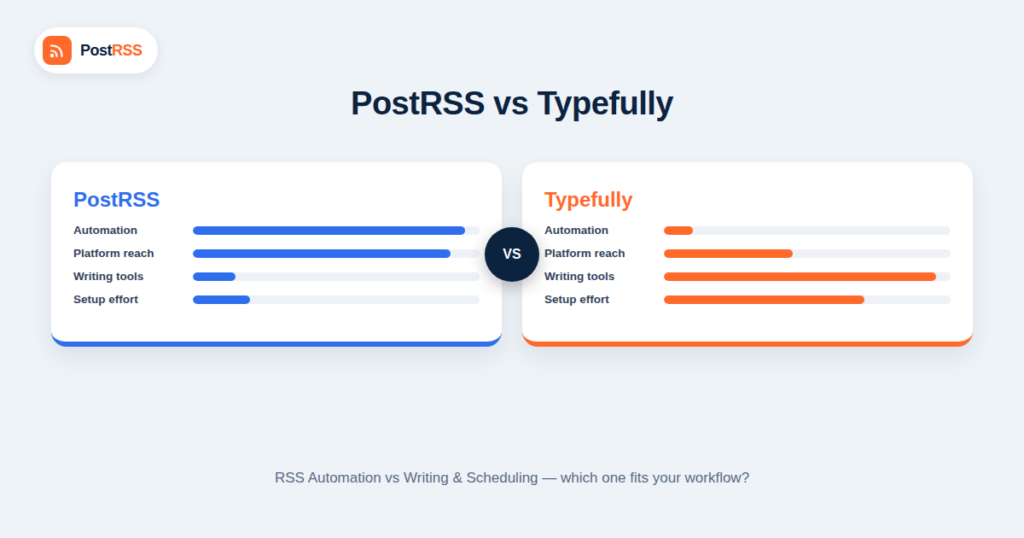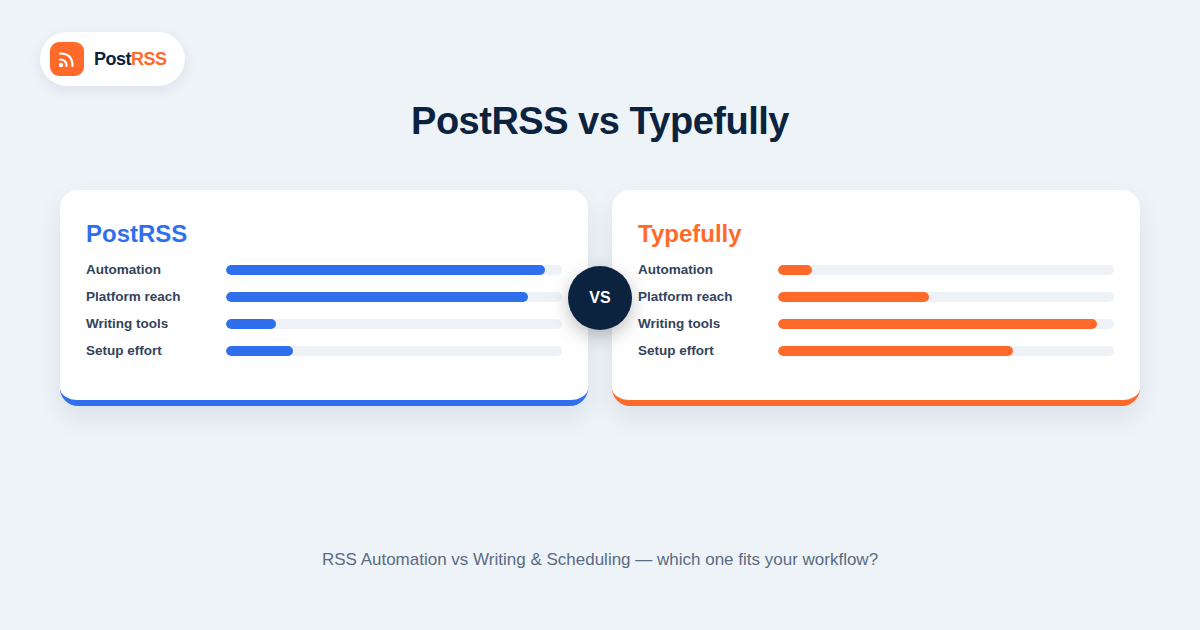
Typefully and PostRSS both show up in searches for “best X scheduling tool,” but they solve almost opposite problems. One is a writing environment built for people who compose original threads by hand and want them to look polished before they go out. The other is an automation engine built for people who’d rather never manually post at all. Confusing the two leads to disappointment either way, so here’s a straight comparison of what each tool is actually for.
Typefully started as a distraction-free writing tool specifically for composing X threads, and that writing-first identity still defines it. Its core workflow is: you open a clean composer, write a thread (or a single post) by hand, use its built-in AI suggestions and readability tools to tighten the copy, preview exactly how it’ll look before publishing, then schedule it into a visual queue. Over time it expanded beyond pure X composition to support cross-posting the same handwritten content to Threads, LinkedIn, Mastodon, and Bluesky, along with analytics that track how individual posts and threads perform.
The entire product assumes a human is writing the content. There’s no concept of pointing it at a data source and having it generate posts on its own — every post in Typefully exists because someone typed it, even if AI helped polish the wording.
PostRSS starts from the opposite assumption: you already have a content source — a blog, a WordPress site, a podcast feed, a YouTube channel, a Google Sheet — and you want new items from it to reach your social accounts automatically, with zero manual composition per post. Connect a feed once, map it to your Facebook, X, LinkedIn, Pinterest, VKontakte, Telegram, or other connected accounts, and every new item gets turned into a post and published or scheduled without anyone touching a compose box again. It’s built for consistency and coverage across many platforms and, often, many content sources, rather than for crafting any single post.
Beyond the core composer, Typefully has built out a set of features aimed squarely at people who write frequently and want to write better: a “Focus mode” that hides everything except the text you’re working on, AI-assisted hooks and rewrites for the opening line of a thread (often the single biggest driver of whether a thread gets read at all), a visual content calendar for planning out weeks of posts in advance, and creator-oriented analytics that show which specific lines or hooks correlated with higher engagement over time. It also supports collaboration features so a small team can draft and review posts before they go out, and browser extensions that let you save ideas or article snippets as draft starting points.
None of this is designed to reduce the number of posts a human has to originate — if anything, it’s designed to make originating posts more frequent and more effective, by removing friction from the writing and refinement process itself.
PostRSS’s feature set points the opposite direction: reducing the number of manual actions required per post to as close to zero as possible. That means feed monitoring on a short polling interval so new items go out quickly after publishing, mapping rules so different feeds or categories can route to different social accounts, image handling that pulls the right picture from a feed item automatically, staggered scheduling so ten new items don’t all blast out in the same minute, and duplicate-detection so an edited or re-fetched feed item doesn’t get posted twice. Multi-account support means a single feed can fan out to accounts across many platforms simultaneously, which matters for publishers maintaining a presence on five or six networks without a team dedicated to managing each one by hand.
For an agency or a multi-brand operation, the choice tends to sort itself out by client type. A personal-brand or thought-leadership client who wants a distinctive voice on X benefits from Typefully’s writing tools, because the value is in the specific wording and hook of each post. A publisher, e-commerce brand, or content-heavy client with a steady stream of blog posts, product updates, or press releases benefits from PostRSS, because the value is in reliable, hands-off coverage across platforms rather than in any individual post’s phrasing. Agencies managing both types of clients often end up running both tools, matched to the right account rather than trying to force one tool to do both jobs.
| Feature | Typefully | PostRSS |
|---|---|---|
| Core workflow | Manual composition with AI writing assistance | Automatic feed-to-post conversion, no manual writing |
| Content source | You, typing directly into the app | RSS/Atom feeds, WordPress, YouTube, Google Sheets, and more |
| Primary platforms | X (Twitter), Threads, LinkedIn, Mastodon, Bluesky | Facebook, X, LinkedIn, Pinterest, VKontakte, Telegram, Discord, Mastodon, Bluesky, and more |
| Thread writing tools | Yes — dedicated thread composer and splitting | No — posts are generated from feed items, not authored threads |
| Analytics | Per-post and account-level engagement analytics | Distribution and posting logs, not engagement analytics |
| Best for | Individual writers, founders, and creators publishing original thoughts | Blogs, publishers, and businesses distributing existing content at scale |
| Manual effort per post | High — every post is hand-written | Near zero after initial setup |
Both tools can get content onto X and a few other networks, and both offer a queue/scheduling concept — but the similarity mostly ends there. Typefully’s queue is a calendar of posts you wrote; PostRSS’s schedule is a cadence for auto-publishing items your feed produces on its own. If you tried to use Typefully to replace an RSS automation workflow, you’d be manually retyping every blog post as a thread — exactly the repetitive work automation exists to remove. If you tried to use PostRSS to replace Typefully’s writing workflow, you’d find there’s no composer at all, because that’s simply not the product’s job.
Typefully prices around its writing and analytics tooling — you’re paying for a better composing experience, AI assistance, and performance insight into content you create yourself. PostRSS prices around distribution volume — how many feeds, accounts, and posting tasks you need automated per month — since the value it delivers scales with how much content you’re moving automatically, not with how polished any single post is. Neither pricing model is “better”; they reflect genuinely different jobs.
Yes, and it’s a genuinely sensible combination for a founder or creator who also runs a blog. Use Typefully for the handwritten, personal-voice threads and takes you want to publish yourself — launch announcements, opinions, behind-the-scenes commentary — and let PostRSS handle the mechanical job of making sure every new blog post, podcast episode, or product update goes out to your other social accounts automatically, without competing for your writing time. The two tools aren’t rivals for the same job; they’re complementary pieces of a full content-distribution setup.
It’s worth being honest about the trade-off rather than pretending automation is a strict upgrade. A hand-written Typefully thread, refined with AI suggestions and tested against what’s worked before, will usually out-perform an auto-generated post on a pure engagement-per-post basis — there’s no substitute for a genuinely well-crafted hook written by someone who knows the audience. What automation trades for that is coverage and consistency: PostRSS won’t ever forget to post, won’t skip a platform because someone’s busy that week, and won’t require ongoing time investment as your publishing volume grows. For a single flagship account, the hand-written approach often wins per post. For maintaining reliable presence across many accounts and platforms tied to a busy content calendar, automation wins in aggregate, simply because the alternative is realistically “post less often or hire someone to do it manually.”
Typefully is built around manual composition rather than automatically converting an RSS feed into posts — its AI features assist with writing and formatting content you create, not with generating posts from an external feed on a schedule.
No — PostRSS doesn’t include a writing composer or AI copy assistant. It formats feed items (title, excerpt, image, link) into posts automatically; it isn’t designed for hand-crafting individual thoughts or threads.
It depends what you need. If you’re only writing and scheduling a handful of original posts a week, Typefully’s plans are built for that scale. If you’re distributing dozens of automatically-generated posts across multiple platforms and feeds, PostRSS’s volume-based pricing is the more relevant comparison.
PostRSS can auto-post feed items to X (Twitter), but it doesn’t offer a thread composer or the writing-focused tooling Typefully is built around — the X integration serves distribution, not composition.
It can work if someone is willing to manually turn each blog post into a thread or post by hand, but most company blogs publish more frequently and across more platforms than manual composition scales well for, which is the gap automation tools like PostRSS are built to close.
Yes, but the scheduling serves different content: Typefully schedules posts you wrote, while PostRSS schedules the cadence at which auto-generated posts from your feed go out, including staggering multiple items across the day.
There’s nothing to migrate in the traditional sense since they store different things — Typefully holds your drafted and scheduled posts, while PostRSS holds your feed connections and platform mappings. Most users who adopt both simply run them side by side rather than switching entirely from one to the other.
Typefully’s focus stays on text-first, thread-friendly networks — X, Threads, LinkedIn, Mastodon, and Bluesky — rather than visually-driven platforms. PostRSS’s broader distribution model extends to Pinterest and other visually-oriented networks, since it’s built to fan a single feed out across as many connected platforms as an account has set up, rather than being scoped to text-based writing.
It can, if it’s the only thing posting to an account with no human voice mixed in. Most accounts that combine both approaches — automated distribution for coverage, occasional handwritten posts for personality — avoid that feeling better than relying on either approach exclusively.
Before signing up for a paid plan on either tool, it’s worth spending ten minutes confirming a few things: which platforms you actually need covered (Typefully’s platform list is narrower and text-focused, PostRSS’s is broader and includes visual and messaging platforms), how much of your content already exists in a feed versus needs to be written from scratch, and whether your team has the bandwidth to keep a manual writing habit going consistently. A tool that assumes daily manual writing only pays off if that writing actually happens; an automation tool only pays off if you have a genuine, regularly updated source feeding it. Mismatching either tool to your actual habits is the most common reason people end up disappointed with a scheduling tool regardless of which one they picked.
Typefully and PostRSS aren’t competing for the same use case, even though they both touch X and scheduling. Typefully makes you a better, faster writer for content you create yourself; PostRSS removes the need to write or post manually at all for content your feed already produces. If you’re choosing one, match it to whether you’re publishing your own original thoughts or distributing an existing content stream — and if you’re doing both, there’s no real conflict in running them side by side.