RSS ke 66 rangkaian sosial: Facebook, Instagram, X, LinkedIn, Telegram dan banyak lagi Blog Afiliasi Hubungi Kami
Dikemas kini: 2026-08-20
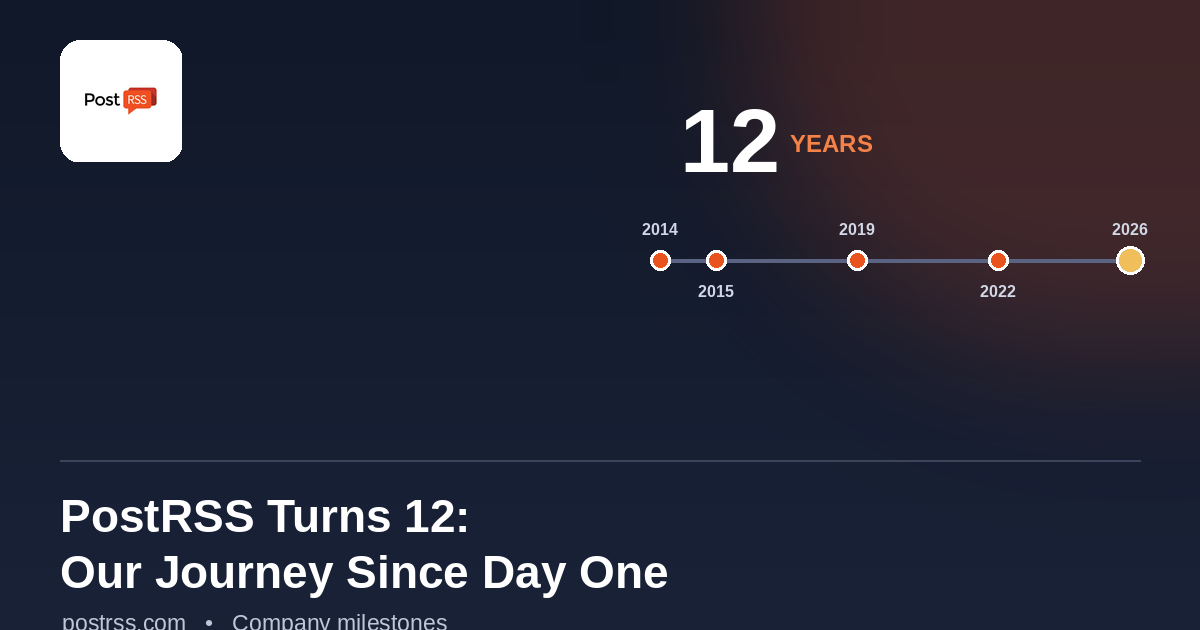
On January 10, 2015, PostRSS celebrated its very first birthday — one year of helping website owners and publishers automatically share their RSS content across social networks. At the time, we marked the occasion by opening up extra free features for our early customers as a thank-you for being part of the journey from the start.
More than a decade later, that first birthday post is still on our blog — a small time capsule from when PostRSS was a one-year-old service finding its footing. It felt like the right moment to look back at how far the platform has come since then, and what’s carried through from those early days to today.
PostRSS launched in 2014 with a simple, focused idea: let people connect an RSS feed once, and automatically share new content to social platforms — instead of manually copying links and captions every time something new got published. In that first year, the core supported destinations were the platforms that mattered most at the time: Facebook pages, and early support for other emerging social networks.
The first-birthday update in January 2015 was about generosity during that early growth phase — giving existing customers access to more free features as a way of building trust and loyalty with the people who’d signed up when the service was brand new.
A lot has evolved since 2015, both in the social media landscape and inside PostRSS itself:
Despite all the changes in the platforms PostRSS connects to and the plans it offers, the core idea from day one hasn’t changed: your RSS feed should be able to do the work of getting your content in front of your audience, without you manually re-posting the same update five different times across five different apps.
That’s still exactly what PostRSS does — connect a feed, choose your destinations, and let automation handle distribution reliably in the background.
Looking back over more than ten years of RSS automation also offers a useful perspective for anyone building a long-term content strategy today:
The idea is the same as in 2014, but the toolbox around it has grown. A few of the things a PostRSS account can do today that simply did not exist in the first year:
Every one of these additions came from the same question users have been asking since the first birthday: how do I get my content out everywhere, looking right, without doing it by hand? You can see the full list on our features page.
From a one-year-old service handing out bonus features to its earliest customers, to a platform supporting 66 networks, including Facebook, X, LinkedIn, Pinterest, Threads, Bluesky, Mastodon, Telegram, Discord, Tumblr, VKontakte, Matrix, Webhook and Instapaper across a full range of plans built for solo creators and enterprises alike — PostRSS’s growth has tracked the broader evolution of social media itself.
If you’ve been a PostRSS user since those early days, thank you for growing with us. And if you’re just discovering RSS automation now, the same core promise from 2014 still holds: connect your feed once, and let your content reach your audience everywhere it needs to be — automatically.
PostRSS launched in 2014, and celebrated its first birthday on January 10, 2015. It has been running continuously ever since.
PostRSS publishes to 66 networks, from Facebook Pages, X, LinkedIn and Telegram to Mastodon, Bluesky, WordPress and team chats, plus webhooks for Slack, Microsoft Teams, Zapier and n8n.
Yes. The Free plan posts to one Facebook Page with up to 10 posts per month, and paid plans from Start to Enterprise add more posts, targets and networks.
Setiap 5 minit pada semua pelan, termasuk Free, dan setiap minit pada pelan Enterprise. Anda juga boleh memilih selang yang lebih jarang, sehingga sekali seminggu.
What changed in the networks, what broke, and how to fix it before it costs you reach.
Dibina oleh Internet Solutions, pasukan di sebalik PostRSS. Setiap produk menjimatkan masa anda dengan cara tersendiri.
 English
 Lietuviškai
 Deutsch
 Français
 Русский
 Español
 Polski
 Italiano
 Українська
 Čeština
 Português
 日本語
日本語 Latviešu valoda
 Eesti
Eesti Magyar
 Bahasa Indonesia
 Türkçe
 हिन्दी
 Ελληνικά
 العربية
 ไทย
ไทย Tiếng Việt
 Română
 Bahasa Melayu
 বাংলা
বাংলা