Cara went from a side project built by illustrator Jingna Zhang to one of the fastest-growing portfolio platforms for artists after the 2024 backlash against AI training data scraping on Instagram, ArtStation, and DeviantArt. If you’re a working artist, illustrator, or creative studio already using RSS auto-posting to keep your Behance and Instagram audiences updated whenever you publish new portfolio work, it’s a fair question to ask whether Cara fits into the same automated pipeline. This guide covers what Cara actually is, why it was built the way it was, and what that means for anyone hoping to auto-post to it from an RSS feed.
Cara is a portfolio and social platform built specifically for artists, illustrators, and photographers who wanted an alternative to platforms increasingly used to train generative AI models without consent. Its defining feature isn’t a technical one — it’s a policy one: Cara explicitly states it does not permit AI-generated content to be presented as original artwork, and it has invested in tooling (including a “Glaze”-style protective layer for uploaded images) specifically intended to make images harder to scrape into AI training datasets.
That mission shapes almost every product decision Cara has made since launch, including, importantly for this article, how open or closed its platform is to third-party automation.
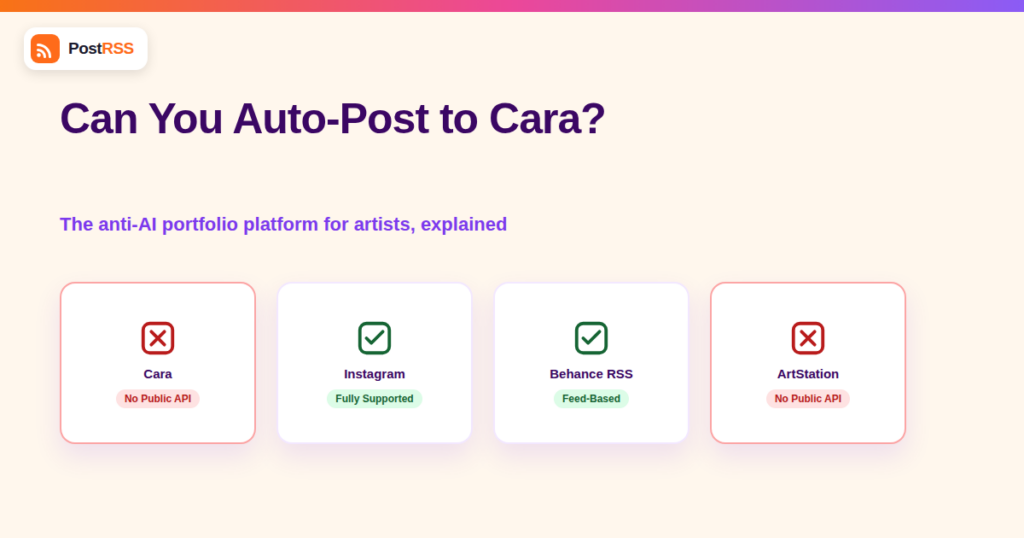
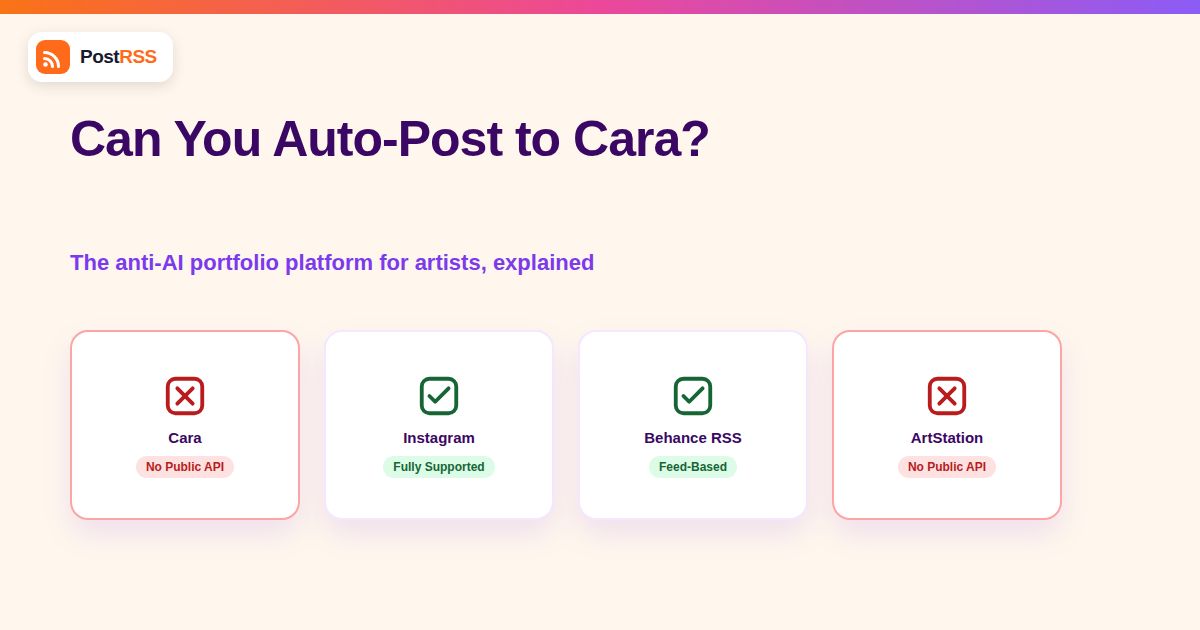
As of 2026, Cara does not offer a public, documented API for third-party posting automation. This is not an oversight — it’s consistent with the platform’s core mission. A platform built around protecting artists from unauthorized scraping and bulk data collection has strong incentives to keep its write (and read) access tightly controlled, unlike platforms such as Facebook, X, or Pinterest that actively court third-party developers and auto-posting tools because broader distribution drives their ad business.
Practically, that means no mainstream RSS-to-social auto-posting tool, including PostRSS, currently supports Cara as a destination. There’s no API key to request, no webhook to configure, and no officially sanctioned bot framework the way there is for Mastodon or Discord.
| Platform | Auto-Posting Support | API Philosophy | Best Current Approach |
|---|---|---|---|
| Behance | Feed-based, indirect | Read-only RSS feeds available for new work | Auto-post new Behance work elsewhere via its RSS feed |
| Dribbble | Not supported for posting | Closed write API | Manual upload, auto-post the announcement elsewhere |
| Fully supported | Open Graph API for Business accounts | Direct RSS auto-posting | |
| Cara | Not supported | No public API by design | Manual upload, auto-post the announcement elsewhere |
| ArtStation | Not supported | No public posting API | Manual upload, auto-post the announcement elsewhere |
It’s worth understanding why this probably isn’t a temporary gap that gets closed as Cara matures, the way many young platforms eventually add developer APIs to grow their ecosystem. Cara’s growth strategy is built around trust: artists migrated there specifically because Instagram, X, and other larger platforms were seen as too permissive about how uploaded images get reused. Opening a public write API would mean trusting every third-party integration built on top of it to respect the same values Cara was founded on — and a single bad actor abusing that access could undo a meaningful chunk of the trust that drew artists there in the first place.
There’s also a simpler business reason. Unlike ad-supported platforms that benefit when more content flows in from more sources, Cara’s appeal to artists is partly about being a smaller, more curated, more human space. Frictionless bulk posting cuts against that positioning even if it would technically be easy to build.
When a platform has no public API, some automation-minded users look at browser-automation tools like Playwright or Selenium as a workaround — essentially scripting a real browser to log in and upload on your behalf. For Cara specifically, this runs into more friction than usual. Cara applies protective image processing (a Glaze-style adversarial layer) to uploaded artwork specifically to make it harder for automated systems to reliably parse and re-use images, and its upload flow includes verification steps aimed at distinguishing real human uploads from scripted ones. Even where a browser-automation workaround is technically possible on other closed platforms, attempting one on Cara runs directly against the platform’s founding purpose, and most artists who value Cara’s community are unlikely to want to undermine the exact protections that drew them there.
There’s also a practical account-risk angle that applies to browser automation on almost any platform, not just Cara: terms-of-service violations from simulated logins can trigger account suspension, and unlike a scheduled RSS post that fails safely (it just doesn’t post), a flagged automation script can take down an artist’s entire portfolio history with it.
Cara isn’t the only modern platform that has chosen to stay closed to bulk automation as a design decision rather than a temporary limitation. Signal, BeReal in its early years, and several invite-based professional networks have made similar calls, usually for reasons tied to trust, authenticity, or user safety rather than technical difficulty. The pattern worth remembering is that a closed API is sometimes a permanent feature, not a temporary gap waiting for a plugin. Auto-posting tools that support dozens of networks, including PostRSS, generally prioritize platforms where automation is an accepted, documented, first-class use case — which keeps your accounts safe and your posting reliable, rather than dependent on a workaround that could break or get flagged at any time.
None of this means Cara is off-limits as part of your broader online presence — it just means it needs a different workflow than the “publish once, distribute everywhere automatically” model that works for blogs and news sites.
Cara is a useful case study in a pattern that shows up across the social web: not every platform wants to be automated, and the platforms that don’t tend to be explicit about why. Recognizing that distinction early saves you from building a workflow around an integration that was never going to be officially supported. The practical move for most artists and creative studios is the same one that applies to RSS auto-posting generally — automate the channels where a consistent posting cadence is the whole point, and keep the channels built around curation and trust running on a human schedule.
A workflow that a lot of working artists have settled on looks like this in practice. They keep a lightweight portfolio page or blog on their own website — often just a simple page listing new pieces with a short description and a thumbnail — and that page has its own RSS feed. Every time they upload a new piece to Cara manually, they also add a short entry to that page. An auto-posting tool watching that feed then picks up the new entry within minutes and distributes an announcement across Instagram, X, Facebook, and Pinterest automatically, with a link back to both their own site and, in the post text, a mention of where to find the full piece on Cara.
This gets artists most of the benefit of full automation — they only have to remember to do two manual things (upload to Cara, add one line to their own site) instead of manually posting to five or six different networks — while keeping Cara itself exactly as manually curated as its own culture expects. It also means the artist, not a third-party tool, retains full control over exactly which pieces get wider promotion and which stay Cara-only, which many artists specifically value about the platform.
Cara welcomes illustrators, photographers, concept artists, 3D artists, and designers. Its positioning is broadly “visual artists who want an alternative to AI-scraped platforms” rather than any single discipline.
Some unofficial browser automation scripts exist in artist communities, but they rely on simulating a logged-in browser session rather than using a sanctioned API, which puts your account at risk of suspension if Cara’s terms of service prohibit automated posting (most social platforms’ terms do, even without a specific Cara clause on record). This is different from the safe, API-based automation used by tools like PostRSS on supported platforms.
Cara does not currently publish a standard RSS feed for individual profiles the way blogging platforms do, so there isn’t a ready-made feed to plug into an auto-posting tool even for the reverse direction (pulling from Cara rather than posting to it).
Support depends on Cara offering an API path that doesn’t undermine its own anti-scraping mission, not simply on user numbers. If that changes, this article will be updated.
Not as of 2026. Cara’s monetization experiments so far have focused on paid promotion within the app and platform sustainability features, not developer or business API tiers.
Cara is a public, dedicated art community with its own discovery feed, tagging, and anti-AI positioning baked into the platform itself, whereas Instagram Close Friends is a visibility setting inside a much larger, ad-driven platform with no equivalent anti-scraping stance.
Most artists treat the two as complementary rather than either-or. Instagram still offers far larger discovery reach and, for commercial and freelance artists, direct access to clients who are not part of the art-specific Cara community. A common approach is to keep Instagram as the automated, high-reach channel and Cara as the smaller, values-aligned community space, rather than picking one exclusively.
The main trigger was the discovery that major platforms’ terms of service allowed uploaded images to be used for AI model training by default, alongside high-profile incidents of AI-generated art flooding art community feeds and marketplaces without disclosure.
Cara was built as a deliberate rejection of the permissive, scraping-friendly API culture that makes RSS auto-posting so easy on platforms like Facebook, X, and Instagram — so it isn’t a gap in current auto-posting tools so much as a platform actively designed not to be automated. The realistic path forward for artists is to keep Cara as a manually curated gallery, and let automated distribution carry the announcement traffic on the platforms that were built to support it, while a short manual cross-link keeps the two worlds connected without compromising either one.
What changed in the networks, what broke, and how to fix it before it costs you reach.