Since X’s ownership change accelerated a search for alternatives, three platforms have emerged as the real contenders for a text-first, X-shaped presence: Threads, Bluesky, and Mastodon. Each has a genuinely different governance model, audience, and technical setup for automation, and picking the wrong one — or spreading your effort evenly across all three without understanding the differences — wastes time that could go toward the platform where your specific audience actually lives. Here’s a grounded comparison of all three specifically from an RSS auto-posting perspective.
| Platform | Governance | Underlying Protocol | Launched | Audience Character |
|---|---|---|---|---|
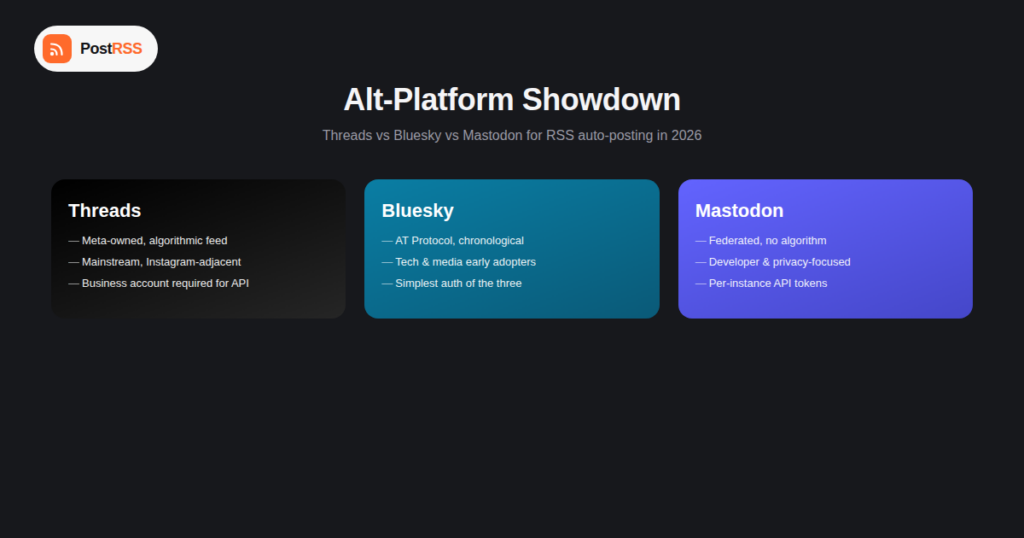
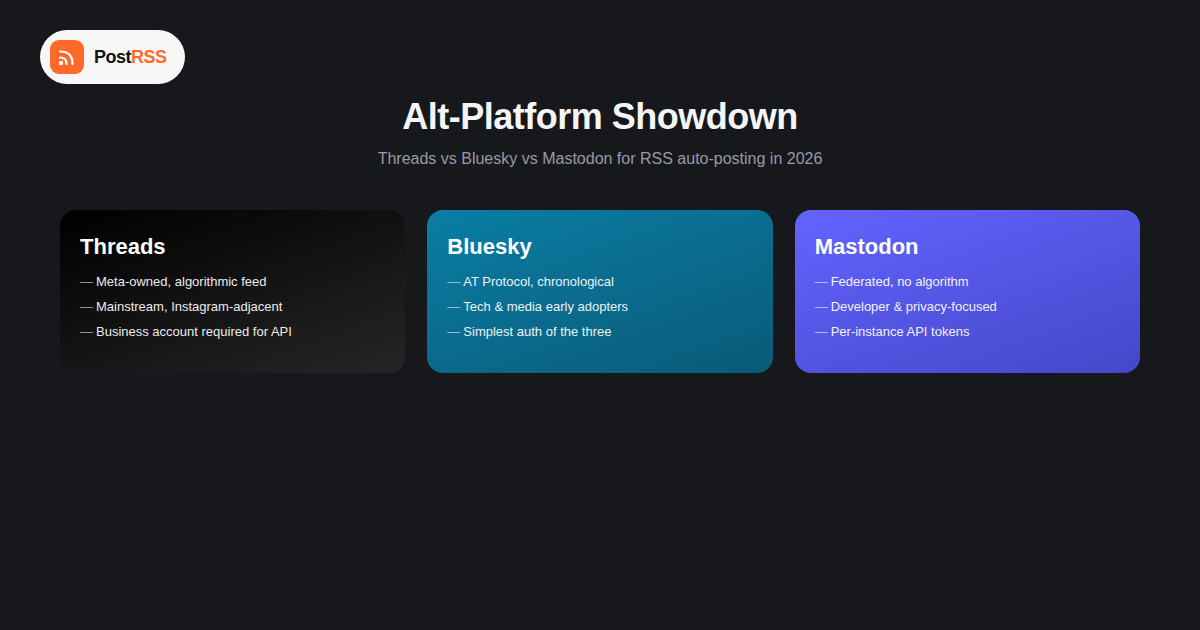
| Threads | Meta (single company) | Proprietary, with limited ActivityPub federation support | 2023 | Mainstream, Instagram-adjacent, broad general interest |
| Bluesky | Independent company, open protocol | AT Protocol | Public launch 2024 | Tech, media, journalism, and politically engaged early adopters |
| Mastodon | No central company — thousands of independent instances | ActivityPub | 2016 (surged 2022–2023) | Privacy-conscious, open-source, and developer-heavy communities |
| Platform | Auth Model | API Stability for Auto-Posting | Setup Complexity |
|---|---|---|---|
| Threads | OAuth via Meta’s official Threads API, requires a linked Instagram Business/Creator account | High — officially supported and documented by Meta | Moderate — app review and account type requirements apply |
| Bluesky | App passwords or OAuth via the AT Protocol | High — one consistent API regardless of which server hosts your account | Low — among the simplest of the three to connect |
| Mastodon | OAuth-style application tokens issued per-instance | Moderate to high — stable API, but every instance is technically a separate integration target | Moderate — requires selecting or confirming your specific instance |
Bluesky’s setup simplicity is worth calling out specifically: even though it’s built on a decentralized protocol, the overwhelming majority of accounts live on Bluesky’s own default infrastructure, so in practice connecting an account behaves almost as simply as a single-company API, without Mastodon’s per-instance complexity or Threads’ Business-account requirement.
| Feature | Threads | Bluesky | Mastodon |
|---|---|---|---|
| Character limit | 500 | 300 | 500 (default, instance-configurable) |
| Native image/video support | Yes, strong — inherits Instagram’s media handling | Yes | Yes |
| Link preview cards | Yes, generated automatically | Yes, generated automatically | Varies by client — not always rendered |
| Hashtag culture | Light — hashtags exist but aren’t central to discovery | Light to moderate — custom feeds sometimes key off them | Strong — hashtags are a primary discovery mechanism across instances |
| Default feed type | Algorithmic, with a chronological “Following” toggle | Chronological by default, with optional algorithmic custom feeds | Chronological only — no platform-wide algorithmic ranking |
Because Mastodon has no platform-wide algorithm, a well-formed auto-posted item with the right hashtags has a reasonably predictable chance of reaching people who follow related tags — there’s no black-box ranking system deciding whether to suppress it. Threads’ algorithmic default feed means an auto-posted item competes for algorithmic distribution the same way any content does on Instagram or Facebook, so consistency and engagement over time matter more than any single post’s formatting. Bluesky sits in between: your followers see posts chronologically by default, but a post’s odds of reaching a wider audience through a custom feed depend on matching that feed’s specific keyword or account-list criteria, a mechanism unique to Bluesky’s architecture.
Yes, and unlike the effort required to manually maintain a distinct voice on three separate platforms, RSS-based automation makes running all three simultaneously nearly as cheap as running one, since the marginal cost of adding a destination platform to an existing feed connection is mostly a one-time setup step rather than ongoing manual work. The main judgment call isn’t “can I afford to post to all three” — it’s whether it’s worth the modest setup time for platforms where your specific audience has genuinely limited presence. For most publishers with a general-interest content feed, connecting all three is low-risk and low-effort enough to be worth doing regardless of which one turns out to perform best.
Governance differences aren’t just philosophical trivia — they translate into real operational risk for anyone auto-posting content at scale. Threads operates under Meta’s centralized content policy, which means a single company’s moderation decisions and terms-of-service changes apply uniformly to every account, for better (consistent enforcement) and worse (policy shifts you have no say in and limited recourse against). Mastodon’s federated model means moderation is set instance-by-instance — an account in good standing on one server could face different rules if it moved to another, and instance operators occasionally shut down or merge with little notice, which is a genuine consideration for anyone treating a specific instance as a permanent, long-term home for their audience. Bluesky sits in between: it’s run by an independent company with its own moderation policy, but the underlying AT Protocol is designed so that accounts and even entire moderation services can, in principle, migrate between infrastructure providers without losing your identity or followers, a portability guarantee neither Threads nor a single Mastodon instance offers as cleanly.
Beyond raw audience size, the three platforms reward genuinely different kinds of content. Threads content that performs well tends to mirror what already works on Instagram and Facebook — visually strong posts, relatable commentary, and content that benefits from an algorithm actively trying to surface engaging material to non-followers. Bluesky’s chronological-by-default timeline means consistent posting volume compounds more predictably over time than chasing viral algorithmic moments, which suits publishers with a steady content cadence better than those relying on occasional viral hits. Mastodon rewards a genuinely conversational presence more than the other two — accounts that only broadcast links without ever replying or engaging within their instance’s local community tend to see meaningfully lower reach than ones that participate, since much of Mastodon’s discovery still runs through local-timeline visibility and boosts from real community members rather than any global ranking system.
It’s worth being clear-eyed about the actual cost of a mismatched choice, since it’s lower than it might feel when you’re staring at three unfamiliar platforms and limited time. Because RSS-based automation handles the ongoing posting work regardless of which platform ends up performing best, “getting it wrong” mostly means spending a bit of setup time on a platform that turns out not to have your audience — not months of wasted manual content creation the way a mismatched hand-written content strategy would cost. That asymmetry is exactly why the earlier recommendation to connect all three when setup effort is low holds up: the downside of over-connecting is minor and reversible, while the downside of under-connecting is a genuinely missed audience segment with no ongoing cost to have covered in the first place.
Growth rates shift with news cycles and platform controversies on all sides, so treat any specific number as a snapshot rather than a permanent ranking. Check current third-party tracking of active user estimates and engagement trends before making a long-term strategic bet based on growth trajectory alone.
Threads specifically requires a linked Instagram Business or Creator account for API-based auto-posting. Bluesky and Mastodon don’t have an equivalent business-account requirement — a standard account is sufficient for API access on both.
If your content is technical or open-source adjacent, yes — Mastodon’s audience, while smaller in raw numbers, tends to be unusually engaged with exactly that kind of content, and hashtag-driven discovery there doesn’t compete against an opaque algorithm the way it does elsewhere.
Character limits differ (300 for Bluesky vs. 500 for Threads and Mastodon), so a well-built auto-posting setup should truncate or adapt post text per platform rather than sending an identical string everywhere and risking an awkward cutoff on Bluesky specifically.
All three currently offer stable, documented APIs, though Threads’ being run by a single large company (Meta) and Bluesky’s single consistent protocol both offer a bit more predictability than Mastodon’s instance-by-instance variation, where individual server admins can occasionally introduce quirks, delay upgrades, or change local moderation policy with little advance notice.
That’s a separate strategic decision from automation feasibility. Many publishers maintain X alongside these three rather than replacing it outright, since X still retains significant reach despite user migration to alternatives — treat this comparison as guidance for where to expand, not necessarily where to retreat from. Dropping an existing platform with an established audience is a much higher-stakes decision than simply adding a new one, and the two shouldn’t be conflated just because they’re often discussed together.
You can, but their effectiveness differs: hashtags are load-bearing for discovery on Bluesky and Mastodon in different ways (custom feeds versus federated tag timelines), while on Threads they play a much smaller role in what content actually gets surfaced to new audiences.
Give any of the three at least six to eight weeks of consistent, uninterrupted auto-posted activity before judging performance — early follower counts and engagement on a brand-new account are noisy, and platforms with chronological feeds like Bluesky and Mastodon in particular tend to compound slowly rather than showing early viral spikes the way an algorithmic platform occasionally does.
Comparing raw follower counts or like counts across these three platforms is misleading, since their feed mechanics reward different behaviors entirely. A Mastodon account with 500 engaged, conversational followers on a well-connected instance may generate more genuine referral traffic than a Threads account with 5,000 passive followers who never see your posts because the algorithm deprioritized them that week. When evaluating whether a platform is “working,” track referral traffic and click-throughs back to your actual content rather than vanity metrics native to each platform, since that’s the one measure that translates consistently and meaningfully across three fundamentally different distribution models.
Threads, Bluesky, and Mastodon aren’t interchangeable, drop-in “X alternatives” — they have genuinely different governance, audiences, and technical automation profiles, and the right one (or combination) depends on where your specific readers have actually gone. Given how cheap it is to connect all three through an existing RSS automation setup, the more common mistake isn’t picking the wrong platform — it’s picking only one when connecting all three would have cost barely more effort and captured audience segments a single-platform strategy misses entirely — and that’s a mistake automation makes unusually cheap to avoid.