RSS uz 66 sociālajiem tīkliem: Facebook, Instagram, X, LinkedIn, Telegram un citiem Blogs Partner programma Kontakti
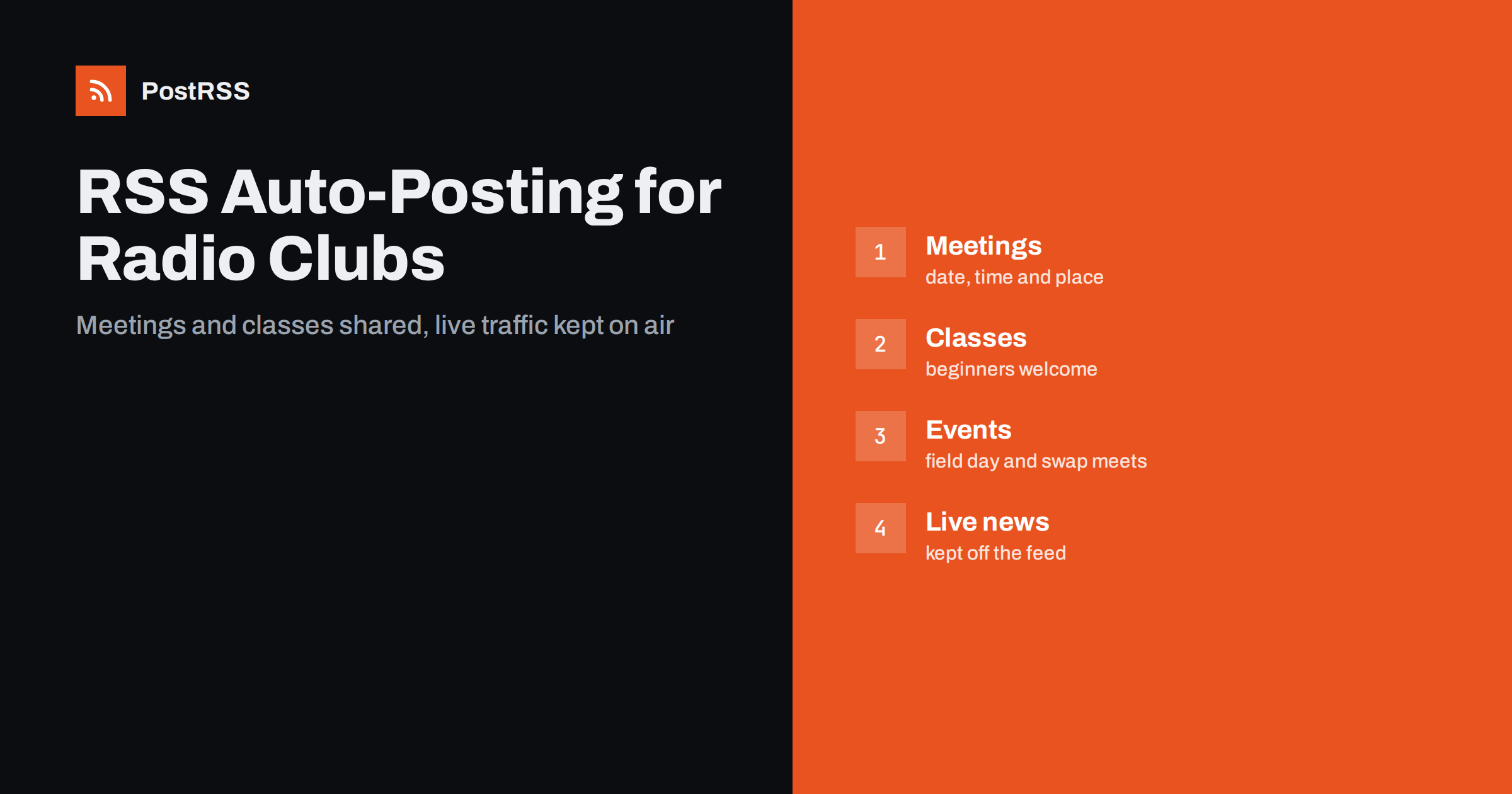
Short answer: RSS auto-posting lets amateur radio clubs share meeting dates, net schedules, license class announcements, exam sessions, field day plans, swap meets and newsletters on social media automatically. Publish each item as a page on your club website, let an auto-poster read the feed, and every new page appears on your Facebook Page, Telegram channel and other networks with its link and image. Members and curious neighbours stay informed without a volunteer retyping each notice, while live operating information, personal addresses and emergency traffic stay on the channels that were made for them.
Amateur radio clubs run on volunteers. The secretary keeps the website, the treasurer collects dues, someone looks after the repeater and a few members teach new people for the license exam. Everybody has a day job, so announcements often reach members late, or only reach those who read one particular mailing list. Yet the information is simple and repeats through the year: when the club meets, when the weekly net starts, when the next class begins and where the next swap meet will be. Once each notice is a page on the club website, a feed can share it everywhere at the moment it is published. This guide explains what to publish, how to connect the website to an auto-poster and which kinds of content should never be automated.
The advice fits many kinds of radio groups:
Each has a website or a blog where news can be listed. That page becomes the source for every other channel.
Most of what a club communicates can be turned into a short page:
Each page is written once and appears on your website, where a person who searches for a local club can find it. The feed then announces it automatically.
Most clubs already use a system that creates feeds:
/feed/ and one for every category, such as /category/classes/feed/. If you are unsure of the address, see how to find your WordPress feed link.Use categories to separate audiences: meetings, classes, events, newsletters and operating news. Each category has its own feed, and each feed can go to the channel where it works best; classes to a Facebook Page aimed at newcomers, operating news to a Telegram channel for members. Routing by category is explained in category filtering for auto-posting.
| Content | Automate? | Notes |
|---|---|---|
| Meeting and class announcements | Yes | Date, time, place and how to join |
| Events, field day and swap meets | Yes | Plan, location and volunteer call |
| Newsletters and summaries | Yes | Published as a page, then shared |
| Live operating information | No | Use the radio net or a dedicated tool |
| Emergency traffic | No | Follow your group plan and official channels |
| Member addresses and phone numbers | No | Never in a public post |
A simple rule: if it is a general notice that helps many people and sits on a finished page, automate it. If it is live, urgent or personal, it belongs on the radio, in a private group or in a call.
Most clubs want new members, and the best way to reach them is through plain pages that explain the hobby to a person who has never held a microphone. A page that answers what amateur radio is, what a license class covers, how long it takes and how much equipment is needed does more than a hundred posts that assume knowledge. Write it in everyday words, avoid jargon without an explanation and add photographs of real club members at the station. Then share the page again before each new class, using a new short announcement that links to it.
Licensing rules differ from one country to another, so do not copy details from a foreign club. State the rules of your own country in general terms and link to the official source instead of repeating exact fees or exam content that may change. Add the date of the last review at the bottom of each page.
A feed is a good place for a schedule and a poor place for a status. Publish the net time, the frequency or the way to join, and the name of the net control in a stable page. Do not use the feed for statements such as the repeater is down or the band is open, because they change faster than any post. Use the radio, a club chat or a status page that is updated in real time, and link to it from your website. A calm note such as the repeater will be off the air for maintenance on a stated date can be a normal page, because it is planned and has a date.
Many clubs train to support the community in emergencies. A feed can publish exercise dates, training pages and calls for volunteers, but it should never carry operational messages. During a real event, messages travel by the channels that your group plan and the authorities describe, and a social post that repeats half of a message can do harm. Keep a clear sentence on your emergency pages that says where real information appears. If you pause your social channels during an event, do it on purpose, and give one person the authority to do so.
Call signs are public by nature, but the people behind them have homes and families. Do not publish member addresses, telephone numbers, antenna locations at private homes or the times when a house is empty during an event. Ask before you publish a photograph of a member, and be careful with pictures of the shack that show equipment worth money at a private address. Names of children who attend a class need the agreement of a parent. A friendly welcome and a link to the next meeting do more for a club than any detail about a member.
Operating weekends are the most visible thing a club does. Publish a plan page a few weeks ahead, with the dates, the location, the call for operators and the simple ways in which visitors can take part. After the event, publish a short report with a few photographs, the number of contacts in general terms and thanks to the volunteers. Members who could not come enjoy reading it, and people who found the club on social media see that it is active. Keep the report honest. A small club that explains what went wrong with an antenna and how it was fixed earns more respect than one that claims every event was perfect.
Most clubs do best with a Facebook Page, a Telegram channel and the existing mailing list. Two or three active channels beat six forgotten ones.
/feed/, and check that it lists recent items.PostRSS has been automating RSS posting since 2014. It checks your website feeds as often as every minute and publishes each new page, with its real image and link, to the channels you connect, from Facebook Pages and Telegram to LinkedIn, Bluesky, Mastodon and many more among its 66 supported networks. You can choose how each post is built, filter items by keywords, add UTM parameters and post only within chosen hours or at exact times in your time zone. See the PostRSS features page for everything it does and the pricing page for plan limits. More ideas for clubs and community groups are under the Local Business tag.
An amateur radio club depends on volunteers who have little time and a message that repeats all year. RSS auto-posting shares each meeting date, class announcement and event plan automatically, as soon as it is published on the club website. Write every page for a newcomer, keep live operating information, emergency traffic and member details out of the feed, review old pages when their dates pass and let the volunteers spend their time at the station and with the students.
Yes. If your club website has a news section, its RSS feed can be connected to an auto-poster that shares each new page on your Facebook Page and other channels. Live and emergency information should stay on the channels made for it.
Meeting dates, net schedules, license class and exam announcements, field day and swap meet plans, newsletters and welcome pages for beginners. Keep member details out of public posts.
Not through a feed. Status changes too quickly, so use the radio, a club chat or a live status page, and link to it from the website.
No. Operational messages follow your group plan and the official channels. A feed is for training dates, volunteer calls and general information.
Yes. PostRSS reads any valid RSS or Atom address that is reachable without a login. Paste the address, connect your channels and new pages are shared as soon as they appear.
What changed in the networks, what broke, and how to fix it before it costs you reach.
Izstrādājusi Internet Solutions — PostRSS komanda. Katrs produkts ietaupa laiku savā veidā.
 English
 Lietuviškai
 Deutsch
 Français
 Русский
 Español
 Polski
 Italiano
 Українська
 Čeština
 Português
 日本語
 Latviešu valoda
 Eesti
 Magyar
 Bahasa Indonesia
 Türkçe
 हिन्दी
 Ελληνικά
 العربية
 ไทย
 Tiếng Việt
 Română
 Bahasa Melayu
 বাংলা