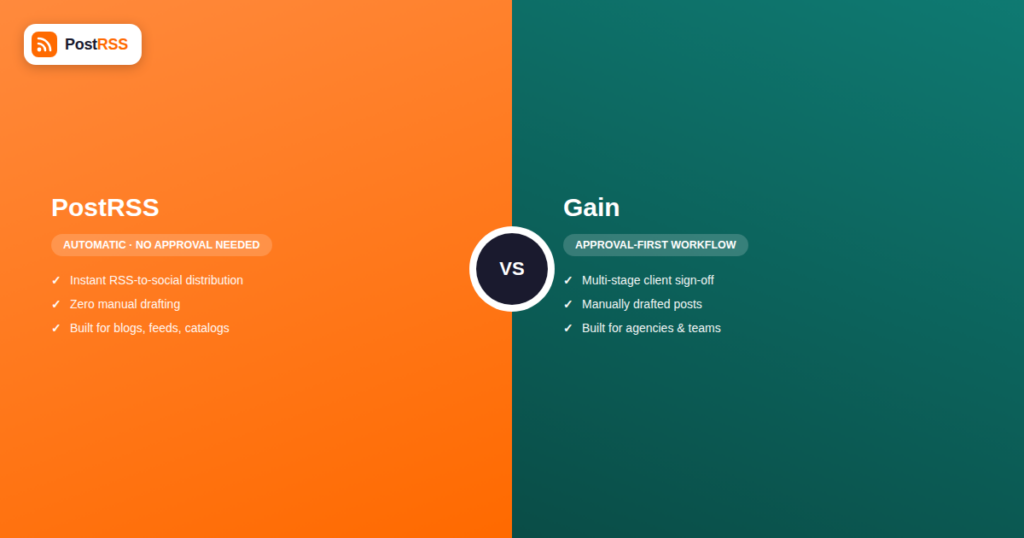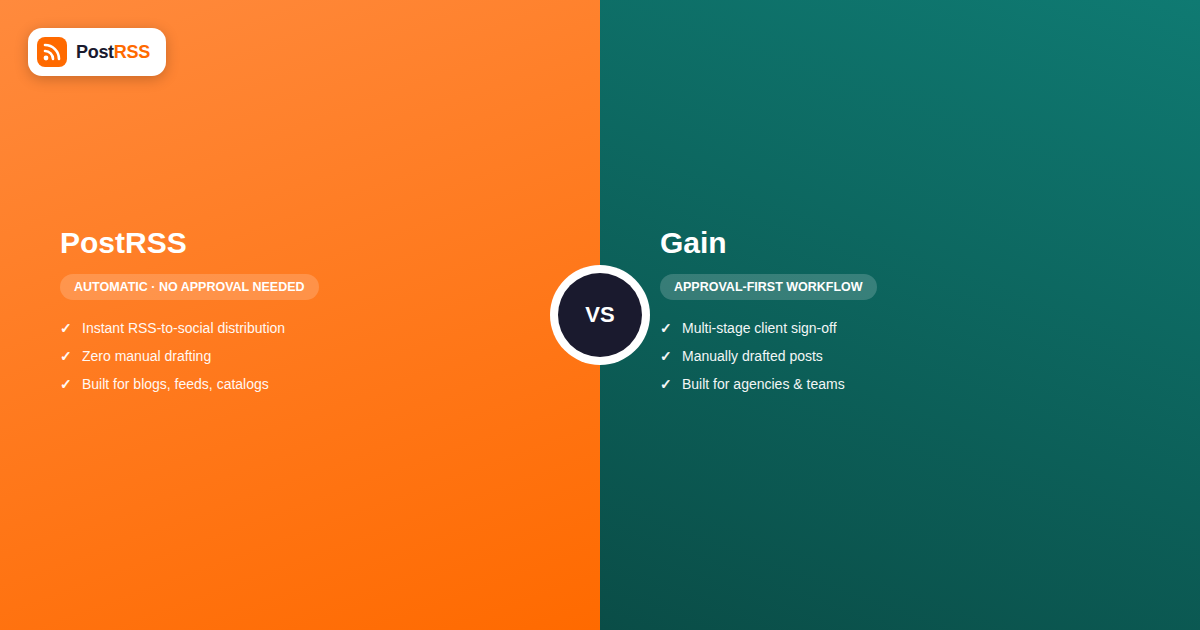
Gain (built by the team behind Buffer) has carved out a specific niche in the social media tool market: an approval-first workflow built for agencies and teams that need client sign-off before anything goes public. If you’re evaluating tools and keep seeing Gain mentioned alongside PostRSS, it’s worth understanding upfront that these two tools solve genuinely different problems — one is built around a client-approval bottleneck by design, the other is built to eliminate posting bottlenecks entirely through real-time RSS automation.
This comparison covers what each tool actually does well, where the overlap is smaller than it might first appear, and which one fits which kind of workflow.
Gain’s core workflow revolves around content approval chains: a team member drafts a post, it routes through one or more approval stages (often including an external client), and only publishes once everyone in the chain has signed off. This is genuinely useful for agencies managing client social accounts where the client wants (or contractually requires) final say on what goes out under their brand. Gain layers scheduling, a content calendar, and basic analytics on top of that approval core, but the approval workflow is the product’s defining feature, not an add-on.
PostRSS starts from a different premise entirely: content that’s already been published somewhere (a blog, a podcast feed, a news source) should reach your social channels automatically, the moment it goes live, without anyone manually drafting or approving a social post for it. There’s no approval chain because there’s nothing to approve — the content was already reviewed and published at its source. PostRSS’s value is speed and reliability for repetitive, high-volume distribution: new blog post goes live, it’s on Facebook, X, LinkedIn, and VKontakte within minutes, every time, without a human in the loop for each individual post.
| Feature | PostRSS | Gain |
|---|---|---|
| Core workflow | Automatic, real-time RSS-to-social distribution | Draft → client/team approval → scheduled publish |
| Best fit | Blogs, news sites, podcasts, e-commerce feeds needing instant distribution | Agencies managing client accounts requiring sign-off before publishing |
| Content source | Your existing RSS/Atom feed | Manually drafted posts, written directly in the tool |
| Approval workflow | None built in — content is already published at the source | Multi-stage approval chains, including external client approval |
| Speed from publish to social post | Minutes, fully automatic | Depends entirely on how quickly approvers respond |
| Client collaboration features | Not a focus — no client-facing approval interface | Core strength — built specifically for client sign-off workflows |
| Manual post composition | Limited — designed around feed-driven content, not from-scratch drafting | Full-featured composer for writing original posts |
Despite the different core workflows, there’s a narrower area of real overlap: both tools can get a piece of content onto Facebook, X, LinkedIn, and other networks, and both offer basic scheduling. If your only requirement is “get posts published to social media,” either tool technically accomplishes that. The meaningful difference shows up in *how* content gets into the pipeline in the first place — PostRSS pulls it automatically from a feed you already maintain, while Gain expects a human to draft it (or paste it in) and then route it through approval.
Agencies rarely run on a single tool for everything, and the more useful question is often “what’s each tool’s specific job in our stack” rather than “which one wins overall.” For agency automation more broadly, a common pattern looks like this: original creative campaigns, seasonal promotions, and anything requiring client sign-off go through an approval-based tool like Gain, while any client with an actively updated blog, news feed, or product catalog gets that content automatically distributed via PostRSS without needing a separate approval step for routine publish-and-syndicate content. This division of labor means the approval tool isn’t bottlenecking content that never needed review in the first place, and the automation tool isn’t being asked to handle content that genuinely requires a human sign-off.
If your organization has a genuine compliance or client-relationship reason to require sign-off before every post — a marketing agency contractually obligated to get client approval, a regulated brand requiring internal legal review, a team where junior staff draft content that a manager must check before it’s public — Gain’s approval-first design is solving a real problem that RSS automation isn’t built to address. PostRSS deliberately doesn’t insert an approval gate because its entire value proposition assumes the content is already approved by virtue of being published at the source.
If your bottleneck is the opposite problem — content already gets reviewed and approved before it’s published on your site, but then someone still has to remember to manually copy it into a scheduler, write a caption, and post it to five different networks — that’s the repetitive task PostRSS eliminates. This fits publishers, bloggers, podcasters, e-commerce stores, and any business where “new content on our website” should reliably become “new post on our social channels” without requiring someone to notice and act on it each time.
Some organizations genuinely benefit from running both tools for different content categories: PostRSS handling automatic, no-review-needed distribution for already-published blog content or product updates, while Gain (or a similar approval-based tool) handles original social campaigns, client-specific content, or anything requiring sign-off before it goes out. This isn’t redundant — it’s matching each tool to the type of content it’s actually built to handle, rather than forcing one tool to cover both use cases poorly.
Moving from Gain to PostRSS typically means identifying which of your currently-approved content sources could skip the approval step entirely going forward — usually blog posts, press releases, or product updates that were only routed through approval as a formality rather than out of genuine compliance need. Moving in the other direction (adding Gain alongside or instead of PostRSS) usually happens when a client relationship changes and starts requiring sign-off that wasn’t previously necessary, or when an agency takes on new original-content creative work that doesn’t have a natural RSS source to automate from. Neither migration is particularly disruptive since the two tools address different content types rather than replacing each other’s core function, which is also why many teams end up running both rather than treating the choice as exclusive. For a broader look at how PostRSS stacks up against other tools in this space, see our full comparison guide covering schedulers, approval tools, and automation platforms side by side.
| Aspect | PostRSS | Gain |
|---|---|---|
| Pricing basis | Typically scales with number of connected feeds/accounts and posting volume | Typically scales with number of team members and client workspaces |
| Cost driver | How much content you’re automatically distributing | How many people and clients need access to the approval workflow |
| Best value for | High-volume, low-touch content distribution | Teams managing many client relationships requiring individual approval chains |
PostRSS’s model assumes content is already reviewed at the point of publication on your own site or feed; it doesn’t include a separate multi-stage approval workflow the way Gain does, since that’s not the problem it’s designed to solve.
Gain is built around manually drafted content moving through an approval chain rather than automated feed ingestion, so it doesn’t offer the same real-time, zero-touch RSS-to-social pipeline that’s PostRSS’s core function.
PostRSS fits a solo blogger’s needs far better — there’s no client or team to route approvals through, and the value is entirely in not having to manually post every new article to social media yourself.
If clients require sign-off before anything publishes under their brand, Gain’s approval-chain design directly addresses that need. If the agency also manages some clients’ blog-to-social distribution where no approval is required, running PostRSS alongside Gain for that specific content type is a reasonable hybrid approach.
Not entirely — PostRSS posts are driven by when your source content is actually published rather than a manually chosen calendar slot, which is a different kind of control (content-driven timing) rather than an absence of control. Many feed-based tools, PostRSS included, also support posting-time preferences and delays layered on top of feed detection, so “instant” doesn’t have to mean “no control over exact timing.”
Cost comparisons depend heavily on your specific usage pattern — a high-volume publisher will generally find automatic RSS distribution more cost-effective per post than a per-seat approval tool, while a small agency with few high-value client relationships may find the reverse true given how each tool’s pricing scales.
Most tools in this space, including both PostRSS and Gain, offer some form of free trial or limited free tier, which is generally the fastest way to confirm which workflow actually matches your content — running a real feed through PostRSS for a week and comparing that experience against drafting the same content manually through Gain’s approval chain will surface the right fit faster than reading feature comparisons alone.
| Aspect | PostRSS | Gain |
|---|---|---|
| Initial setup | Connect an RSS feed and social accounts, configure a posting rule — typically minutes per feed | Set up approval chains, invite team members and clients, configure roles and permissions |
| Ongoing time investment | Near zero once configured — the system runs unattended | Ongoing, since every post requires drafting and moving through approval each time |
| Team training needed | Minimal — mostly a one-time configuration task for whoever manages the feeds | Moderate — team members and clients both need to understand the approval interface and their role in it |
This difference in ongoing time investment is really the heart of the comparison: Gain is designed to insert human judgment into every single post, which takes time by design, while PostRSS is designed to remove human involvement from posts that don’t need it, which is also true by design. Neither is a flaw — they’re optimizing for opposite things.
It’s worth being direct about the gaps. PostRSS isn’t built for composing original, from-scratch social content with no underlying published source — if you need to write and schedule a standalone campaign post with no corresponding blog article or feed item, that’s outside its core design. Gain, on the other hand, isn’t built for high-volume, zero-touch distribution — if you’re publishing dozens of items a day from an e-commerce catalog or a fast-moving news feed, routing every single one through a manual draft-and-approve cycle would be impractical regardless of how efficient the approval interface is. Recognizing which category your actual content falls into is usually a faster way to choose than comparing feature checklists, since the two tools were built to solve opposite ends of the same broader problem: getting the right content to the right social accounts reliably.
Feature checklists alone won’t settle this comparison, because the two tools were built to answer different questions: “how do we get sign-off before this goes public” versus “how do we stop forgetting to distribute content we’ve already approved.” PostRSS and Gain aren’t really competing for the same job — Gain solves the client-approval bottleneck for teams that need sign-off before publishing, while PostRSS eliminates the manual-posting bottleneck for content that’s already been approved by virtue of being published at its source. Choose Gain if approval chains are a genuine requirement of your workflow; choose PostRSS if your real problem is remembering to distribute already-approved content reliably and instantly across every channel that matters. Whichever direction fits, matching the tool to the actual shape of your content workflow — rather than picking whichever tool has the longer feature list — is what determines whether the automation actually saves time.