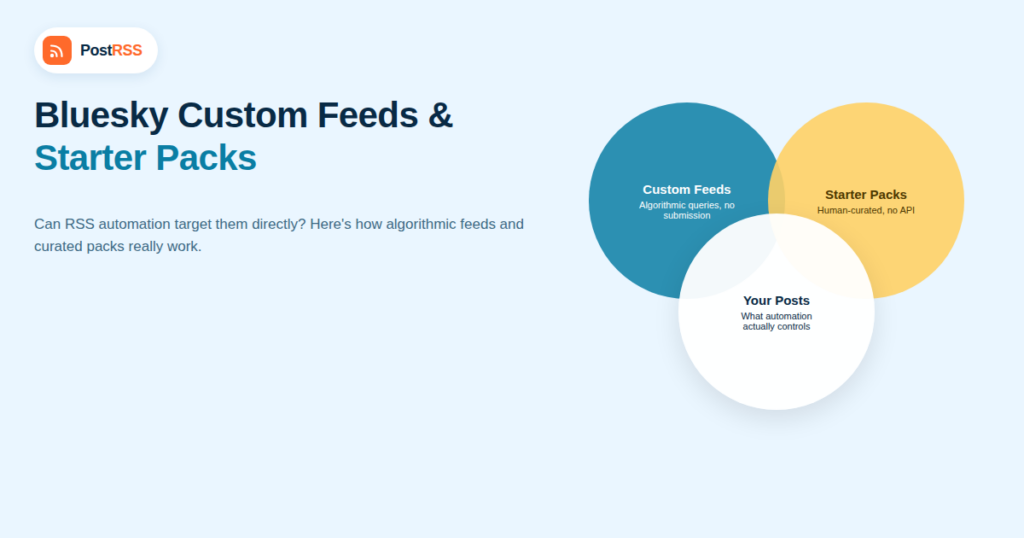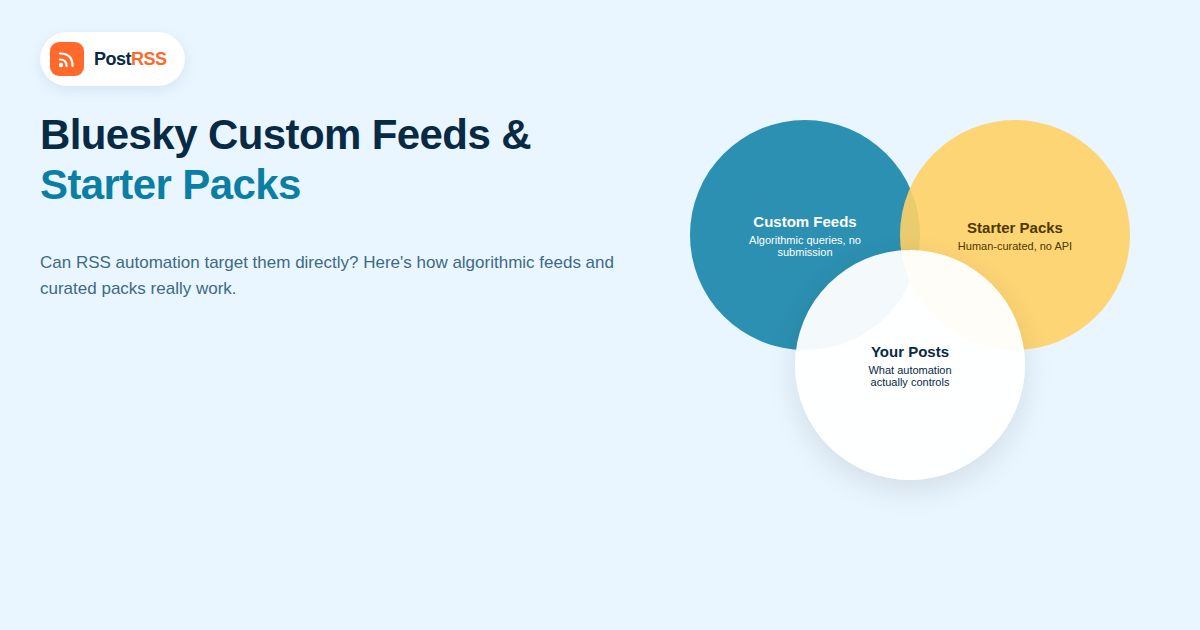
Bluesky’s custom feeds and starter packs are two of its most distinctive features — and also two of the most misunderstood when people start asking whether automation can “get into” them. If you’re auto-posting your RSS feed to Bluesky already and wondering whether you can target a specific custom feed or land in relevant starter packs the same way, the honest answer requires understanding how fundamentally different these features are from a normal social media inbox or timeline.
A custom feed on Bluesky isn’t a place you post into — it’s a saved algorithmic query that runs continuously over the entire public network. Built using the AT Protocol’s open Feed Generator API, anyone can create one: a feed that shows only posts containing a specific hashtag, a feed that surfaces posts from a curated list of accounts, a feed built around engagement signals, or a feed combining several of these rules. Users then subscribe to and pin whichever custom feeds match their interests, similar to subscribing to a specialized RSS feed of Bluesky content itself.
Critically, a custom feed doesn’t have an “inbox” you submit content to. It’s a live filter over everything already posted publicly on the network. Your post either matches the feed’s criteria and gets surfaced, or it doesn’t — there’s no submission step, no approval queue, and nothing an auto-posting tool can directly connect to and “publish into.”
Starter packs are curated bundles — a hand-picked list of accounts and often one or two custom feeds — that a user assembles and shares as a single link, typically to help new users onboard quickly by following a relevant group all at once (a common pattern: “Tech Journalists Starter Pack,” “Climate Scientists Starter Pack”). Someone else decides who goes into a starter pack; there’s no automated or self-service mechanism for adding your own account to someone else’s existing pack, and no API endpoint an RSS tool could call to insert itself.
This design isn’t an oversight — it’s a deliberate architectural choice that sets Bluesky apart from platforms with a single, company-controlled algorithm. By opening up feed creation to anyone through the AT Protocol, Bluesky lets its community build and compete on ranking algorithms rather than leaving all discovery in the hands of one company’s black-box formula. The trade-off is exactly the one automation tools run into: there’s no single “the algorithm” to optimize for or integrate with, because there are potentially thousands of different community-built feeds, each with its own independent, often undocumented ranking logic. That openness is a genuine feature for users who want more control over what they see, but it means there’s no equivalent of a Meta Business Suite API where a tool could request “please feature this post” — the entire concept doesn’t exist on Bluesky the way it might elsewhere.
Most well-known Bluesky custom feeds fall into a handful of recognizable patterns, and understanding them helps explain why hashtag and keyword hygiene is the main lever available to auto-posted content:
Knowing which type a specific feed relevant to your niche uses is often publicly discoverable by reading the feed’s own description or asking its creator directly — many are transparent about their ranking approach specifically because it helps genuine community members understand how to participate.
| Feature | Who Controls It | Can RSS Automation Post Directly Into It? | How to Influence Inclusion |
|---|---|---|---|
| Your own timeline/profile | You | Yes — this is what auto-posting actually publishes to | N/A — this is the account automation posts from |
| Custom feeds (algorithmic) | The feed’s creator, via its ranking rules | No — no submission mechanism exists | Match the feed’s known criteria (hashtags, keywords, topic) in your regular posts |
| Starter packs | The individual curator who created it | No — entirely manual, human-curated | Build relationships and visibility so a curator chooses to include you |
| “Discover” algorithmic feed | Bluesky’s own ranking system | No direct control, similar to any platform’s default algorithm | Consistent, genuine engagement over time — no shortcut via automation |
While you can’t submit directly to a custom feed, your regular auto-posted content can still end up appearing in one, the same way any public post can. If a niche custom feed aggregates posts containing #webdev arba #indiehacker, and your RSS-to-Bluesky automation reliably includes accurate, relevant hashtags on every new post, your content has a genuine chance of surfacing in that feed exactly like a manually written post would — the feed generator doesn’t distinguish between automated and manual posts, only between posts that do or don’t match its rules.
This means the practical lever available to you is content hygiene, not integration engineering: consistent use of the hashtags and terminology that relevant niche feeds are actually built around, posted from an account that behaves like a genuine participant rather than a pure broadcast bot.
Several popular custom feeds explicitly filter out or deprioritize accounts that look purely automated — posting only links with no replies, no original engagement, and a suspiciously mechanical cadence. This is a meaningful consideration for anyone relying entirely on RSS automation for a Bluesky presence: an account that only ever auto-posts links, never replies, and never posts anything that isn’t a direct feed item is more likely to get quietly filtered by feed generators built to reward genuine participation. Mixing automated distribution with even occasional manual engagement — replies, quote posts, or original observations — measurably improves an account’s odds of surfacing in curated and algorithmic feeds alike.
Since starter packs are entirely manual curation, there’s no automation workaround — but there are legitimate, non-automatable steps that increase your odds: build a genuinely useful, active presence in a specific niche, engage visibly with the community that starter pack curators are already part of, and in some cases, simply ask a curator whose pack is relevant to your niche whether they’d consider adding your account. None of this touches your RSS automation setup at all; it’s a relationship and reputation exercise that happens independently of however your content gets distributed.
The one lever available to you directly: you can create your own starter pack featuring accounts and custom feeds relevant to your niche, and share that pack as a resource. This is a manual, one-time curation act rather than something RSS automation performs, but it’s a legitimate way to build visibility and goodwill in a community — especially if your organization’s account anchors a genuinely useful pack that others end up sharing.
None of this changes the fundamentals of why auto-posting to Bluesky is worth doing in the first place: it’s a fast-growing platform, and RSS feed automation is still the most efficient way to make sure every new article, product update, or announcement reaches it without manual copy-pasting. Custom feeds and starter packs are best understood as a discovery layer sitting on top of that baseline activity, not a replacement for it. An account with zero regular posts has nothing for any feed generator or curator to find in the first place, no matter how well it understands the mechanics described here — so the automation piece remains the foundation, and the community-and-content-quality piece is what determines how far that foundation’s visibility actually extends.
No — custom feeds have no submission mechanism at all. They’re algorithmic queries over public posts, not destinations you publish into. Auto-posting publishes to your own account’s timeline, and your post may or may not get picked up by a given custom feed based on that feed’s own rules.
No guarantee, but it’s the single biggest lever available. Feed generators vary in exactly how they weight hashtags, keywords, and account reputation, so matching a feed’s known criteria improves your odds without guaranteeing inclusion.
No official mechanism for this exists. Starter packs are individually curated lists, and inclusion depends entirely on the curator’s own judgment, not a submission or advertising system.
It can. Several custom feeds and Bluesky’s own discovery mechanisms tend to favor accounts that show genuine engagement alongside their posts, so a purely automated broadcast account without any manual replies or original posts may be filtered out of feeds built to reward real participation.
No — “Discover” is Bluesky’s own default algorithmic feed shown to most users, while custom feeds are third-party-built, rule-based feeds users choose to subscribe to separately. Both are un-submittable in the same way; neither has a direct publishing API for third-party tools.
Yes — regular, reliable posting to your own timeline is still the foundation everything else builds on, since a custom feed can only surface a post that already exists. Skipping automation there just means fewer posts exist to potentially be picked up in the first place.
Yes — Bluesky’s open Feed Generator API lets developers build and publish their own custom feeds, which is a separate, more involved technical project from RSS-based post automation and requires hosting your own feed generator service rather than simply connecting an account.
Not directly — feed generators evaluate the post content and account behavior itself, not which client or automation tool published it. What matters is whether the resulting post matches a given feed’s criteria, not the technical path it took to get published.
Before investing significant effort into optimizing for one particular custom feed, it’s worth confirming that feed is actually still active and meaningfully sized — Bluesky’s feed ecosystem has grown quickly, and not every feed with an appealing name has a large, engaged subscriber base behind it. A feed’s own profile typically shows its subscriber count, which is a quick way to judge whether tailoring your hashtag strategy around it is likely to be worth the effort compared to simply maintaining broad, consistent posting habits.
You can’t automate your way directly into a Bluesky custom feed or a starter pack — both are built around human curation and algorithmic rules that have no submission mechanism for third-party tools to plug into. What RSS automation can still do is make sure your account consistently publishes genuine, well-tagged content to your own timeline, which is the only raw material custom feeds and discovery algorithms have to work with in the first place. Pair that reliable posting cadence with occasional real engagement, and you’ve done everything automation can legitimately contribute — the rest is a community and content-quality question, not a technical one.