Digg’s 2026 relaunch — rebuilt from the ground up with human moderation, community “diggers,” and a cleaner ranking algorithm — has brought a wave of new search interest from site owners who remember its 2000s heyday and want back in. If you’re already running an RSS automation workflow for Facebook, X, and LinkedIn, the obvious next question is whether you can plug Digg into the same pipeline and have new posts submitted automatically the moment your feed updates.
The short answer: not automatically, and for a reason that’s baked into Digg’s whole relaunch pitch. Here’s exactly what’s possible, what isn’t, and how to fit Digg into a broader auto-posting routine without wasting time chasing an API that doesn’t exist.
Most platforms that PostRSS auto-posts to — Facebook Pages, X, LinkedIn, VKontakte — treat a new post as content the platform will distribute to your existing followers. Digg is structurally different: every submission enters a shared public queue where it lives or dies based on upvotes (“diggs”) from the community, not on being pushed to a pre-built audience. There’s no “your page,” no follower graph to auto-publish into — just a submission form and a public vote.
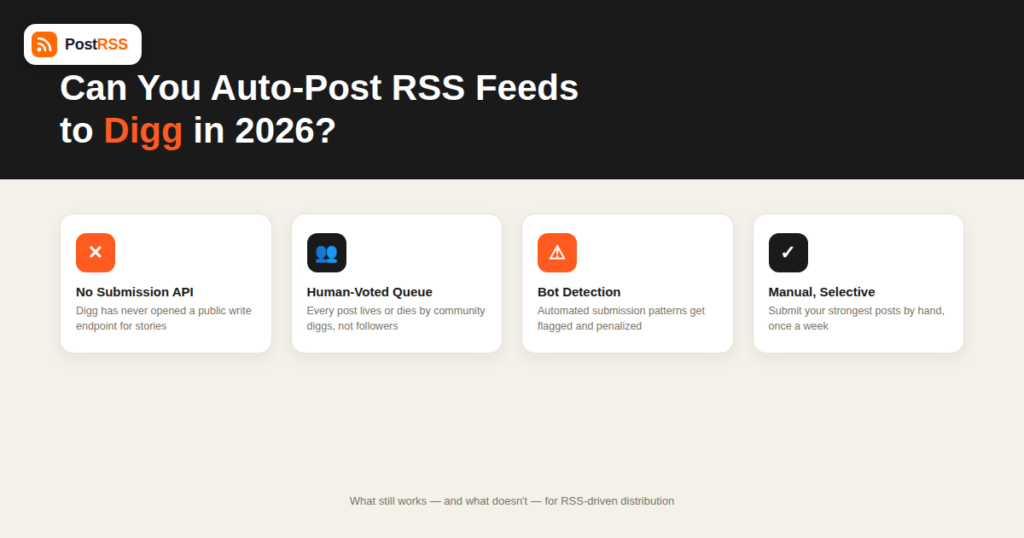
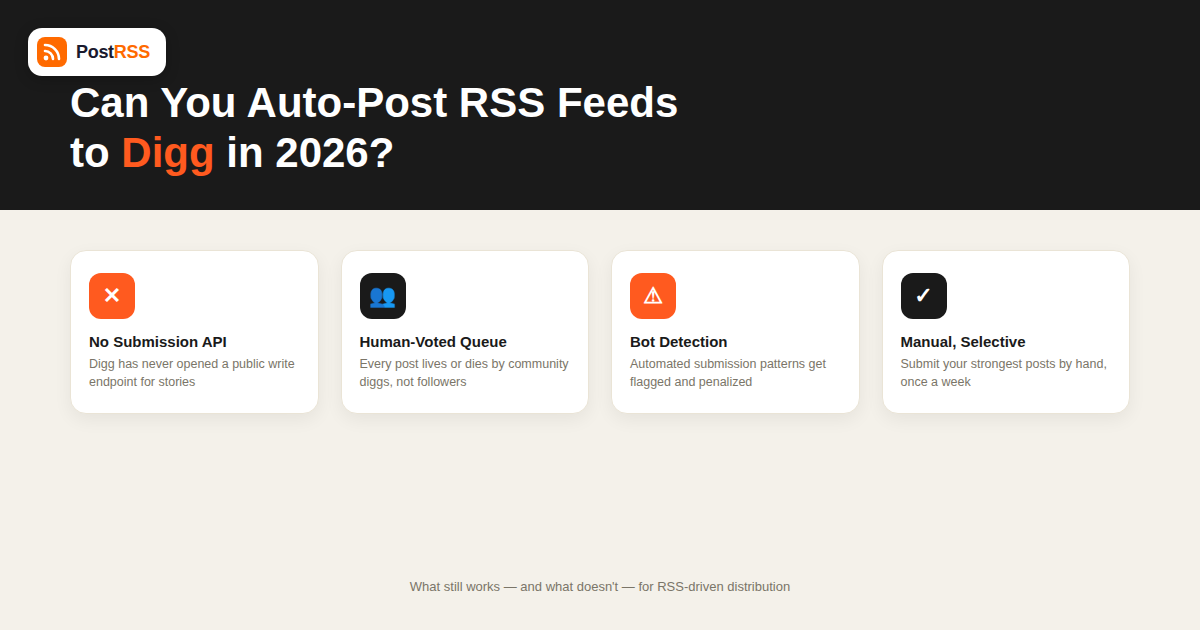
That design choice is deliberate. Digg’s 2026 relaunch was explicitly built to avoid becoming another bot-flooded link farm, which is exactly what happened to the platform in its first run and to competitors like early Reddit before spam filtering matured. As a direct consequence, Digg has never opened a public submission API, and its current terms explicitly prohibit automated or bulk submissions from third-party tools. There’s no technical workaround here — it’s a platform policy line, and PostRSS won’t build a route around a wall a platform has deliberately put up.
You may still find browser extensions or scripts claiming to “auto-submit to Digg.” In every case worth checking, these rely on browser automation that logs into your account and clicks the submit button programmatically — not a sanctioned API. That approach carries real account risk: Digg’s abuse detection is tuned specifically to catch this kind of automated submission pattern, since it’s the exact behavior the 2026 relaunch was designed to stop. An account flagged for automated submissions can lose its ability to post, and in some cases its digg-weight (how much its votes count) gets zeroed out permanently. It’s not a trade worth making for a single extra distribution channel.
Even without a submission API, there’s a legitimate workflow that keeps Digg in your distribution mix without touching the submission step itself:
Keep your existing RSS-to-social pipeline running exactly as it is. Every new post from your feed still goes out to Facebook, X, LinkedIn, and VKontakte the moment it’s published, via a tool like PostRSS, with zero manual intervention.
Instead of submitting everything, use engagement data from your automated social posts (likes, shares, click-throughs) as a signal for which articles are actually worth the two minutes it takes to submit manually to Digg. This mirrors how experienced community marketers already treat Reddit and Hacker News — submit selectively, submit your best work, and never automate the vote-dependent step.
Because Digg submissions are manual and irregular, tag the links you do submit with a distinct UTM source (e.g. utm_source=digg) so you can see in your analytics whether the manual effort is worth continuing, separate from your always-on automated channels.
Digg’s relaunch brought back topic and front-page RSS feeds you can subscribe to as a reader — useful for competitive monitoring or content research — but this is a one-way read feed, not a write path. Don’t confuse “Digg has RSS feeds” with “Digg accepts RSS submissions”; they’re unrelated features that happen to share a protocol.
| Platform | Public Submission/Posting API? | Auto-Post via RSS? | Distribution Model |
|---|---|---|---|
| Facebook Pages | Yes | Yes | Pushed to page followers’ feeds |
| X (Twitter) | Yes | Yes | Pushed to follower timeline |
| Yes | Yes | Pushed to connections/followers | |
| VKontakte | Yes | Yes | Pushed to group/page subscribers |
| Digg (2026) | No | No | Public queue, ranked by community vote |
| Limited, heavily rate-limited | Not recommended | Public queue, ranked by community vote |
For a blog or news site publishing several times a week, a workable split looks like this: everything auto-posts through your RSS pipeline to your owned social channels without exception. Once a week, review which posts got the strongest engagement or click-through from that automated distribution, pick the one or two genuinely link-worthy pieces, and submit those manually to Digg with a thoughtful title and the right topic tag. This keeps the manual time investment small (ten minutes a week, not per post) while still giving your best content a shot at Digg’s front page.
It’s worth reframing the lack of an API as a feature rather than a gap. Community-voted platforms that do allow automated submission — old Digg included — tend to degrade into spam within months, at which point real users leave and the traffic value collapses for everyone still submitting. Digg’s 2026 team has been explicit that keeping the submission step human is core to keeping the front page worth reading, and by extension worth being featured on. A restriction that keeps the platform’s core audience intact is a restriction that protects the value of the referral traffic you’re chasing in the first place.
If your goal is broad, reliable distribution with minimal ongoing effort, Digg should sit at the bottom of your automation priority list, not the top. Focus your automated distribution budget on the channels that actually support it end-to-end, and treat Digg (along with Reddit and Hacker News) as a manual, selective, high-effort-per-post channel reserved for content you’re confident can win on merit rather than volume.
Understanding why automation is a dead end here means understanding what Digg’s ranking actually rewards. The relaunched platform uses a weighted voting system rather than a simple upvote count:
Every one of these mechanisms exists specifically to blunt the effect of automation and coordinated voting. That’s why there’s no submission API to pair with them — the entire ranking model assumes a human submitted the story and a community of humans is evaluating it on its own timeline.
Since the platform can’t be automated, most of the mistakes worth avoiding are strategic rather than technical:
| Mistake | Why It Backfires |
|---|---|
| Submitting every new post, not just the strongest ones | Diggers quickly recognize and downvote low-effort repeat submitters, hurting future submissions too |
| Asking employees or friends to all vote at once | Reputation-weighted, velocity-aware ranking flags this as coordinated activity and can suppress the story |
| Submitting to the wrong topic community | Topic moderators bury off-topic posts regardless of vote count |
| Using a generic, clickbait-style title different from the article’s real headline | Digg’s community and moderators penalize mismatched or misleading titles more aggressively than most social platforms |
| Treating Digg traffic like automated social traffic (set-and-forget) | Digg submissions often need a comment or context from the submitter to gain early traction — it rewards active participation, not passive posting |
Because every Digg submission costs real attention and reputation on your account, it’s worth treating each one like a small campaign rather than a quick copy-paste. Before submitting anything manually:
None of this is automatable, and that’s fine — it’s a deliberate, occasional promotion task, not a daily distribution channel, and it should take a backseat to the always-on automation handling the rest of your social presence.
Digg has discussed developer tools for reading public data (like trending topics), but as of 2026 there is no public write API for submitting stories, and the platform’s terms explicitly bar automated submissions.
It’s a real risk. Digg’s anti-spam systems are specifically tuned to detect scripted or bot-like submission patterns, and accounts caught doing this have had their submission privileges and vote weight suspended.
Yes — sharing a link to your own Digg submission on Facebook or X to ask for votes is fine and common; it’s the submission step itself, not sharing afterward, that has no automation path.
For content genuinely aimed at a broad, curious audience — long-form journalism, unique research, strong visual stories — a manual Digg submission can still drive a meaningful traffic spike. For routine product updates or niche B2B content, it’s rarely worth the manual effort.
The same logic applies: both are community-voted queues without a sanctioned bulk-submission API, so PostRSS focuses automation on the platforms built for it (Facebook, X, LinkedIn, VKontakte, and others with genuine publishing APIs) rather than risking your account on unofficial workarounds.
You can monitor mentions and backlinks with a standard alert tool (like Google Alerts) subscribed to your domain, which is a separate, fully legitimate use of RSS-based monitoring, unrelated to submission automation.
No — PostRSS’s job is the channels where auto-posting is both possible and sanctioned. Digg simply sits outside that category, the same way Reddit and Hacker News do, and belongs in your manual, high-effort content promotion routine instead.
You cannot auto-post RSS feed content to Digg in 2026 — there’s no submission API, and Digg’s own terms and anti-spam systems are built specifically to keep the submission step human. The right move isn’t to chase a workaround; it’s to keep your always-on RSS automation running on the channels built for it, and treat Digg as a deliberate, manual, once-in-a-while promotion tool reserved for your strongest content.