RSS 66 sotsiaalvõrgustikku: Facebook, Instagram, X, LinkedIn, Telegram ja teised Blogi Partnerprogramm Kontaktid
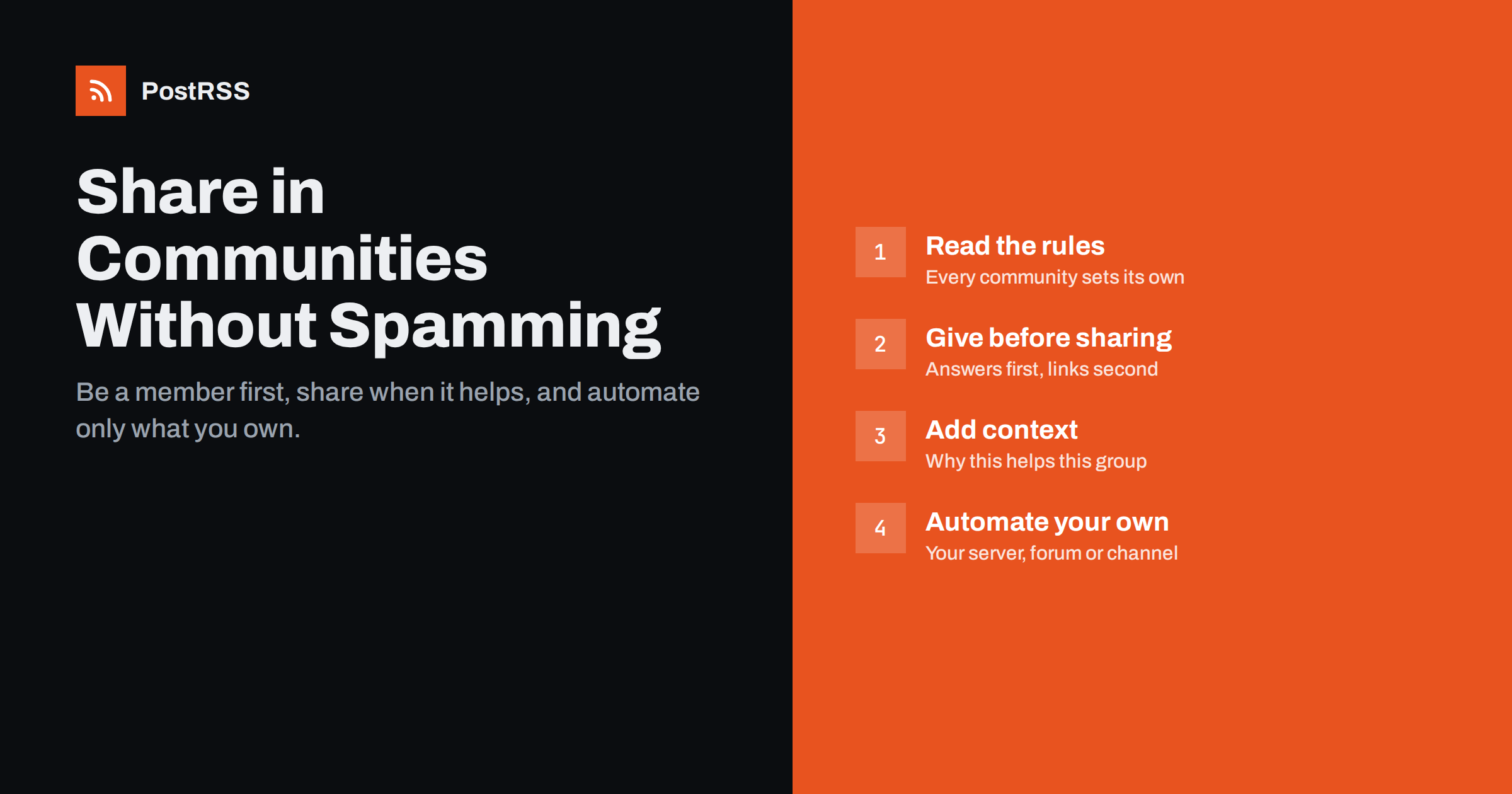
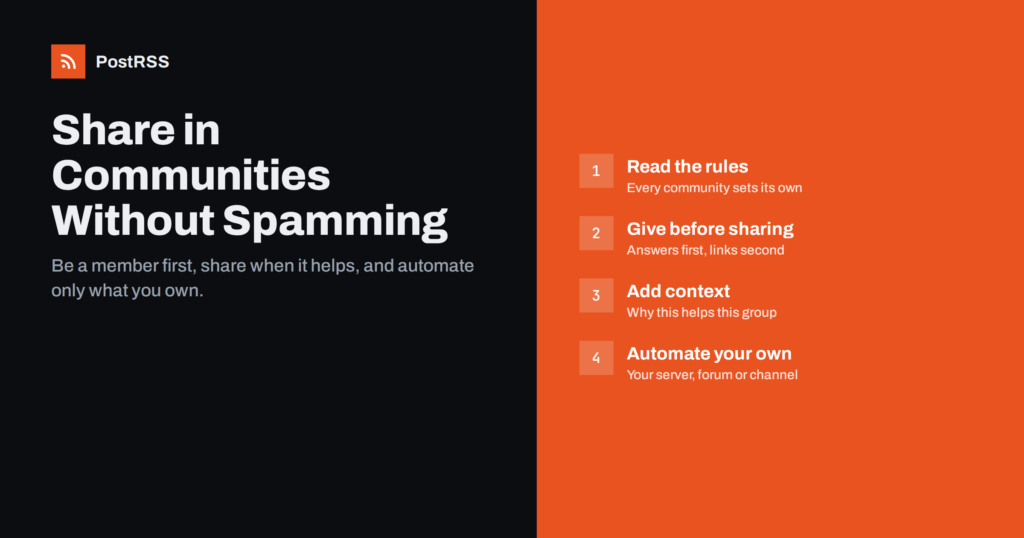
Short answer: Online communities such as forums, subreddits, Discord and Slack servers, Lemmy communities and professional groups can bring highly engaged readers, but only if you share as a genuine member. Read each community’s rules, contribute answers and discussion before posting links, share only content that is truly relevant to that group, and add context explaining why it helps. Automate posting only into spaces you own or run, such as your own Discord server, forum or channel, or where moderators have explicitly agreed. Automated link-dropping into other people’s communities is the fastest way to get banned.
Social networks built around ranking systems reward broad appeal. Communities reward relevance. A focused forum about home brewing, a subreddit for web developers, a Discord server for a game, a Lemmy community for open-source tools: each gathers people who care about one subject and actively look for useful material on it.
For publishers, bloggers and businesses, that makes communities valuable in ways that follower counts are not:
Communities also reveal what people actually struggle with. Reading the questions in a forum or server for a few weeks gives you a list of real problems, in the words people use to describe them. Articles written to answer those questions tend to be more useful, and they are the ones members are happy to see linked.
The same qualities make communities protective. Members and moderators have seen countless people join only to promote themselves, and most communities have clear rules against it.
Treat that protectiveness as a feature rather than an obstacle. The rules that make it hard to promote yourself are the same rules that keep the community useful, which is exactly why its members are worth reaching.
Spam is not only mass advertising. In community terms, it usually means any contribution that serves the poster more than the community. Common patterns that moderators remove:
Moderators also look at patterns over time. A single helpful link from a regular member is rarely a problem, while the same link from a new account that posts nothing else almost always is. The content can be identical; what differs is the relationship behind it.
Many communities also have specific rules: self-promotion only on certain days or in certain threads, required flair or tags, minimum account age or activity before posting links, or a total ban on promotional content. Reddit, for example, has long discouraged accounts that mainly post their own links, and many subreddits add stricter rules of their own. Our article on auto-posting to Reddit and what the rules say goes into that platform in detail.
The most reliable way to share content successfully in a community is to become a genuine part of it first. In practice:
Be realistic about how many communities you can take part in properly. Two or three where you are genuinely active are worth far more than twenty where you appear only to drop links. Choose the ones closest to your expertise and your readers, and let the rest go.
This takes time, which is exactly why it works. Members recognise people who contribute, and they are happy to read links from them.
When you do share your own content, the way you present it makes a big difference:
Timing matters too. Posting a link late at night in a community whose members are mostly in another time zone means it may sink before anyone sees it. Watch when discussions are most active and share then, but never repost the same link repeatedly to catch different time zones.
Automation has a legitimate and useful place in community distribution, but mainly in spaces you own or manage. Examples:
Even in your own spaces, automation should be tuned to the community. A server with a lively discussion culture may prefer only major articles in the announcements channel, while a pure update channel can receive everything. Filters and category feeds let you decide what reaches each space, and it is worth asking members occasionally whether the volume feels right.
In each case, members joined knowing they would receive your content, and a dedicated channel keeps automated posts separate from conversation. That is very different from pushing links into communities run by others.
Sometimes a community run by someone else would genuinely welcome your updates. A local business association forum might want member news, an industry Discord might have a channel for member blogs, a subreddit might run a weekly thread for self-promotion. In those cases:
If the answer is no, accept it gracefully and keep contributing as a normal member. Communities remember how people react to a refusal, and a polite response often leads to a better arrangement later, such as an occasional feature of your best content or an invitation to an “ask me anything” session.
Without explicit permission, do not automate posting into communities you do not run. Some platforms also restrict automation technically: Facebook Groups, for example, can no longer receive posts from third-party tools since Meta closed the Groups publishing API in April 2024.
A simple test before any share in someone else’s community: would you still post this if the link were not yours? If the answer is yes because it genuinely answers the question, go ahead and disclose your connection. If the honest answer is no, keep it for your own channels.
For many publishers and businesses, the best long-term move is to create a small community of their own. It does not need to be large to be valuable:
Running a community is also work. Someone has to welcome new members, answer questions, remove spam and keep discussions friendly. Start small, with a single platform and a clear purpose, and grow only when you can keep up with moderation. A quiet but well-kept community is better than a large one that nobody looks after.
Over time, such a community becomes a reliable audience that does not depend on any ranking system, and a source of ideas for future content.
PostRSS is designed for channels you own or manage. It posts new items from your RSS or Atom feed to community platforms such as Discord, Discourse, Lemmy and PieFed, Matrix, Telegram and team chats like Mattermost, Zulip and Rocket.Chat, as well as to social networks. Reddit is currently temporarily unavailable. You can choose message formats per target, filter items with keywords so only relevant posts reach each community and set posting windows on paid plans. The full list of networks is on the features page.
Communities can be the most rewarding place to share your content, and the least forgiving. Join as a member, contribute before promoting, share only what fits, add context and stay for the conversation. Keep automation for the spaces you own or where moderators have agreed, such as your own Discord announcements channel or forum category. That way you earn attention instead of borrowing it, and communities welcome your links instead of removing them.
Not necessarily. It becomes spam when it is off-topic, repetitive, undisclosed or the main thing you do there. Share relevant content occasionally, explain why it helps and take part in discussions.
Only if you run it or the moderators have explicitly agreed. Automated posting into communities run by others usually breaks their rules. Many platforms also restrict automation technically.
In spaces you own or manage, such as your own Discord announcements channel, your own forum category or a Telegram channel people joined for your updates. Members there expect your content.
Much less often than you contribute in other ways. Follow the community’s rules, which may limit promotion to specific threads or days. When in doubt, ask the moderators.
No. Meta closed the Facebook Groups publishing API in April 2024, so no third-party tool can post to Groups automatically. PostRSS posts to Facebook Pages.
What changed in the networks, what broke, and how to fix it before it costs you reach.
 English
 Lietuviškai
 Deutsch
 Français
 Русский
 Español
 Polski
 Italiano
 Українська
 Čeština
 Português
 日本語
日本語 Latviešu valoda
 Eesti
Eesti Magyar
 Bahasa Indonesia
 Türkçe
 हिन्दी
 Ελληνικά
 العربية
 ไทย
ไทย Tiếng Việt
 Română
 Bahasa Melayu
 বাংলা
বাংলা