RSS 66 sotsiaalvõrgustikku: Facebook, Instagram, X, LinkedIn, Telegram ja teised Blogi Partnerprogramm Kontaktid
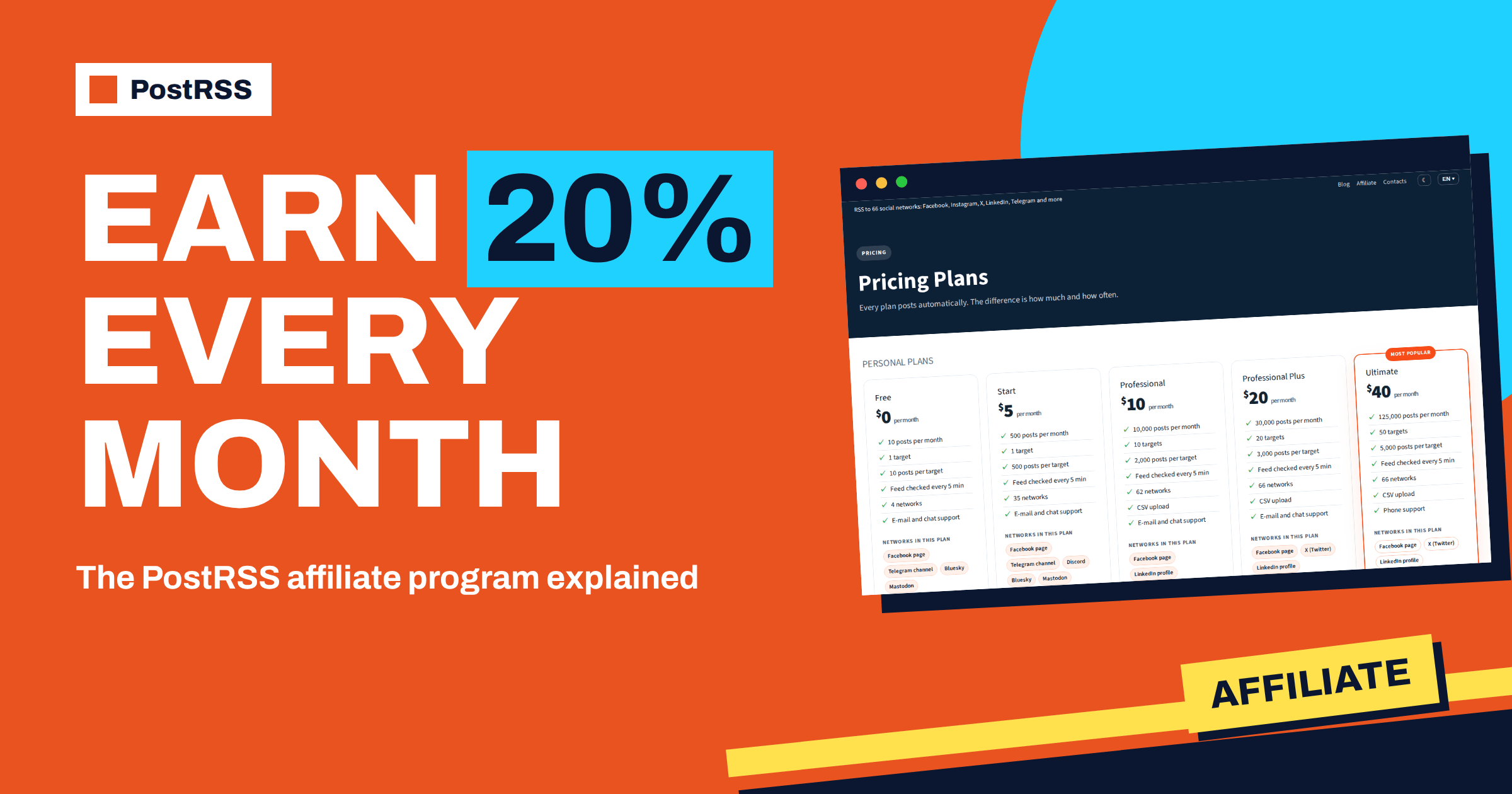
Short answer: the PostRSS affiliate program pays a flat 20 percent of the subscription of every customer you refer, every month, for as long as that customer stays subscribed. There is no cap and no one-time bounty. The referral cookie lasts 60 days, joining is free, no approval is needed to start sharing a link, and payouts go to PayPal once your balance reaches the minimum threshold of 50 US dollars. Self-referrals are not allowed. This guide explains how the program works step by step, what the numbers look like for each plan, how to promote PostRSS honestly and who the program suits.
Affiliate programs vary a great deal, and the differences are in the details that sales pages do not stress: whether the commission is recurring, how long the tracking window lasts, what counts as a referral, when the money is paid and what is forbidden. The affiliate page of PostRSS answers most of these questions in plain words. This article reads that page carefully and turns it into a practical guide for a blogger, a reviewer, an agency or a newsletter writer who is thinking about joining. Everything stated about the program comes from the live affiliate page, and the program can change, so read the page and the terms of service before you sign up. Nothing here is a forecast of earnings; the examples are arithmetic that you can repeat with your own numbers.
The page describes three steps. First, you create a free affiliate tracker profile, which the page says takes under two minutes and does not require an approval delay before you can start sharing your link. Second, you place your unique tracking link where your audience will see it: in blog reviews, video descriptions, social media posts or newsletters. Third, you receive payouts to your PayPal account every month that your balance clears the minimum threshold.
A referral converts when someone signs up for a paid PostRSS plan through your tracking link within the 60-day cookie window. The page adds that for the specifics of how free-plan signups or upgrades are tracked, you should check with the PostRSS affiliate team, so ask that question before you build a campaign around free signups.
In many programs an affiliate receives one payment when a customer first subscribes. PostRSS pays twenty percent of the referral’s subscription fee every month for as long as the customer remains a paying customer. If a referred customer stays for two years, you are paid for two years. This changes how you think about the work: a good article that brings a loyal customer is worth more than one that brings a customer who leaves after a month, so quality and fit matter more than volume.
Because the commission is a flat share of the plan price, the amount depends on the plan that the referral chooses. The page gives the examples below, in US dollars per month.
| Referral’s plan | Plan price per month | Your monthly commission |
|---|---|---|
| Alustus | 5 | 1 |
| Professional | 10 | 2 |
| Ultimate | 40 | 8 |
| Enterprise | 100 | 20 |
The same twenty percent applies to the other plans, so a referral on Professional Plus, which costs 20 US dollars a month, would produce 4 US dollars a month. Ten referrals on the Professional plan produce 20 US dollars a month in ongoing commission, as the page says, and that figure grows with the number of customers who stay. These are examples of how the percentage works and not a promise that you will find ten customers.
Payouts are processed automatically every month through PayPal once your account reaches a minimum threshold of 50 US dollars. The arithmetic helps you plan expectations. At 2 US dollars a month per Professional referral, you would need 25 referral-months to reach the threshold, which could be five customers for five months. With one customer on the Enterprise plan paying 20 US dollars a month in commission, you would reach it in three months. A balance below the threshold waits until it reaches the minimum. Because the threshold depends on cumulative commissions, a small audience can still reach it, but it will take time.
The page is clear about self-referrals. You cannot use your own affiliate link to buy a subscription for yourself, and the system automatically detects and flags internal accounts to prevent abuse of the program. If you plan paid advertising that uses your link, the page asks you to check with the affiliate team first for any guidelines for that channel. Read the terms of service as well, since they apply to affiliates as they do to every user.
You do not need to be a paying customer to be an affiliate, but the page notes that many successful affiliates use the product they recommend. That is common sense: you can only explain a tool honestly if you have used it.
The page lists the audiences for whom the program is a natural fit. Bloggers and content creators who write about RSS automation, social media scheduling or marketing tools. YouTubers and course creators who cover WordPress plugins and content marketing workflows. Marketing agencies and consultants who already recommend automation tools to clients. Newsletter writers in software, marketing or productivity. Comparison and review sites that cover tools for posting from RSS to social networks.
The common factor is an audience that already cares about the problem that PostRSS solves. A reader who has a blog and wants it to appear on social networks without extra work is a good fit. A reader who has no website is not.
The best affiliate content is useful with or without the link. Write a real setup guide that shows the steps for a specific case, such as posting a WordPress blog to a Facebook Page and a Telegram channel. Publish a comparison that states what each tool does and what it does not. Share a case study of your own use, with the real settings that you chose. Readers trust specifics, and search engines reward them.
State facts from the live pages and keep them up to date. Plans, limits and networks change, and a guide that quotes last year’s limits damages your credibility. The features page and the pricing page are the sources to use. If you mention a feature, check that it exists today, and if a network carries the label being tested, say so.
An affiliate link is a commercial relationship, and most countries expect you to tell your audience. Put a short, clear statement near the link: for example that you earn a commission if the reader subscribes through it. The article on affiliate and sponsored disclosures in auto-posted content explains how to do this when your posts go out through automation, which is relevant if you share your articles through a tool like PostRSS itself.
Imagine a blog about small-business marketing with a few thousand monthly readers. The writer decides to publish three PostRSS articles over three months: a setup guide for a WordPress blog and a Facebook Page, a guide to choosing between the Free, Start and Professional plans, and a use case for local shops. Each article ends with one clear mention of PostRSS, a disclosure and a link. The writer also adds a short mention in a monthly newsletter.
The arithmetic of success is modest and honest. If the three articles bring a handful of paying customers over six months, and most of them choose the Professional plan, the monthly commission is a few US dollars at first and grows if they stay. The writer does not count on a number. She watches how many readers click, how many sign up and how many stay, and she improves the articles that perform. After a year she has a small, steady stream that came from useful content, which is the way recurring programs are meant to work.
Track three numbers for each piece of content: visits to the page, clicks on the affiliate link and referred customers. Compare articles by the share of readers who click and by the number of customers per hundred clicks. A guide with high traffic and no clicks is probably missing a clear next step. A guide with few visits and many clicks deserves more promotion and a better place in search results. Add a short note about the plan that your referrals choose, because that decides the commission per customer.
Be patient with recurring commissions. A customer who subscribes this month may stay for years, and the value of the content grows as long as the customer stays. Resist the urge to chase one-time conversions with exaggerated claims, since those customers leave early and the reputation of your site suffers.
When you write about a product, put the essentials in the first screen: what it does, for whom and how to start. PostRSS reads an RSS or Atom feed, or a CSV file on plans that include it, and posts each new item to the networks that you choose, as often as every minute, with the item image and link. It has been running since 2014, offers a Free plan and paid plans, and supports sixty-six networks, some of which carry the label being tested. Mention the limits of the Free plan honestly, so that readers know what to expect before they sign up.
The page itself suggests two questions: how free-plan signups and upgrades are tracked, and whether there are guidelines for paid advertising. You may also want to ask how your commission is reported, how often the report updates and what happens to commissions when a customer changes plan. Write the answers down, because they will shape how you plan your content and your expectations.
The PostRSS affiliate program is simple: a recurring twenty percent, a 60-day cookie, a free start with no approval, monthly payouts through PayPal above the minimum threshold and a ban on self-referrals. It rewards affiliates who bring customers that stay, so the strategy is to write honest, specific, current content for people who need the product. Read the affiliate page and the terms, ask the team about free signups and advertising, and disclose your link. The program page is at the affiliate page, and the numbers that your readers will see are on the pricing page.
Twenty percent of every referral’s subscription, every month, for as long as the referral remains a paying customer.
Sixty days. If someone clicks your link and subscribes within that window, you are credited as the referring affiliate.
Payouts are processed automatically every month through PayPal once your account reaches the minimum threshold of 50 US dollars.
No. Self-referrals are prohibited, and the system detects and flags internal accounts.
No. Joining is free, no approval is needed to start sharing your link, and you do not need to be a paying customer.
What changed in the networks, what broke, and how to fix it before it costs you reach.
Loonud Internet Solutions, PostRSS-i taga olev meeskond. Iga toode säästab aega omal moel.
 English
 Lietuviškai
 Deutsch
 Français
 Русский
 Español
 Polski
 Italiano
 Українська
 Čeština
 Português
 日本語
 Latviešu valoda
 Eesti
 Magyar
 Bahasa Indonesia
 Türkçe
 हिन्दी
 Ελληνικά
 العربية
 ไทย
 Tiếng Việt
 Română
 Bahasa Melayu
 বাংলা