KakaoTalk dominates messaging in South Korea the way WhatsApp dominates in much of the rest of the world, and any brand selling into or communicating with a Korean audience eventually asks the same question: can a new blog post or product update from an RSS feed auto-post straight into a KakaoTalk Channel the way it might into a LINE official account or a Telegram channel? The honest answer requires understanding how differently Kakao built its business messaging tools compared to Western-style broadcast channels — and that difference changes what “auto-posting” even means in this context, and what a realistic, sustainable workflow actually looks like for a business trying to reach that audience.
A KakaoTalk Channel (formerly called a Plus Friend) is the business-facing equivalent of a Facebook Page inside the KakaoTalk app — a brand profile that users can add as a “friend” to receive messages, browse a storefront, or start a chat. Unlike a Telegram channel or a LINE official account’s broadcast feed, a KakaoTalk Channel’s core interaction model is closer to a customer service and CRM tool than a public content feed users casually scroll through.
Not in the simple, direct sense. KakaoTalk doesn’t offer an open “post this content to your channel’s timeline” API the way Telegram’s Bot API lets a bot fire off a message to a channel with no prior approval. Instead, Kakao’s business messaging is built around a small set of specific, template-based message types delivered through Kakao’s own business partners or approved third-party messaging providers:
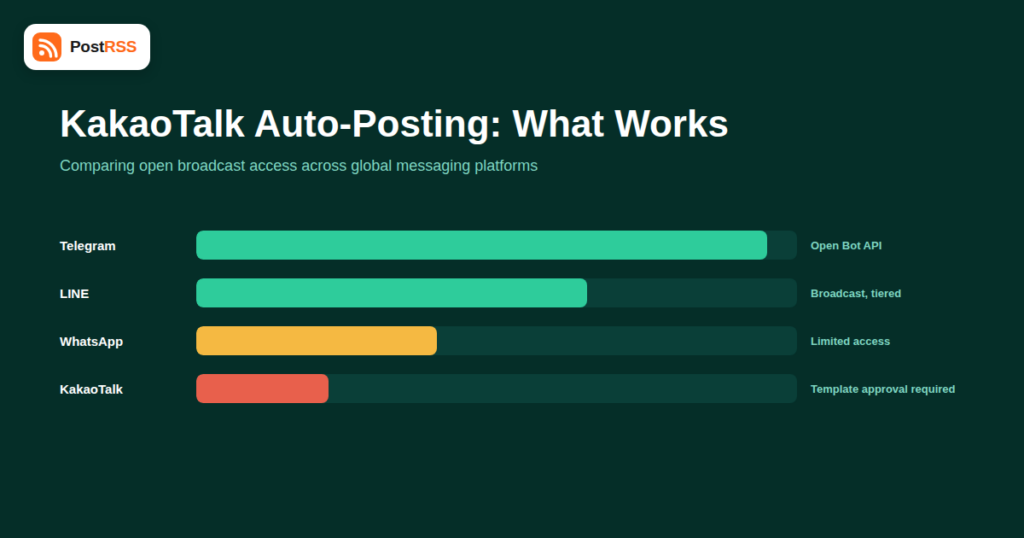
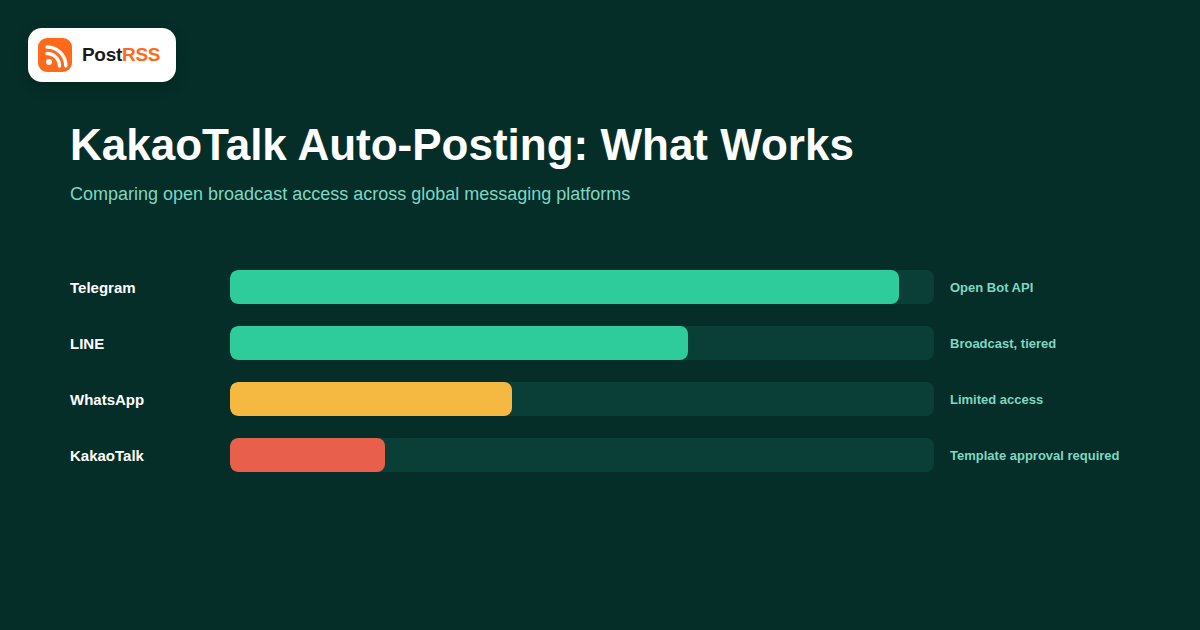
Every one of these message types requires the underlying template to be submitted and approved by Kakao before it can be used, and delivery generally goes through a registered business messaging partner rather than a simple open API call. That approval gate is fundamentally different from how a Telegram bot or a LINE broadcast message works, where a connected feed can push new content the moment it’s published with no per-message review.
| Platform | Open Broadcast API? | Requires Message Template Approval? | RSS Auto-Posting Fit |
|---|---|---|---|
| Telegram | Yes, via Bot API | No | Strong — near real-time, no approval needed |
| LINE | Partial, via Official Account broadcast | No, for standard broadcasts | Moderate to strong depending on account tier |
| WhatsApp Channels | Limited, evolving API access | Varies by message type | Limited |
| KakaoTalk | No, template-based only | Yes, for nearly all business message types | Weak — not built for open content broadcasting |
South Korea has comparatively strict regulations around unsolicited commercial messaging, and Kakao’s template-approval system is largely a response to that regulatory environment — it prevents businesses from blasting arbitrary promotional content to users who added a channel expecting customer service, not a marketing firehose. This is a meaningfully different design philosophy than Telegram’s open broadcast model, and it means KakaoTalk Channels function more like a compliance-first CRM and notification layer than a content distribution channel in the RSS-to-social sense.
Given the template-approval requirement, most brands that want to notify a Korean audience through KakaoTalk when new content is published take one of these approaches:
This isn’t a universal requirement — it matters specifically for businesses with a meaningful Korean customer base: e-commerce brands shipping to South Korea, SaaS companies with Korean enterprise customers, media outlets covering Korean markets, or any international marketing operation treating South Korea as a priority market. For a business without that audience, the setup overhead of template approval and a registered messaging partner isn’t worth it compared to the near-zero-friction broadcast options available on other platforms.
| Content Type | Fits KakaoTalk’s Template Model? |
|---|---|
| New blog post or product update notification (title + link) | Yes — simple, reusable template |
| Order confirmation or shipping update | Yes — this is exactly what AlimTalk was designed for |
| Long-form article content in full | No — templates favor short, structured messages, not full article bodies |
| Rich image galleries or carousels | Limited — Brand Message supports some visual formatting but not arbitrary layouts |
For a business starting completely fresh, the practical setup sequence looks like this:
This is meaningfully more setup than connecting an RSS feed to Facebook or X, where authorization takes minutes and there’s no content review step at all. Budgeting a few days to a couple of weeks for the full setup, including template approval turnaround, is realistic for a first-time integration, and subsequent templates for new use cases will generally move faster once the business relationship with a messaging partner is already established.
| Misconception | Reality |
|---|---|
| “KakaoTalk has a public channel API just like Telegram” | No — all business messaging goes through approved templates and typically a registered partner |
| “Once a template is approved, I can send anything through it” | No — the approved template’s structure is generally what gets sent; you can’t substitute arbitrary free-form content into an approved template’s format |
| “This only matters for e-commerce” | No — SaaS companies, media outlets, and service businesses with Korean customers all use the same messaging infrastructure |
| “KakaoTalk automation is the same as WeChat automation” | Similar in spirit (both use template approval), but the technical integrations, partners, and specific message formats are entirely separate systems |
Before committing engineering time to a KakaoTalk integration, it’s worth checking basic signals: what percentage of your current traffic or customer base already comes from South Korea, whether competitors in your space are using KakaoTalk for customer communication, and whether your support or sales team already fields inquiries in Korean. A business with even a few hundred active Korean customers can often see a meaningful lift in engagement from a well-targeted Friend Talk notification, since KakaoTalk’s open rates for business messages tend to run considerably higher than email for users who’ve actively opted in by adding the channel as a friend. For a business with only a handful of Korean users, the same setup effort is better spent on channels with lower integration overhead and immediate reach.
Generally not out of the box the way it can connect to Facebook or Telegram, because KakaoTalk requires an approved message template and typically a registered business messaging partner rather than an open posting API.
This varies by the messaging partner and the complexity of the template, but simple, clearly commercial templates tend to move through review faster than templates with ambiguous or borderline content.
Not for business-initiated messages at any real scale. Kakao’s system is specifically designed to prevent unapproved bulk messaging, so any legitimate, sustainable notification workflow needs to go through the approval process at least once per template.
No — this applies specifically to business Channels sending messages to users. Personal accounts messaging individual friends operate under completely different rules and aren’t a relevant comparison for content distribution.
Templates are built for short, structured messages — a title, a short description, and a link — rather than full article bodies, so the practical pattern is to notify with a link back to the full content on your own site rather than trying to reproduce the entire article inside the message itself, which the template format generally doesn’t accommodate well anyway.
For brands with a genuinely large Korean audience, yes — KakaoTalk’s penetration in South Korea is high enough that many users check it more reliably and more frequently than email, and the one-time template approval cost is small relative to the ongoing reach and engagement it provides over the life of the business.
Some do — WeChat’s official account system uses a broadly similar template-and-approval structure for business messaging, reflecting a wider regional pattern of stricter oversight on commercial messaging compared to platforms like Telegram. This makes template-based, approval-gated messaging closer to the regional norm across East Asia than the open broadcast model many Western marketers default to expecting from every platform.
The businesses that get the most value from KakaoTalk rarely treat it as a replacement for their existing RSS-to-social automation — they treat it as an additional, higher-touch layer reserved for their Korean audience specifically. A typical setup keeps the standard automation running across Facebook, X, LinkedIn, and Pinterest for the general audience, while a separate, lighter-weight KakaoTalk notification fires only for the subset of content most relevant to Korean customers: a localized product launch, a Korea-specific promotion, or a support announcement. Trying to mirror every single piece of content into KakaoTalk’s template system usually isn’t worth the operational overhead, since the approval-gated nature of the platform makes it far better suited to a curated, high-signal notification stream than a full content firehose.
This mirrors a pattern seen across most messaging-app automation: the platforms with open broadcast APIs are where a full RSS mirror makes sense, while the more tightly controlled platforms are best reserved for the announcements that matter most to that specific audience.
KakaoTalk Channels aren’t built for the same kind of open, no-approval RSS broadcasting that works on Telegram or, to a lesser extent, LINE. Getting new content in front of a Korean audience through KakaoTalk means registering an approved message template once and routing notifications through it — more setup than a typical auto-posting connection, but a one-time cost rather than a recurring one. For businesses with real reach in South Korea, that setup is worth doing; for everyone else, it’s a channel to revisit once the Korean audience actually justifies the effort, rather than a box to check on day one simply because every other messaging platform happened to connect automatically without any extra setup at all.
What changed in the networks, what broke, and how to fix it before it costs you reach.