RSS σε 66 κοινωνικά δίκτυα: Facebook, Instagram, X, LinkedIn, Telegram και άλλα Blog Συνεργατικό Πρόγραμμα Επικοινωνία
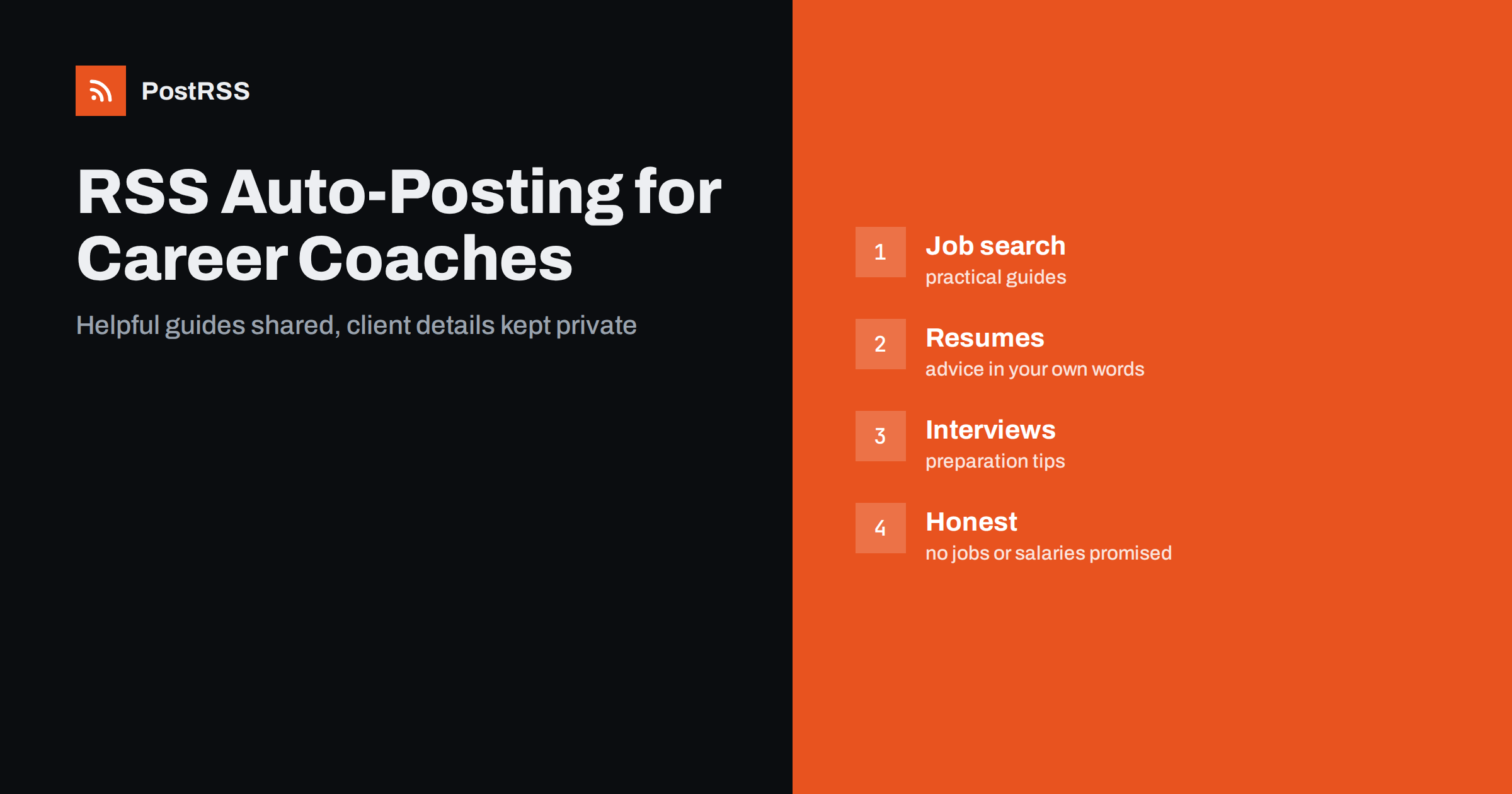
Short answer: RSS auto-posting lets career coaches and resume writers share job search guides, interview tips, resume advice, market notes, workshop dates and new service pages on social media automatically. Publish each item as a page on your website, let an auto-poster read the feed, and every new page appears on your LinkedIn page, Facebook Page, Telegram channel and other networks with its link and image. Job seekers and career changers find practical help and a clear way to book, while client stories, résumés, employer names and promises about jobs or salaries stay out of every automated post.
Looking for work is stressful, and the people who do it are often unsure where to turn. They search late in the evening for how to explain a gap in their history, how to answer a difficult question, how to change fields at forty or how to ask for a raise. They read many articles, and they trust the sources that are specific and honest. A career coach or resume writer has exactly this knowledge, and much of it can be written once as a page and used for years. At the same time, a coach is a small business that depends on being visible at the moment a person decides to ask for help, and on the steady habit of sharing useful content that earns trust over months. A feed turns each page into a post as soon as it is published, so that the habit runs without daily effort. This guide explains what to publish, how to connect it and where to be careful, because career advice touches private lives and you cannot promise outcomes.
The advice fits many kinds of professionals who help people with work and careers:
Each has services, a style and an audience at a particular stage of working life. The website is the natural source for every other channel.
Most of the useful content can be turned into a short page:
Each page appears on your website, where a person who searches for help can find it. The feed then announces it automatically, and a short post about a new guide reaches the people who follow you.
Most coaches already use a system that creates feeds:
/feed/ and one for every category, such as /category/interview-tips/feed/. If you are unsure of the address, see how to find your WordPress feed link.Use categories to separate topics and audiences: job search, resumes, interviews, career change, leadership and events. Each category has its own feed, and each feed can go where it works best: job search and resume advice to LinkedIn and Facebook, leadership topics to LinkedIn for managers, workshop dates to every channel. Routing by category is explained in category filtering for auto-posting.
| Content | Automate? | Notes |
|---|---|---|
| Service pages and process guides | Yes | Clear steps and honest limits |
| Job search, resume and interview guides | Yes | Practical, in your own words |
| Workshop and webinar announcements | Yes | Date, time zone and how to register |
| Credentials and training news | Yes | Stated accurately |
| Client names, résumés and employers | No | Confidential |
| Results such as salaries and offers | No | Cannot be promised and may identify clients |
A simple rule: if it helps many people with their search, automate it. If it concerns one client, one document or one offer, it needs a private conversation.
The most tempting words in this field are guaranteed interviews, doubled salary and landed in thirty days. They are also the most damaging, because no coach controls an employer’s decision. Do not publish success rates unless you can prove them in a way that regulators accept, and in most cases it is better not to publish them at all. Do not write that a resume will get a job. Describe what you do: you help a client to present their experience clearly, to prepare for conversations and to organise a search. Be equally careful with claims about the market, such as the number of vacancies in a field or the average pay, unless you can name a source and give a date. Describe your own qualifications exactly, and do not use titles that you have not earned. A modest page attracts clients who want real work, and it protects you from complaints.
Clients’ words are persuasive, and they are also sensitive. A person who found a new job may not want a former employer or a current colleague to know that they worked with a coach. Ask for written permission for every testimonial and every story, explain where it will appear and let the client approve the final text. Remove names, employers, towns and any detail that could identify them, unless they ask to be named. Rules about advertising and testimonials differ between countries, and some require that results are typical or that connections are disclosed, so check the rules that apply to you and link to a statement about how stories are collected. Never publish a client’s résumé, even with the name removed, because the career history itself can identify a person. Prefer content about the method over stories about people.
Readers of career content are often at a low point: laid off, overlooked, burned out or afraid of change. A clear, kind and practical tone is more persuasive than urgency. Avoid fear-based headlines about missed chances, and avoid pressure to buy now. Give each page one useful idea that the reader can try today, a checklist, a short script for a difficult email or a way to prepare for a question, and a calm way to take the next step. If your topic touches health, such as burnout or stress, say clearly that you are not a medical professional and point to qualified help. Use plain language and short paragraphs, because tired readers skim. A feed of such pages becomes a library that people return to at every stage of working life.
Job searches follow rhythms. January brings resolutions and new roles, the end of the school year brings graduates, September brings a second wave and the weeks before the holidays are quiet. Evenings and Sunday nights are popular times for browsing advice. Plan pages a little ahead of each wave: a resume refresh guide in December, a graduate series in May, an interview preparation series in late August. Use the scheduling features of your website to prepare the pages in advance, and let the feed announce them when they go live. Choose posting hours in the time zone of your audience, and if you serve several regions, create a separate feed for each.
Most coaches do best with LinkedIn and one more channel, plus the website and a booking page that works. Two active channels beat five forgotten ones.
/feed/, and check that it lists recent pages with their images.PostRSS has been automating RSS posting since 2014. It checks your website feeds as often as every minute and publishes each new page, with its real image and link, to the channels you connect, from LinkedIn pages and Facebook Pages to Bluesky, Mastodon, Telegram and many more among its 66 supported networks. You can choose how each post is built, filter items by keywords, add UTM parameters and post only within chosen hours or at exact times in your time zone. See the PostRSS features page for everything it does and the pricing page for plan limits. More ideas for service professionals are under the Professional Services tag.
A career coach sells clarity, confidence and a plan at a time when people feel they have none. RSS auto-posting shares every guide, service page, workshop and credential update automatically, as soon as it is published on your website. Write each page for a tired reader who needs one useful idea today, never promise a job or a salary, name the source of any market figure, get written permission for every story, keep résumés and client details out of automated posts and let your hours go to clients and not to the keyboard.
Yes. If your website has a blog or guides section, its RSS feed can be connected to an auto-poster that shares each new page on LinkedIn, Facebook and other channels. Client details must stay out of automated posts.
Service pages, resume and cover letter guides, interview preparation tips, workshop announcements and news about your qualifications. Do not publish client résumés or results.
Only with written permission and with details that could identify the client removed or approved. Check the advertising rules for testimonials in your country.
LinkedIn reaches job seekers, managers and recruiters, so it is the first choice. A Facebook Page helps with local audiences. Start with two channels and add others later.
Yes. PostRSS reads any valid RSS or Atom address that is reachable without a login. Paste the address, connect your channels and new pages are shared as soon as they appear.
What changed in the networks, what broke, and how to fix it before it costs you reach.
Από την Internet Solutions, την ομάδα πίσω από το PostRSS. Κάθε προϊόν σάς εξοικονομεί χρόνο με τον δικό του τρόπο.
 English
 Lietuviškai
 Deutsch
 Français
 Русский
 Español
 Polski
 Italiano
 Українська
 Čeština
 Português
 日本語
 Latviešu valoda
 Eesti
 Magyar
 Bahasa Indonesia
 Türkçe
 हिन्दी
 Ελληνικά
 العربية
 ไทย
 Tiếng Việt
 Română
 Bahasa Melayu
 বাংলা